California's Nuclear Paradox: How Floating Reactors Could Rewrite Energy Rules
A startup is proposing floating nuclear barges off Long Beach to power data centers—despite California's 1976 ban on new nuclear plants. The collision between AI infrastructure demands and state energy law could force a reckoning.
The Ban That Isn’t
California outlawed new nuclear power in 1976. The law was born from genuine fears about radioactive waste, seismic risk, and the aftermath of Three Mile Island. It worked—at least until now.
A 31-year-old startup called Bluecore Energy wants to place small modular reactors on barges miles offshore from Long Beach. They would power shipping ports and the AI data centers eating through California’s electricity grid. The reactors float. They sit outside state jurisdiction. And they may force the state to answer a question it has avoided for decades: what happens when the energy you need doesn’t fit inside your borders?
Bluecore raised $10 million in pre-seed funding last January and became the first nuclear company to partner with the Maritime Administration (MARAD) on offshore reactors. Founder Kofi Asante built his career in logistics—at Uber Freight, heavy-cargo drone company Elroy Air, and electric barge startup Arc—before pivoting to nuclear. His pitch is blunt: if you need that much power, you arrive at a reactor. If you need real estate, two-thirds of the planet is water.
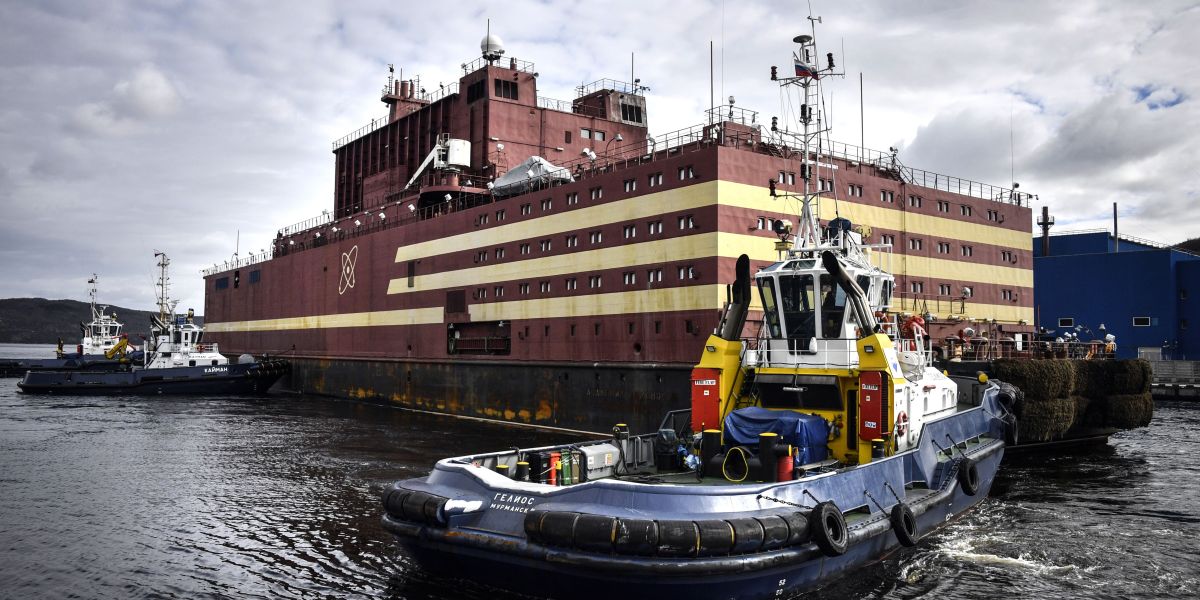
Each barge-mounted reactor produces 10 megawatts—enough for roughly 10,000 homes. Multiple barges can be stacked for additional capacity. They connect via subsea cable. They can be moved by tugboat. And they sit far enough from shore that, Asante argues, they don’t need to co-locate at the port or near neighborhoods.
The Regulatory Ghost
Here’s the complication no one in the source material mentions directly: California law prohibits the development of new nuclear facilities within the state. Bluecore’s reactors would sit in federal waters, technically outside that prohibition. But the Port of Long Beach is still navigating a legal maze.
Port CEO Noel Hacegaba acknowledged the reality. “Nuclear is having a moment at the Port of Long Beach,” he said, “and we are engaged with the private sector, along with state and federal legislators on this issue.” State lawmakers are already debating legislation to study lifting the ban. The port called the project “years away from becoming a reality due to the technological advancements and regulatory hurdles that still need to be cleared.”
That understatement deserves attention. This isn’t just about permits. It’s about whether California’s 48-year-old nuclear freeze survives contact with the AI boom. Data centers are projected to consume massive amounts of electricity. The grid can’t keep up. Natural gas faces its own environmental constraints in a state that has made decarbonization a political religion. Nuclear, even floating, is the only source that delivers both capacity and cleanliness.
A Federal Push
While California debates, the federal government is moving faster. This week, MARAD announced a partnership with London-based Core Power to develop regulatory frameworks for nuclear-powered merchant cargo vessels. The day after, the U.S. and the International Atomic Energy Agency launched ATLAS—the Atomic Technologies Licensed for Applications at Sea initiative—designed to advance SMR and micro-reactor technologies for maritime use.
The messaging is careful. The IAEA emphasized “the highest levels of nuclear safety, security, and non-proliferation.” The appeal is speed and endurance: nuclear-powered ships refuel every two or three years instead of per voyage. Floating reactors can serve coastal or remote communities. The architecture being built is national, not Californian.
Max Hopkins, a nuclear power analyst at CITIC CLSA, called offshore barges “almost ideal” for fast deployment. “To put something into place fast, with production means, and then you can just float it somewhere,” he said. “I think it’s going to become pretty accepted, much more so than people realize.”
Hopkins qualified his enthusiasm appropriately. The technology is years from commercial deployment. Regulatory frameworks need to be built. Supply chains don’t exist yet. Manufacturing systems need to be designed from scratch. But the direction is clear.
The Safety Question
The obvious objection to any nuclear proposal—floating or otherwise—is accident risk. What happens during a tsunami? A major storm? California sits on a fault line. The ocean doesn’t cancel that risk.
Asante’s answer relies on redundancy. Modern SMR designs wrap uranium fuel pellets in multiple layers of heavy-duty ceramics and graphite casing, rendered inert when separated. His reactors are mobile—they can be repositioned before severe weather hits. They’re shielded to withstand extreme conditions and can operate underwater. Multiple control mechanisms automatically shut down the reactor if needed. “Water is the cooling mechanism and safest place for our systems,” Asante said. “We have an unlimited amount of access.”
Hopkins offered a different comparison: “A jet engine is actually much more complicated to build than a nuclear reactor from a materials science perspective.” The implication is that if we trust aviation, we should be able to trust these designs. Whether that analogy holds under public scrutiny is another matter.
Who Wins, Who Loses
The winners are predictable. Bluecore wins if this proceeds—it’s the first mover in a category that barely exists. MARAD wins because it now has a tangible project to attach to its federal push. Data center developers win because they get the power they need without waiting decades for conventional nuclear licensing. The military wins because the same technology serves dual purposes.
The losers are harder to identify but more important. California residents, particularly near Long Beach and Los Angeles, may lose the right to decide what happens off their coast. Federal authorities gain jurisdiction over energy siting in ways that bypass state legislatures. Traditional nuclear opponents lose their geographic refuge—if the technology works offshore, the ban becomes irrelevant rather than resolved.
There’s also a quieter loser: the timeline. Asante and Hopkins both emphasize that commercial deployment is years away. The AI infrastructure crunch is happening now. Companies building data centers don’t have that kind of patience. They may find other energy sources—natural gas, imported electricity, or yes, nuclear—rather than wait for a regulatory framework that doesn’t exist yet.
The Real Story
The story here isn’t really about floating nuclear reactors. It’s about whether state-level energy prohibitions can survive contact with federal-level energy demand. California banned new nuclear in 1976 because the technology, the regulations, and the political will didn’t support it. None of those conditions have changed significantly—except the demand side. AI data centers are creating a load that existing infrastructure cannot satisfy.
Bluecore’s proposal exploits a jurisdictional loophole: offshore means outside state law. But loopholes tend to close, or they get patched by legislation. The Port of Long Beach is already talking to state lawmakers about studying the ban. That process could take years. Or it could accelerate if the federal government moves fast enough to make state legislation feel mandatory.
Denmark’s Saltfoss Energy is developing similar technology in Europe. The IAEA’s ATLAS initiative is building international frameworks. The U.S. Maritime Administration is partnering with private companies on merchant vessel nuclear power. The infrastructure for offshore nuclear is being assembled globally, whether California likes it or not.
The question isn’t whether floating reactors will exist. It’s whether California will still be banning them when they do.