Canada's Dollar-for-Dollar Threat Changes the US Trade Game
Canada is matching US tariffs dollar for dollar after trade talks collapsed. The move tests whether integrated North American manufacturing can survive a 50% tariff wall—and signals to every US trading partner what happens when diplomacy fails.
A Neighbor Turns the Table
Canada is no longer trying to charm Washington. After the United States announced it would slap 50 percent tariffs on roughly $20 billion in Canadian goods starting midnight local time on August 22, Prime Minister Mark Carney did something unusual for a close ally: he said no, and meant it.
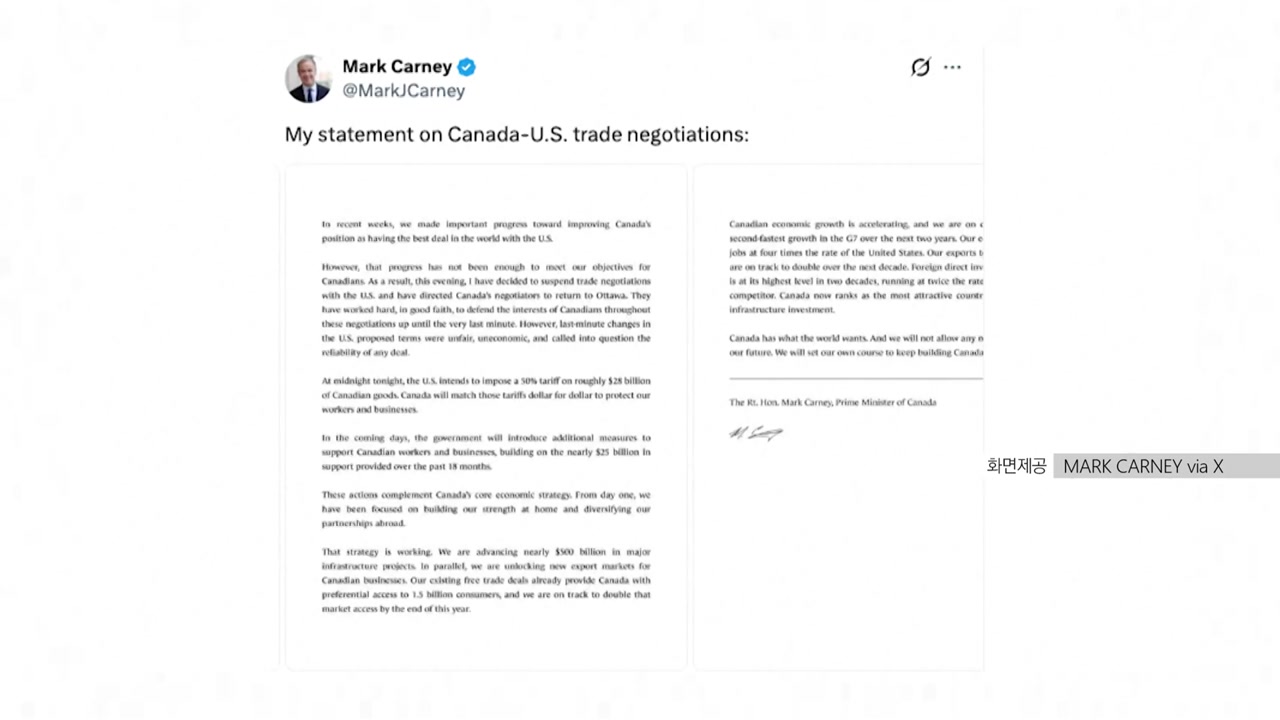
The response was immediate and carefully calibrated. In a social media post on the 21st, Carney announced that Canada had suspended trade negotiations and ordered its negotiating team back to Ottawa. He called America’s final proposed terms “unfair and economically unjustifiable,” adding a pointed note: “one can question whether any agreement would be reliable.”
Then came the line that reframed the entire exchange. “Dollar for dollar,” Carney wrote. Canada would impose matching tariffs on American goods, one-to-one, in what he called a necessary defense of Canadian workers and companies. Additional support measures were promised, though details remained sparse.
The message carried extra weight coming from a man who spent years at the Bank of England and the IMF before entering Canadian politics. This is not a novice making emotional gestures. Carney’s language was measured but uncompromising—the tone of someone who understands that once you start negotiating under the threat of economic harm, the deal you eventually sign is not truly a deal.
What the $20 Billion Actually Means
The $20 billion figure deserves scrutiny before anyone declares economic armageddon. According to the source material, it covers just over 5 percent of Canada’s total exports to the United States. That is significant but not civilization-ending. Some of the targeted goods—wooden hockey sticks, oddly enough—are so niche they barely register in mainstream trade flows.
But focusing only on the headline number misses the point. Tariffs are rarely about the goods they nominally target. They are about leverage, signaling, and precedent. The 5 percent figure is the tip of the iceberg. The deeper threat lies in what happens next: does the US expand the tariff net? Does it revisit sectors that were previously exempt, such as autos, energy, or critical minerals?
That is where the real risk lives.
The Auto Industry Lives on Thin Ice
North American automotive manufacturing is the single most integrated industrial ecosystem in the world. A single vehicle crosses the Canada-US border an average of eight times during production. Parts, engines, transmissions, and completed cars flow back and forth across a border that functions less like an international boundary and more like a internal logistics checkpoint.
A 50 percent tariff on any segment of this supply chain does not merely raise prices. It makes the entire model structurally unviable. The math is brutal: if a subassembly built in Michigan ships to Windsor for integration, then back to a plant in Oshawa, each border crossing with a 50 percent tariff erodes margins that already operate at single-digit percentages.
Carney’s government has not yet specified which American sectors will face reciprocal Canadian tariffs. But the threat alone changes calculus for every automaker with North American operations. General Motors, Ford, Stellantis, Toyota, Honda, and Hyundai all have major Canadian facilities. They now face a scenario where their US-market exports from Canada become dramatically more expensive—and their Canadian-market exports from the United States face the same treatment in reverse.
The likely outcome is not a clean decoupling. North American auto production cannot simply relocate. What is more probable is a slow bleed: reduced investment, delayed model launches, workforce reductions, and a gradual reshoring of some assembly to the US side of the border. The tariff acts as a tax on integration itself, and integration is precisely what made North American autos competitive globally.
The Domino Question
Here is what English-language coverage of this story tends to underplay: Canada is not the only country watching. Mexico sits directly in the same tariff pipeline. The European Union, Japan, South Korea, and others have their own outstanding trade disputes with the United States. Every one of them is running the same calculation.
If Canada—America’s largest trading partner, a NATO ally, a country with which the US shares the world’s longest undefended border—can be hit with 50 percent tariffs after talks collapse, then no bilateral relationship is structurally insulated from this approach. The precedent matters as much as the tariff schedule.
Mexico’s reaction so far has been quieter but no less significant. Mexican officials have signaled readiness to negotiate but have also begun exploring diversification of trade flows, including deeper ties with the European Union and Asia. That diversification is a long-term project, but the psychological shift has already begun. When your biggest customer treats you as a bargaining chip, you start looking for other customers.
The Domestic Fracture
Canada is not speaking with a single voice, and that internal divergence matters. Ontario Premier Doug Ford publicly backed Carney’s hardline stance, posting the same “dollar for dollar” slogan. Ford’s province is home to the automotive heartland and has the most direct exposure to US market access. His support is both ideological and pragmatic.
Alberta Premier Daniel Smith took a different tone, calling the failure to reach a deal “very disappointing” and urging a quick return to negotiations. Alberta’s economy is more energy-oriented and carries different pressures. The federal-provincial split reveals something important: Canada’s trade strategy is not monolithic because Canada’s economic geography is not monolithic. Ontario worries about factories. Alberta worries about pipelines. Both worry about the US, but the pain points differ.
This fragmentation gives Washington room to exploit. Divide-and-conquer is an old trade tactic, and the US knows that Canadian provinces have different economic constituencies and electoral cycles.
What Happens Next
Three scenarios are plausible in the near term.
The first is escalation. The US expands tariff coverage beyond the initial $20 billion. Canada reciprocates in kind. Trade volume shrinks. Political rhetoric hardens on both sides. This path leads to a prolonged cold trade war with measurable GDP losses on both sides—likely 0.5 to 1.5 percent of Canadian GDP and a smaller but still meaningful hit to US consumers, particularly in the Midwest and Great Lakes regions.
The second is a partial rollback. Some pressure from business groups, state legislators, and automotive executives forces a negotiated settlement that preserves most tariffs but carves out exemptions for sensitive sectors like autos and energy. This is the most likely outcome if the current impasse lasts more than a few weeks. The tariffs remain as leverage; the worst cases are avoided through quiet deal-making.
The third is systemic reorientation. Canada accelerates trade diversification—deepening ties with the EU via CETA, expanding postcussions with Asian partners, and potentially revisiting relationships with traditional partners it has neglected. This is a multi-year project but has already been whispered about in policy circles. If the US is willing to weaponize trade relationships with its closest ally, other allies will hedging accordingly.
The Bigger Picture
The dollar-for-dollar response is more than retaliation. It is a statement that the old assumptions about US-Canada economic relations no longer hold. For decades, the relationship operated on an implicit bargain: Canada accepts US dominance in security and many economic areas, and in return enjoys preferential or frictionless access to the American market. That bargain is now clearly broken.
Carney’s comment about questioning whether any future agreement would be reliable is the kind of sentence diplomats spend months avoiding. He said it plainly. That plainness is the story.
What happens in the next few weeks will determine whether this is a painful but temporary disruption or the opening chapter of a fundamentally reshaped North American trade order. The autos will tell first. When manufacturers start announcing plant slowdowns or relocation studies, the scale of the damage becomes visible. Until then, the tariffs are a threat. And threats, unlike actions, can still be withdrawn.
But the trust required to make that withdrawal credible—that may be the hardest thing to rebuild.