Canada's EU Pivot Rewrites the Rules of Alliance Politics
Canada's pursuit of EU associate-member status is not mere diplomacy—it is a structural realignment triggered by US protectionism. The implications stretch far beyond Ottawa and Brussels, touching critical mineral supply chains, tech infrastructure, and the credibility of the transatlantic order.
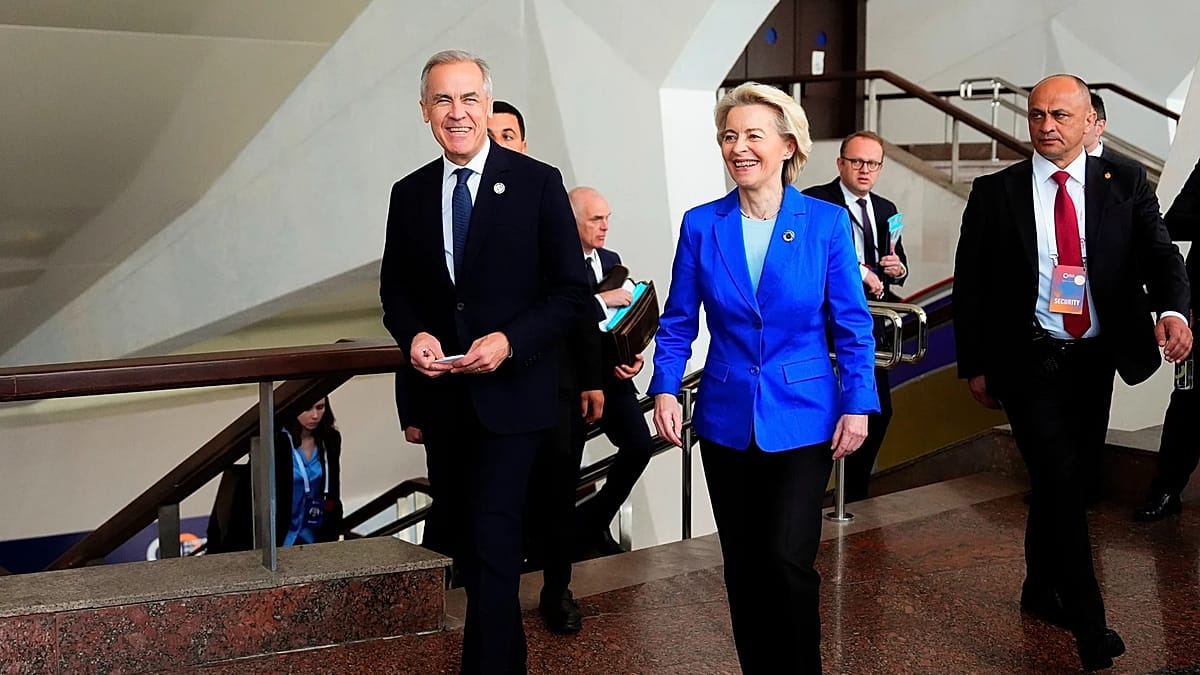
A Relationship in Real Time
Canada is doing something Washington never expected. Prime Minister Mark Carney is negotiating a new kind of membership with the European Union — one that does not yet exist, one the EU has no template for, and one that could quietly redraw the map of Western alliance politics.
The Wall Street Journal reported over the weekend that Ottawa is exploring associate-member status with the bloc. The idea is not wildly new inside European capitals. German Chancellor Friedrich Merz floated the concept earlier this year, originally envisioned for Ukraine, but the framework could just as easily accommodate Canada. What makes this moment different is the speed and direction of the pivot.
Ottawa is locked in an open trade war with the United States. Tariffs are steep, de-escalation is absent, and the political mood in Canada has shifted from frustration to something sharper: strategic reorientation.
The Real Deal Is Not About Trade Labels
The associate-member proposal sounds procedural. It is not. The substance behind it is where the structural shift lives.
Canada and the EU want to deepen cooperation on energy, artificial intelligence, defence, and critical minerals. They are discussing joint infrastructure projects — undersea cables, data centres, cloud networks, satellite systems. Canada also wants to expand energy exports to Europe. This is not a soft-power exercise. It is a supply-chain realignment.
The critical-minerals angle matters most when you step back. Canada sits on some of the largest untapped deposits of lithium, cobalt, and rare-earth elements in the Northern Hemisphere. The EU has been desperate to diversify away from Chinese-dominated supply chains. The US, under its current administration, has treated these same materials as leverage rather than partnership assets. Canada is now offering Europe an alternative it can trust and access without Washington’s permission.
For countries like South Korea and Japan — both deeply dependent on critical minerals and both watching US protectionism with growing alarm — Canada’s move is a signal. If a close American ally can build a parallel architecture with the EU, the logic for other mid-tier economies to do the same grows stronger. The question is not whether this model spreads. It is who moves first.
Who Wins. Who Loses.
The winners are clear.
Canada gains diplomatic insulation. It gains access to the EU’s regulatory market — the single market for goods, services, and workers — without surrendering sovereignty or joining the euro. It gains a seat at the table for standards-setting on AI, climate tech, and digital infrastructure. And it gains a counterweight to American economic coercion.
The EU wins too. It gains a partner with geographic proximity, shared language in key provinces, aligned legal traditions, and a resource base that complements European manufacturing. It gains a foothold in North American energy and tech that does not run through Washington. It gains proof that the bloc can project institutional depth beyond its borders.
France is already cashing in symbolically and strategically. President Emmanuel Macron and Carney are visiting Saint-Pierre-and-Miquelon next week — a French archipelago twenty kilometres off Canada’s Atlantic coast. The visit is historic. No Canadian prime minister has ever been there. The last French president to visit was Francois Hollande in 2014. The Elysee Palace framed the trip around shared values: freedom, democracy, rule of law, sovereignty. But the subtext is equally important. France is positioning itself as the bridge between Canada and Europe — a role that elevates Paris inside EU decision-making and reinforces itsAtlantic strategic identity at a time when Washington looks unreliable.
The losers are harder to name precisely because the losses are still prospective. The United States loses credibility among its allies. Every announcement of deeper Canada-EU integration is a quiet indictment of the Trump administration’s trade policy. The US loses a buffer zone. Canada was always going to be the first domino if the transatlantic bond frayed. It is falling.
Donald Trump responded to the Macron-Carney visit by posting a map on Truth Social showing US flags over French overseas territories including Saint-Pierre-and-Miquelon, Guadeloupe, Martinique, Greenland, Iceland, and much of Central America and the Caribbean. The message was opaque — territorial claim? Strategic ambition? Just a display of frustration? — but the effect was unmistakable. An American president treating allied territory like a chessboard does not inspire confidence in NATO’s political foundation.
The EU’s Dilemma Is Canada’s Opportunity
Associate membership is not easy to create. The EU has strict rules. Amending existing arrangements requires unanimous agreement among member states and approval from the European Parliament. The process is lengthy. Germany’s earlier push for associate status tied to Ukraine ran into exactly this kind of institutional friction.
But Trump’s presidency changes the calculus. The EU has spent years debating strategic autonomy. Canada’s overture gives Brussels a concrete test case. If the bloc refuses to adapt, it risks looking rigid precisely when flexibility would serve its interests. If it accepts, it sets a precedent that could eventually include other partners — Taiwan, South Korea, Japan — all of whom have strong reasons to seek deeper institutional ties with Europe.
That is the second-order consequence English-language wires are largely missing. The Canada story is being reported as bilateral diplomacy. It should be reported as a prototype.
What Happens Next
Carney is scheduled to address the European Parliament in Strasbourg on Thursday. Expect him to frame Canada not as a peripheral ally but as a natural partner for a Europe that wants to act independently. He will likely emphasise energy, technology, and shared democratic resilience. He may avoid the term associate member directly — the EU has not confirmed openness to the concept — but the policy substance will point in that direction.
The European Commission declined to comment on the report. That silence is itself informative. Brussels is thinking through the implications internally before committing publicly.
What to watch: whether Germany pushes the associate-member framework forward, whether the European Parliament signals receptivity, and whether other G7 members — particularly Japan and South Korea — begin quietly exploring similar arrangements. The template, once normalized, becomes self-reinforcing.
Canada is not leaving the West. It is expanding the West’s geometry. And the US, for all its military and economic weight, is already on the outside of the new shape.