Canada's 50% Retaliatory Tariff Is a Warning Shot to Every US Ally
Canada's mirror-image 50% tariff on American goods marks the first full-throated retaliation against Trump's trade aggression from a close ally. The collapse of last-minute negotiations reveals cracks that could spread across NATO and trans-Pacific partnerships.
The Mirror Strike
Canada did something unusual for a country that shares a 8,891-kilometer border with its largest trading partner. It looked the United States straight in the eye and hit back with the same weapon — a 50% tariff — on American steel, dairy, appliances, farm equipment, pulp and paper, and electronics.
The timing matters. Starting September 8, the Canadian levy will land on goods flowing across one of the busiest trade corridors on Earth. The two countries move roughly $900 billion in goods annually. This is not a symbolic gesture. It is a calibrated squeeze designed to make American manufacturers and farmers feel the pain their counterparts are enduring.
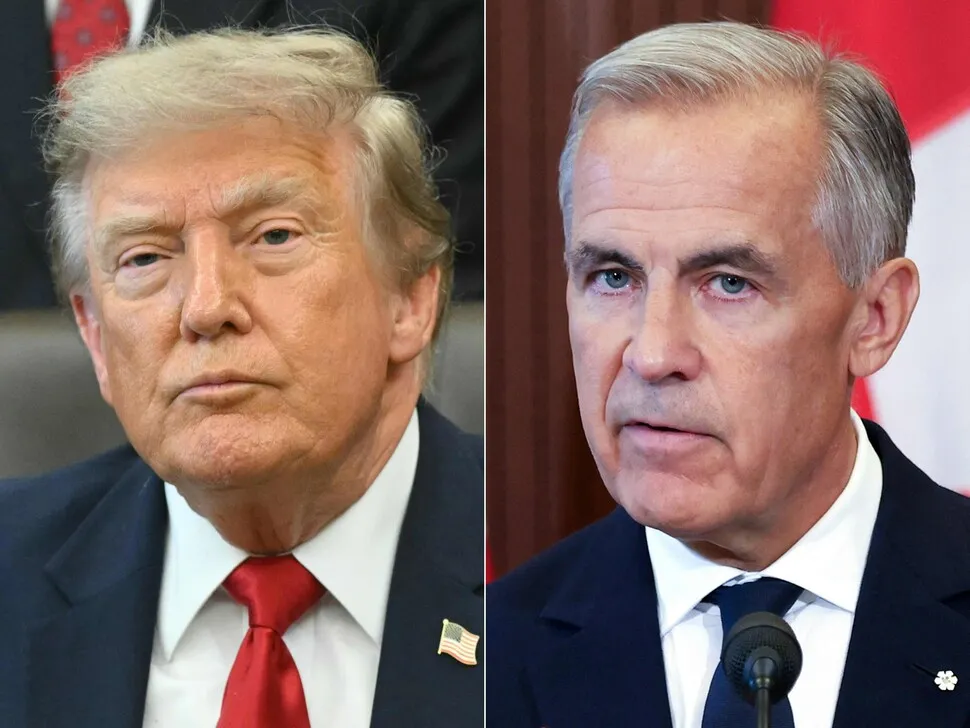
Mark Carney, Canada’s prime minister, did not mince words at an Ottawa press conference on the 22nd. When asked whether the country was entering a trade war, he answered plainly: “When you’re attacked, you go to war. We have been attacked.”
The word “attack” is deliberate. Carney framed the US move as an act of economic aggression, not a negotiating tactic. That framing does three things at once. It justifies escalation to a domestic audience tired of accommodation. It signals to other allies that Canada will not absorb unilateral pressure quietly. And it sets a rhetorical template that the European Union, Japan, and South Korea may already be studying closely.
How the Negotiations Unraveled
The path to this point was neither clean nor sudden. Trump had been building the case for months, accusing Canadian provincial policies on liquor sales, dairy protection, and automotive quotas of discriminating against American goods. The administration invoked Section 338 of the Smoot-Hawley Tariff Act of 1930 — a Depression-era law dragged out of dormancy for its first practical application in nearly a century.
For a few days in mid-August, there was reason to believe a deal was possible. Trump himself posted on social media on the 18th that an agreement had been reached, with the US willing to slash its tariffs on Canadian steel and aluminum from 50% to 25%, and auto tariffs from 25% to 15%. Markets that had braced for catastrophe exhaled.
Then, on the night of the 21st, the talks collapsed.
Carney’s account was specific. The US removed medium and heavy trucks from the category of goods eligible for tariff relief. It added conditions that would constrain Canada’s ability to strike trade deals with third countries. And it introduced requirements that could impair Canada’s language and cultural protections — a reference to policies preserving French-language commerce and Canadian content rules that any government in Ottawa would struggle to surrender.
“They asked for too much and offered too little,” Carney said, characterizing the demands as constraints on Canadian sovereignty itself.
The White House pushed back, telling reporters that Canada had introduced new demands at the eleventh hour, particularly regarding trucks. Neither side appeared willing to concede ground after hours of what insiders described as frantic final-stage diplomacy.
Internal divisions within the US administration likely exacerbated the impasse. Both the Wall Street Journal and Politico reported that the US aluminum industry mounted a fierce opposition to any tariff reductions, while Commerce Secretary Howard Lutnick maintained a hardline posture that overrode more conciliatory voices in the trade circle.
Who Actually Gets Hurt
The immediate casualty list is long and oddly specific. Canada’s $20 billion in exports to the US — roughly 5% of its total trade south of the border — now faces a 50% wall. Wine, hockey sticks, cement, furniture, clothing, and agricultural products are on the receiving end.
But the reciprocal Canadian tariffs cut deeper into the American economy in proportional terms. The US sends far more goods to Canada than it receives in return, making the trade imbalance a structural feature of the relationship. Every dollar of Canadian tariff on American output represents a larger percentage hit to US exporters than the American tariff does to Canadian ones.
Augustin Roe, a trade attorney, told AP that nearly every industry and occupation would feel the chain reaction. The US Chamber of Commerce warned of a feedback loop: higher costs, slower growth, and rising prices feeding off each other.
That last point lands with particular weight. Inflation pressures from the Iran conflict are already compressing American consumer budgets. A prolonged trade dispute with Canada adds another source of cost-push inflation at a politically fragile moment. The 2026 midterm elections are less than a year away, and Republican lawmakers in swing districts — particularly those with manufacturing and agricultural constituencies — will feel the pressure from constituents facing higher prices and disrupted supply chains.
The USMCA Fracture Line
Perhaps the most consequential detail in this escalation is what the US did differently this time. Unlike previous rounds of tariff threats, Washington has begun counting USMCA-qualifying goods among the products subject to new levies.
The United States-Mexico-Canada Agreement was supposed to lock in predictable, rules-based trade across North America. By treating USMCA-compliant products as fair game for punitive tariffs, the US is effectively hollowing out the treaty from within. If the agreement’s safeguards can be overridden by executive action invoking older tariff statutes, the legal architecture that underpins trilateral commerce becomes optional rather than binding.
Mexico, which sits in the other seat of the USMCA trinity, is presumably watching. So is the European Union, which has its own unresolved disputes with Washington on steel, subsidies, and digital services. And so are Japan and South Korea, whose semiconductor and automotive industries already navigate a landscape of American extraterritorial tariff threats.
Canada’s mirror-tariff strategy sends a message: the rules-based order that allied economies helped construct after World War II is not immutable. When the architect of that system decides to rewrite the terms unilaterally, other signatories have both the incentive and the precedent to respond in kind.
What Comes Next
The immediate question is whether this ends in a negotiated settlement or escalates into a prolonged exchange. Carney’s government faces a narrow political calculus. Retaliation satisfies a public that resents being treated as a economic vassal, but it also risks raising prices for Canadian consumers and businesses that depend on American inputs.
The US faces an equally tight constraint. Trump’s base responds to toughness, but American farmers and automakers — the very constituencies most vulnerable to Canadian retaliation — are also his core supporters. Each round of escalation narrows the space for a face-saving compromise.
There is a third scenario worth considering: spillover. If Canada’s response emboldens other allies to mount coordinated retaliatory measures — whether through the WTO, through bilateral clusters, or through new trade arrangements that explicitly exclude the US — the American tariff strategy transforms from a bilateral tool into a catalyst for a fragmented trading system. That outcome would deepen the very economic uncertainty Trump’s tariffs are supposed to reduce.
What is clear is that the Canada-US trade relationship has crossed a threshold. The language of “attack” and “war” does not belong in diplomatic correspondence between two allies who exchange goods worth billions every day. Its presence signals that something has shifted — not just in trade policy, but in the underlying assumptions about how the postwar economic order functions when its principal beneficiary decides the rules no longer serve it.
Allies do not need to agree with Canada’s approach to recognize the signal it carries. The question for Brussels, Tokyo, and Seoul is not whether they will face similar pressure. It is whether they will meet it alone.