The Charlie Kirk Effect: How Trump's Martyrdom Backfired
A year after Charlie Kirk's assassination, the conservative movement's attempt to sanctify him has produced the opposite of what Trump wanted — turning him into the internet's most memed corpse and marking the beginning of Peak MAGAdom.
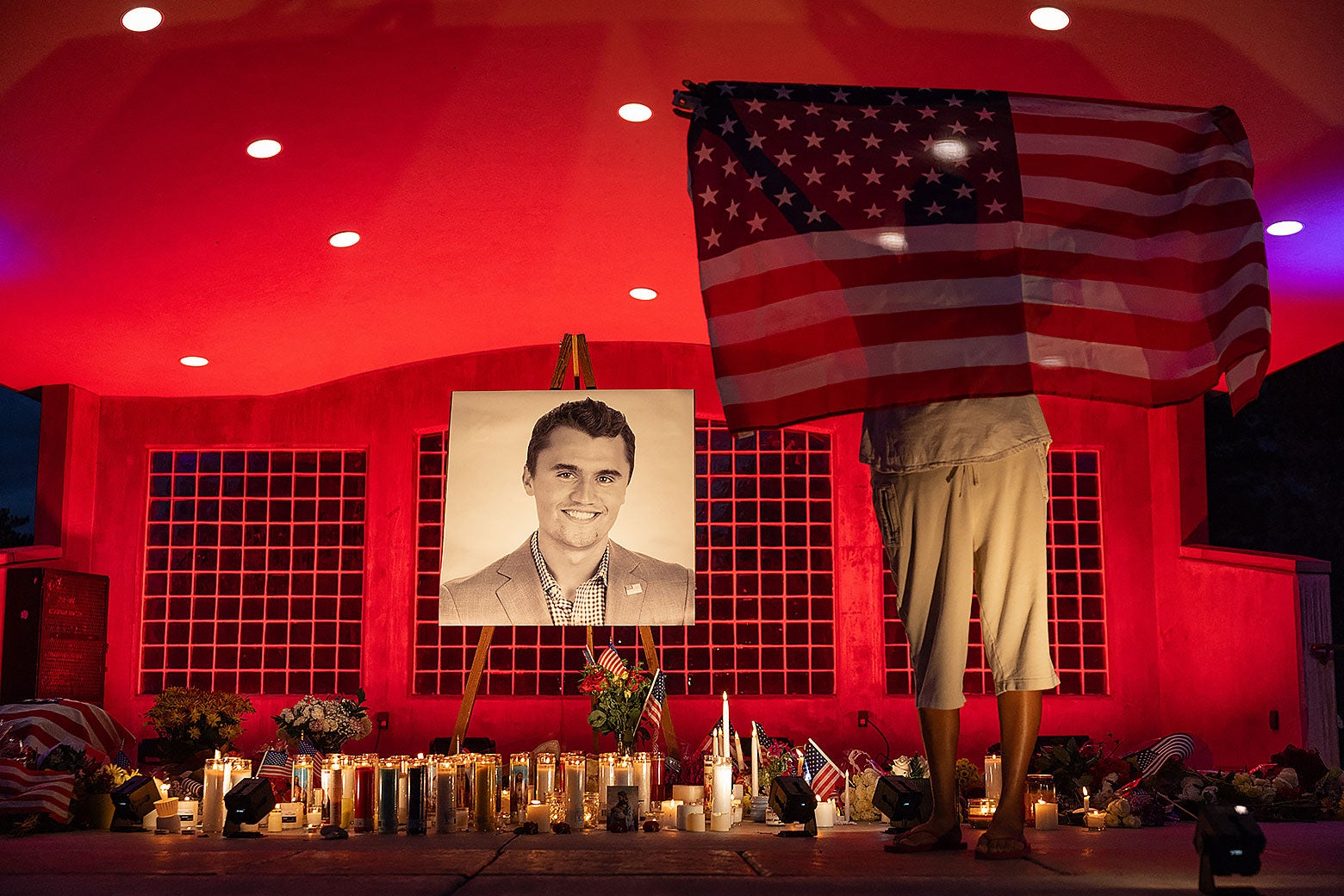
The Martyrdom That Failed
Exactly one year ago, Charlie Kirk was shot dead at a campus debate show in Utah. The footage is not for the faint of heart — a young man killed in front of a crowd, blood and chaos spreading across a warm afternoon. Donald Trump immediately seized the moment. He called it on Truth Social, announced a state funeral, pushed for Kirk to lie in state in the Capitol Rotunda, and watched as Vladimir Putin toasted his defense of traditional values. The conservative media machine began the canonization process.
It didn’t work. Not even close.
Where Trump and his allies expected a Nelson Mandela moment — a unifying symbol that would cement MAGA’s cultural dominance and provide endless ammunition against the left — they got something else entirely. They got Kirkification. By the first anniversary of his death, Kirk had become the single biggest meme on the internet, and every sacred gesture the administration made only fueled the mockery further.
The Memes Won
Let’s be specific about what Kirkification looks like. An AI-generated video of Kirk’s death, posted by X user @GlobalNewsMontr, has accumulated over 1.3 million views — reimagining the fatal bullet being caught inches from its target, with Jeffrey Epstein appearing as Kirk’s savior in a conga line of grotesque absurdity. A subreddit called r/kirkified, created less than two months after the assassination, hosts thousands of images pasting Kirk’s face onto Napoleon Bonaparte, Gordon Freeman from Half-Life, and the McLovin ID from Superbad. One Kirkified Odyssey scene, where an unlucky soldier takes an arrow to the neck, has 5.3 million views.
The slang has spread beyond the meme sphere. Getting Kirked is now Zoomer shorthand for getting killed. It has also been deployed as a euphemism for oral sex — I’m reporting this because it exists and it matters, not because it’s impressive. Comedian Ivy Wolk recently noted that just hearing the name Charlie Kirk makes her generation laugh uncontrollably, coining the portmanteau lowkirkuinely to capture the feeling.
This is not the legacy of a man who was supposed to become a conservative martyr. This is the legacy of a man who became the internet’s favorite punching bag.
The Overreach That Broke Something
To understand why this happened, you have to remember what summer 2025 felt like inside the MAGA movement. Trump had just won re-election with a popular vote. The culture war had rolled back aggressively. Companies were capitulating. Liberal elites were having existential crises. Gavin Newsom had invited Kirk onto his podcast — yes, really. The movement felt triumphant.
So when Kirk was killed, the response was unrestrained. Trump personal-announced it. Republicans tried to get him lying in state. Statues were commissioned. Stephen Miller announced a crackdown on far-left terror networks that smelled unmistakably like a political weapon. And then came the Jimmy Kimmel incident: the late-night host was pulled off the air under direct pressure from the FCC for making a mild joke about Kirk’s death.
That last move was the breaking point. Kimmel’s removal wasn’t just heavy-handed — it was a demonstration that the administration wanted to control not just policy but sentiment, not just votes but grief itself. The demand for solemnity around Kirk, a man who had spent a decade stoking hatred and helped bus rioters to the Stop the Steal rally, crossed a line even for people who’d tolerated a lot.
The Unforced Error
Here is the thing Trump’s team forgot: Charlie Kirk was not a martyr. He was a podcaster and agitator whose entire brand was built on provocation. He made flagrantly racist comments about gang violence hours before he died. He antagonized minority communities relentlessly. The administration wanted the emotional weight of a pope, a firefighter, or a veteran applied to a man who was none of those things. When you demand reverence for someone the public knows to be a grift-peddling provocateur, you don’t get reverence. You get rebellion.
The memes are not just edgy humor. They are an act of reclamation — of the right to define Kirk on your own terms rather than accept the version the administration was forcing down everyone’s throat. Two months after his death, an AI-generated tribute song called We Are Charlie Kirk was released, all saccharine choruses about carrying the flame and honoring the name. Within days, it was remixing as a meme, the lyrics inverted into something darkly satirical. The memes will carry the flame, the meme-makers decided. They just won’t carry it the way the administration wants.
Peak MAGAdom
The most important implication of Kirk’s death is not the violence itself but what it revealed about the state of the movement. Less than a year after Trump’s return to office, the fever had broken. MAGA had reached its cultural ceiling and then stumbled past it. The overreach around Kirk — the state funeral demands, the FCC pressure on Kimmel, the Putin toasts — signaled a movement that was trying to manufacture devotion rather than earn it. That’s when you know a political wave is cresting.
The campus debate circuit Kirk built was always about provocation and performance, not policy. Its infrastructure — Turning Point USA chapters, campus chapters, the whole debate-show apparatus — now faces a leadership vacuum with no natural successor who can command the same energy. The movement that thought it could turn a murdered provocateur into a unifying symbol discovered that symbols only work when people believe in them, and belief cannot be mandated from the White House.
What Comes Next
The question now is whether the conservative movement can rebuild around something other than grievance and spectacle. The Kirk assassination produced a cultural flash point that revealed deep fractures: between the MAGA apparatus and the public it was trying to convince, between Gen Z’s irreverence and the movement’s hunger for solemn authority, between the reality of Kirk’s record and the sainthood the administration tried to impose.
Twelve months later, the memes are still growing. The tribute song is still being remixed. The name Charlie Kirk still makes people laugh. Trump wanted a bloody shirt. He got a punchline instead.
And the punchline, historically speaking, is where movements go when they’ve run out of convincing arguments.