The Fighter Who Burned White: Chiba Tetsuya's Afterlife
When manga artist Chiba Tetsuya died at 87, the world mourned Joe Yabuki — a fictional boxer who had become real through sheer narrative force. His masterpiece taught Mexico, Korea, and Japan how to burn bright.
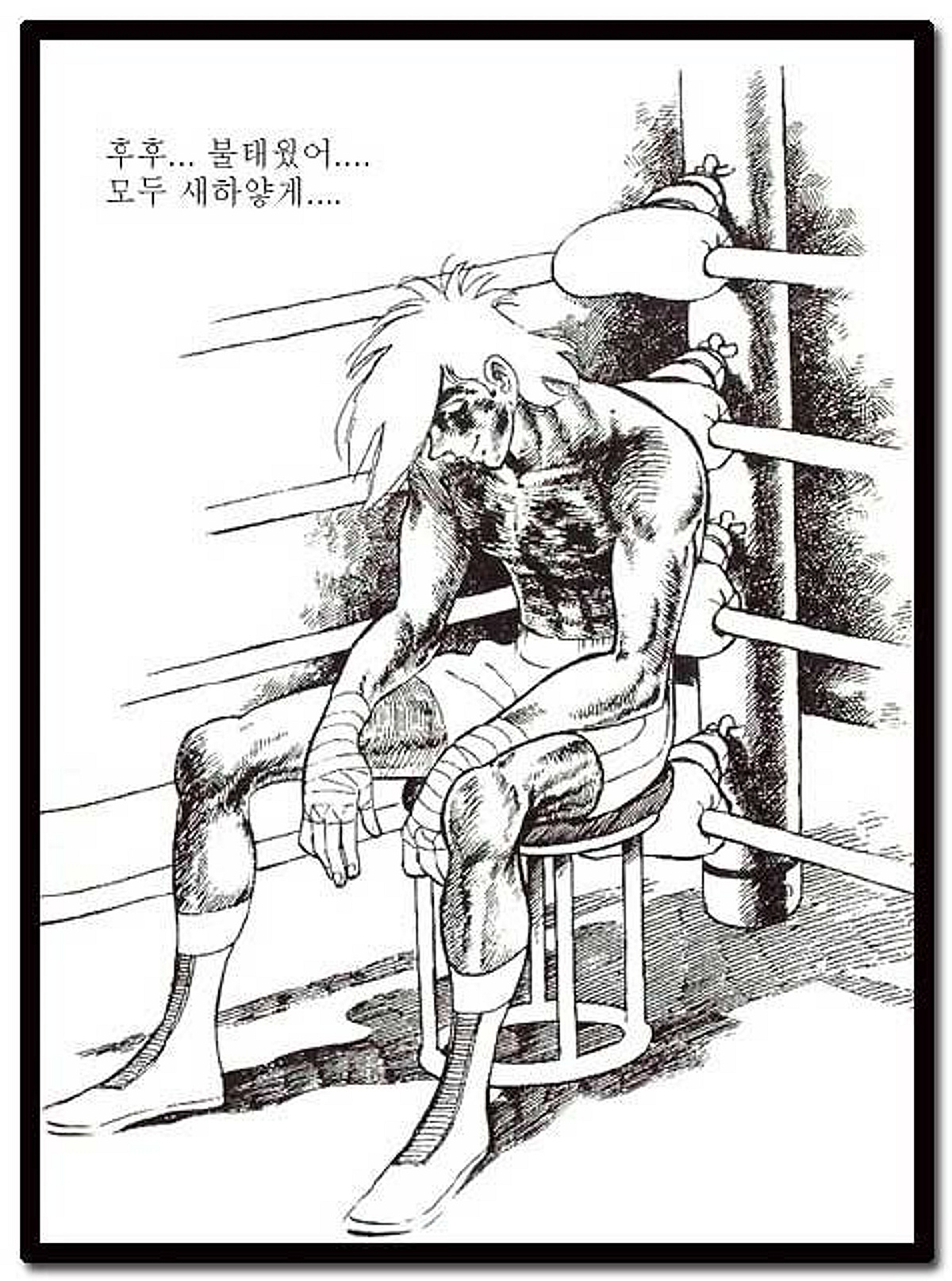
The White Ring
He lies in the center of the canvas now, surrounded by ropes that seem to narrow around him, body cracked open like a shell, ribs visible, the last of his fire bleeding out onto the mat. The crowd has gone silent. There is nothing left to give.
This is the final panel of Ashita no Joe — the single image that made Chiba Tetsuya the most consequential sports manga artist Japan has ever produced, and one of the most emotionally ruthless storytellers in the medium’s history. Joe Yabuki, a teenage brawler from the slums of Tokyo, has fought his way through every opponent in the ring. Now he has nothing. He has given everything.
Chiba called it shinai de mo tsuyoku nare — become strong even without fighting. But the image says something far more devastating: you don’t become strong by surviving. You become strong by burning yourself down to ash and calling it victory.
The manga ended in 1973. Japan has not stopped talking about it since.
The Funeral for a Dead Character
The proof of Ashita no Joe’s cultural gravity is almost impossible to convey to readers who grew up outside its orbit. When Joe’s rival, Tetsuo Rikiishi, was killed off inside the manga, fans held a real funeral. They attended. They brought flowers. They wept for a character who existed only on paper, drawn in ink by a man who was, at the time, just 34 years old.
That is not hyperbole. That is a documented event in Japanese pop culture history, and it tells you everything you need to know about what Chiba had built. Fiction was not decoration for his readers — it was architecture. They lived inside it.
Chiba Tetsuya died on October 22 at a Tokyo hospital, according to reports confirmed by Japanese outlets including Nikkei, from myelodysplastic syndrome. He was 87. The news traveled through Asian media with remarkable speed. In Korea, where the series ran under the title Heorikeineu Jo (Hurricane Joe), headlines featured the iconic final panel alongside the phrase “새하얗게 불태웠어” — “he burned himself white.” The Korean angle, repeated across multiple outlets, was not incidental. It confirmed what any reader of the work already knew: Ashita no Joe never belonged to Japan alone.
A Boy from Manchuria Who Learned to Fight
Chiba was born in Tokyo in 1939. His childhood was spent in Manchuria, the Japanese puppet state in northeastern China, before his family returned to Japan after the war. He grew up in a country that had just watched its empire collapse overnight — humiliated, hungry, rebuilding from rubble.
It is impossible to read Ashita no Joe without hearing the echo of that generation’s hunger. Joe Yabuki comes from nowhere. He has no trainer, no team, no advantage. He has fists and a refusal to stay down. He fights because fighting is the only language he knows — the only way to claim space in a world that has already decided he does not belong.
Chiba debuted as a manga artist in 1956, still in high school. He spent the next decade drawing gag strips and rom-coms, grinding through an industry that treated sports manga as disposable filler. Then in 1968, he picked up Asao Takamori’s script for Ashita no Joe and changed everything.
What followed was five years of serialization in Weekly Shonen Magazine that redefined what a sports story could do. Joe doesn’t win. He doesn’t even survive. He fights until his body breaks, and the reader — across a nation, across generations — sits in the dark and calls it beautiful.
The Mexican Connection No One Talks About
Ashita no Joe found its most unexpected and enduring afterlife in Mexico. The series arrived there in the 1970s and took root with a ferocity that surprised even its creators. Mexican boxers trained to it. Mexican fans adopted Joe Yabuki as a folk hero. The manga’s themes — poverty, defiance, the dignity of the broken body — mapped directly onto Mexico’s own boxing culture, a tradition that stretches from Canelo Álvarez to the barrio gyms of Guadalajara.
The story circulated informally for years, passed hand to hand through photocopies and pirated volumes, until official translations finally caught up. But the盗版 phase was not a failure of distribution — it was proof of demand so intense that no formal pipeline could contain it.
Brazil found similar ground. The working-class protagonists, the relentless pacing, the refusal to offer easy hope — all of it resonated in countries where sport was not entertainment but testimony. Chiba’s art, brutally energetic and unflinching, matched the visual violence of the ring itself. Every panel felt like a punch.
More Than One Champion
Ashita no Joe was Chiba’s masterpiece, but it was not his only voice. Over the decades he produced a string of sports manga that covered kendo, golf, sumo wrestling, and baseball — each one approaching the physical discipline from a different angle. Waga Yaku Detpe (I Am Number Thirty-Eight) followed a kendo prodigy. Nanbougun Matsutaro turned to sumo. Ashita wa Tenki Zaru treated golf with the same emotional gravity he had brought to the boxing ring.
He also held institutional power. He served as professor and later president of Bunka University of Art, mentored a generation of younger artists, and chaired the Nihon Manga Kyokai, the Japanese Cartoonists Association. In 2022 he was elected a member of the Japan Art Academy in the manga category. In 2024, he became the first manga artist to receive the Order of Culture, Japan’s highest civilian honor for artistic achievement.
The cultural establishment, which had long treated comics as juvenilia, finally bowed. Not because Chiba changed his art to suit them — he never did — but because the art had changed them without their knowing it.
What Burns Last
There is a paradox at the heart of Ashita no Joe that makes it nearly impossible to summarize in a single sentence. The story is simultaneously brutal and tender, nihilistic and deeply hopeful, relentlessly violent and profoundly moving. Joe dies alone in a ring no one will remember, and yet — and yet — every reader who has ever read it remembers him.
That is Chiba’s gift. He understood that the point of sport, at its core, is not winning. It is the willingness to stand inside the ring and give everything you have, knowing you will lose, and doing it anyway. The white-hot final panel is not a defeat. It is a declaration.
The Korean press, the Mexican gym walls, the Brazilian bookstalls, the Tokyo funeral — they all testify to the same thing. Ashita no Joe crossed borders not because it was translated well, but because it was honest. Joe Yabuki was never real. He was realer than most living boxers.
Chiba Tetsuya drew him that way. And for five years, he drew him burning.
He was 87. The fire remains.