China Fills the Void Samsung Left at IFA 2026
Samsung abandoned Berlin's CityCube for the first time in over three decades at IFA 2026. Chinese mobility and AI brands moved in — a quiet signal of a shifting global tech landscape Western headlines aren't covering.
The Empty Building That Says Everything
For twelve years, CityCube Berlin belonged to one company. Since 2014, Samsung Electronics claimed the massive standalone convention center at Messe Berlin as its own — a 6,000-square-meter statement in concrete and glass that no other exhibitor could match. The building was so synonymous with Samsung at IFA that it became shorthand in trade reporting: if you wanted to see what Samsung was building next, you walked into CityCube.
This year, the doors were open to everyone except Samsung.
The Korean giant relocated to Humboldt Carré, a modest convention space in downtown Berlin, as part of a strategy shift toward B2B relationship management. The move was framed as a deliberate choice, not a retreat. But the optics arriving from Berlin tell a different story. CityCube’s main hall, once a Samsung monopoly, now hosts dozens of exhibitors — and the lineup is unmistakably Chinese.
Who Moved In
NAVEE, a Chinese electric scooter company founded in 2021, took the largest booth in the vacated space. The company has exhibited at IFA since its early days, but this year’s footprint was visibly expanded. Notably, NAVEE’s signage paired its own name alongside Dreame, the Chinese home appliance manufacturer — signaling that the scooter brand now operates within Dreame’s broader ecosystem. That kind of corporate scaffolding would have been unthinkable five years ago for a company this young.
XPENG, the Guangzhou-based electric vehicle maker, reserved a similarly large presence. The company displayed both its production EVs and its flying car prototypes — a dual showcase aimed squarely at international media. XPENG is widely regarded as China’s most advanced player in urban air mobility, and IFA proved to be the stage where it wanted the world to notice.
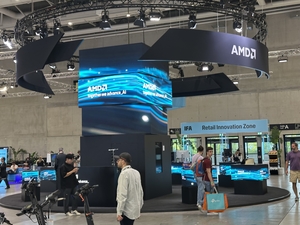
AMD, the American AI chip company, also joined the Retail Innovation Zone inside CityCube. It delivered the opening keynote under the theme “The Era of Personal AI.” Yet despite the AI branding, the booth floor told a different tale: gaming PCs powered by AMD processors dominated the display. An AMD representative told reporters the company was highlighting its long-standing console partnerships with Xbox and PlayStation, not its AI credentials — a strategic recalibration that itself speaks to how saturated the AI hardware narrative has become.
What the Space Tells You
IFA has always been a barometer for consumer electronics power. Where companies choose to stand reveals more than what they choose to show. CityCube was Samsung’s cathedral. Its partial repurposing for Chinese mobility brands and an American chipmaker is not coincidence — it is a structural realignment playing out in real time.
Samsung’s decision to leave CityCube was motivated by a desire to deepen B2B engagement with enterprise clients. The company did not vanish entirely from the fair: it sponsored the “IFA Creator Hub” at Messe Berlin, where it hosted a Korean-themed Samsung AI escape room experience. But the Creator Hub is a peripheral activation compared to commanding an entire building. The contrast between the two setups is the point.
Meanwhile, Chinese companies are treating IFA as a global launchpad. This is no longer a trade show for Asian electronics firms to monitor Europe — it is a stage where they actively compete for European and global attention. The presence of XPENG alongside AMD and NAVEE inside the same hall that Samsung once ruled alone is a visual timeline of who is rising and who is receding.
The Numbers Behind the Narrative
Samsung’s CityCube exhibit peaked at 6,000 square meters before this year — larger than many small hotels. Its IFA participation began in 1991 with a mere 43-square-meter booth. Over three decades, Samsung scaled from a participant to a dominator. The speed of its decline from that position, however, deserves scrutiny. A single strategic pivot toward B2B did not hollow out a 12-year occupation overnight. Rather, it revealed that the conditions sustaining Samsung’s dominance had been eroding for some time.
Chinese appliance and mobility brands have spent the last decade closing capability gaps. Dreame, now a parent company to brands like NAVEE, has built a portfolio that spans vacuums, air purifiers, and personal mobility — exactly the kind of diversified hardware ecosystem that makes a CityCube booth matter. XPENG’s flying car is still a prototype, but its very presence at a German trade show signals confidence that Europe is a market worth courting directly.
What Happens Next
IFA 2026 will not rewrite the history of consumer electronics on its own. But the image of an empty Samsung building filled with Chinese and American exhibitors will linger. Western trade desks cover IFA as a product announcement circuit — new fridges, new TVs, new washing machines. They rarely ask who is occupying the real estate or why it matters.
Samsung’s B2B pivot may prove strategically sound. But strategic soundness does not automatically translate into market perception, and at a trade show, perception is infrastructure. Every photo circulated from CityCube in 2026 will show the same thing: a Chinese e-scooter brand and a Chinese EV maker in the spaces Samsung once filled alone.
The erosion of Korean tech dominance in consumer hardware has been discussed in boardrooms and analyst reports. IFA 2026 made it visible in brick and mortar. The question for the coming year is whether Samsung treats this relocation as a temporary adjustment or as a signal that its consumer electronics positioning in Europe needs a fundamentally different approach — one that does not cede the physical ground to competitors who are already comfortable on it.