China's Humanoid Speed Run: What WRC 2026 Reveals About the Real Race
China just built a state-backed humanoid robot platform with 5,000-unit annual capacity, open-source AI models, and a free data loop. For Korean robotics firms, the question is no longer whether they can compete on specs — it is whether they can compete on price and velocity.
The Platform Is the Product
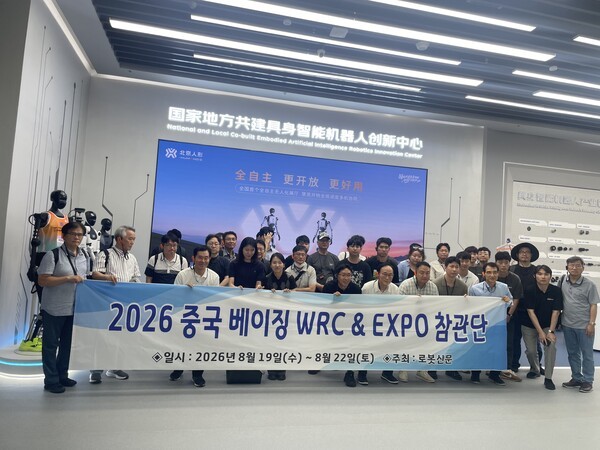
At WRC 2026 in Beijing, the most consequential story was not a single robot’s leap in capability. It was the confirmation that China has built a national-scale humanoid platform — one that intentionally lowers barriers for everyone except incumbents who cannot match its volume.
The Beijing Humanoid Robot Innovation Center, also known locally as Beijing Humanoid, announced it has reached annual mass-production capacity of 5,000 units. It opened a dedicated training base for embodied AI data collection. And it threw open its source code, releasing foundation models for the world to use.
This is not accidental openness. It is a strategic choice to make the platform itself the product, and to let scale do the rest.
A State-Backed Stack Built in 18 Months
The center was established in November 2023 as a joint venture between UBTECH, Xiaomi, Jingcheng Electromechanical, and Yizhuang Robotics. That combination alone is notable: a robotics company, an internet giant with deep manufacturing experience, a state-owned industrial firm, and a local government vehicle.
By October 2024, the platform received approval from China’s Ministry of Industry and Information Technology and the Beijing municipal government to operate as a national-level embodied AI innovation center. The timeline is aggressive — a full platform cycle from founding to national designation in under 12 months.
Xiong Youjun, formerly UBTECH’s CTO, runs operations. His background suggests the center prioritizes engineering velocity over incremental research milestones.
The Open-Source Trojan Horse
The center’s most significant move may be the simplest: releasing its AI foundation models as open source.
Three systems stand out. Pelican-VL, the “brain” responsible for situational awareness and task planning, has already ranked among the top performers in international evaluations. XR-1, the “cerebellum” handling motor execution, became the first Chinese system to pass official certification for embodied motion control. WoW, the embodied world model, and the VLA architecture complete a stack that covers perception, planning, and action.
The center is also distributing training data for free. It collects scenario-specific data at its new training base and makes it openly available. If a customer wants, the center can go to that customer’s site and collect more. This creates a data flywheel: every deployment enriches the platform, and the platform gets better for everyone who downloads it.
For Korean firms, the risk is clear. If the global ecosystem gravitates toward an open Chinese platform, proprietary Korean models face a credibility and cost disadvantage — not because they are worse, but because they are closed and expensive to run.
Five Commercial Scenarios, Not One Hero Product
The center has chosen to focus on five application areas: commercial services, energy inspection, laboratory and cleanroom work, general industry, and logistics sorting. It is not betting on a single killer use case. It is betting that broad deployment will itself be the moat.
Tiangong 3.0, the general-purpose humanoid at 170 cm and 65 kg, and Tianyi 2.0, a wheeled humanoid optimized for service tasks, represent the hardware side. Both are already running in warehouses, factories, labs, and power facilities. The center is also offering its Wise KaiWu platform, which bundles brain and cerebellum capabilities into a deployable stack for factories, stores, homes, and special-mission contexts.
This is a volume play. The center’s stated goal is not to sell premium robots to a handful of enterprise customers. It is to produce thousands of units, populate the ecosystem with free models and data, and let adoption follow.
What This Means for Korea
Korean robotics companies have long held advantages in precision actuation, sensor integration, and reliability engineering. Companies like Hyundai Motor Group’s Boston Dynamics acquisition, Samsung’s robotics divisions, and startups such as SoftBank Robotics Korea have built reputations on high-performance hardware. But hardware alone cannot defend against a platform strategy backed by state infrastructure and a domestic market of 1.4 billion people.
The real threat to Korean firms is not that Chinese robots will be better. It is that they will be good enough, free, and everywhere.
If Pelican-VL and XR-1 become the default open-source stack for embodied AI, then every developer, university, and small robot company outside China will build on top of Chinese models. The ecosystem lock-in will be structural, not technical. Korean firms would find themselves supplying components or building niche products on a platform they do not control.
There is a second-order risk as well. Chinese humanoid production at 5,000 units annually will depress global pricing. Korean manufacturers who cannot achieve similar scale will either need to differentiate on performance that Chinese systems cannot match or accept lower margins. The gap between the two paths is narrow.
The Leapfrog Question
Can Korean firms leapfrog by linking Chinese supply chains to Korean technology?
It is theoretically possible. China’s component supply chain — actuators, reducers, sensors — is deep and inexpensive. Korean firms have design expertise and integration capability. A partnership model could produce competitive robots faster and cheaper than building from scratch.
But this strategy carries political risk. Export controls, technology-transfer restrictions, and growing US-China tensions make deep supply-chain integration between Chinese and Korean robotics firms increasingly complex. A Korean company that becomes dependent on Chinese components may find its market access restricted by third-party regulators.
There is also a timing problem. China’s platform strategy is moving fast. Every month of deliberation is a month during which the open-source ecosystem consolidates around Chinese models. The window for a leapfrog strategy is closing.
Who Wins, Who Loses
The winner in this scenario is the developer who can ship a robot next week using a free, well-documented stack. That is not always the highest-performing robot. It is the one that works, costs less, and does not require a license.
The loser is the company that bets on proprietary superiority without a corresponding advantage in distribution or ecosystem. History is full of such companies. They built better products and waited for the market to notice. By the time it did, the platform had already won.
For Korean robotics firms, the challenge is existential. The question is not whether they can build a competitive humanoid. It is whether they can participate in a world where the foundation layers are open, free, and owned by someone else.
The answer may determine not just the fate of a sector, but the trajectory of Korea’s position in the next era of industrial automation.