China's Blunt Military Threats Are Reshaping Manila's Defense Posture
Beijing's ambassador told the Philippines it could easily win a military conflict. Manila's president called it an act of coercion. The incident marks a dangerous escalation in South China Sea tensions with ripple effects across regional trade and security.
A Diplomatic Statement That Wasn’t Really Diplomatic
Beijing usually wraps its warnings in layers of plausible deniability. It does not need to with Manila. On June 15, Chinese Ambassador Zheng Quanjun stood at a public event in the Philippine capital and said something that would have sounded like a bluff coming from any other capital. If China decided to use force, he told the assembled crowd, it could win easily. He then offered the obligatory softener — China does not want to use force and loves peace — before adding that the Philippines should consider itself fortunate that its neighbor is China rather than some other power.
It was, by any definition, a military threat delivered through diplomatic channels. And it drew a response rarely seen in the careful dance between the two capitals. Philippine President Ferdinand Marcos Jr. called the remarks an act of coercion. The Foreign Ministry issued a statement saying the language could be read as threatening the use of force and undermining mutual trust. Both were unusual in their directness.
Why This Matters Beyond the Headlines
The timing of Zheng’s comments deserves scrutiny. The Philippine defense secretary, Gilberto Teodoro, had just publicly identified China as the instigator of regional disputes — a stark reversal from years of Manila’s diplomatic hedging. Zheng was clearly responding to Teodoro’s framing. But he chose a public forum to make his reply, which suggests Beijing calculated that signaling strength domestically and to regional audiences outweighed the diplomatic cost.
The escalation follows a pattern. In June, China banned Teodoro and his family from entering mainland China, Hong Kong, and Macau — sanctions that targeted a sitting defense minister for the first time in the long-running dispute. That move signaled Beijing was willing to personalize the conflict, moving from state-to-state friction toward individual consequences. Zheng’s remarks two days later extended that pressure into the military domain.
Manila’s Calculus Is Shifting
Marcos came to office in 2022 promising a softer approach toward China, pivoting away from the confrontational stance of his predecessor Rodrigo Duterte. Three years later, the pivot has reversed. The Philippines has deepened its military ties with the United States, welcoming additional troops under the Enhanced Defense Cooperation Agreement and signing new bases-access deals with Washington, Tokyo, and Canberra. The trend accelerates with each incident at sea.
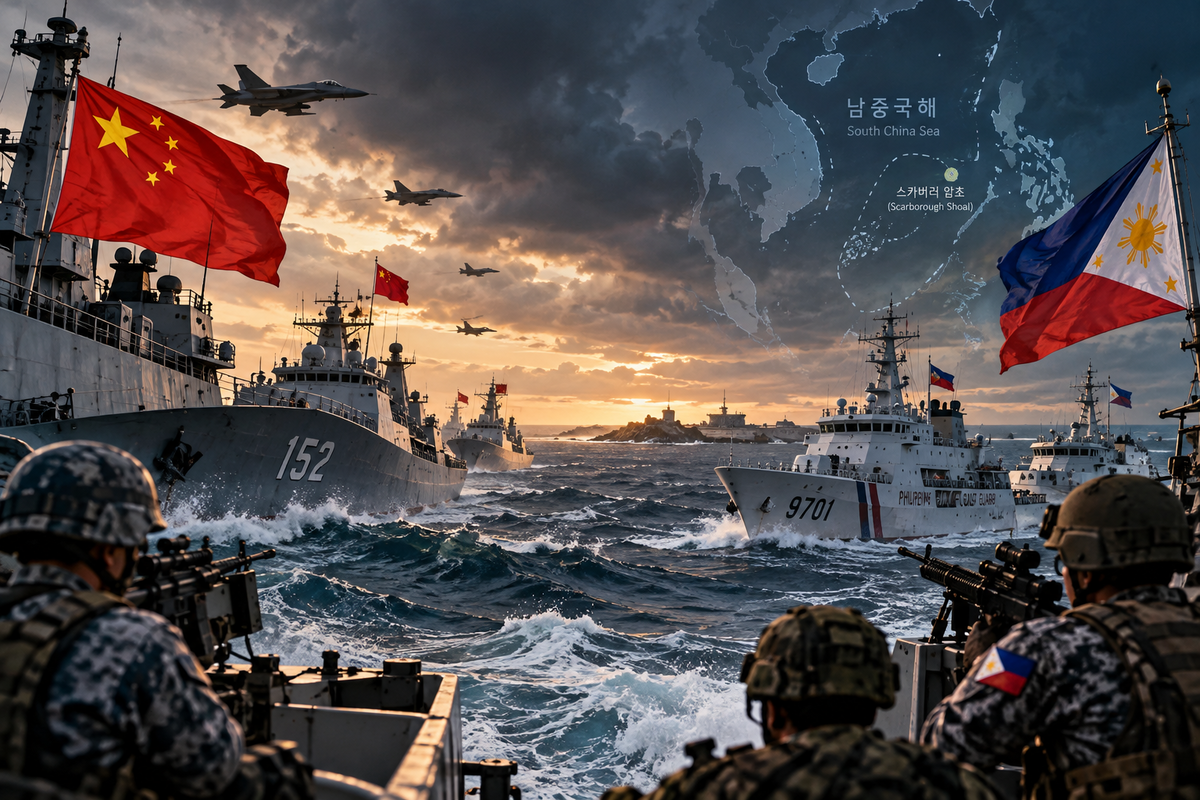
What makes this moment different from previous flare-ups is the explicit nature of the threat. Past Chinese coast guard and maritime militia encounters — the water-cannonings, the laser-aiming, the reckless maneuvers near Scarborough Shoal — were brutal but deniable. They operated in a gray zone. A diplomat saying his country could win a war easily removes the gray zone entirely. It forces Manila to respond at the presidential level rather than through back-channel diplomats.
Who Wins and Who Loses
Beijing wins if the threat achieves its intended effect: intimidating Manila into backing down on maritime claims and slowing its security partnerships with Washington and its allies. The messaging to other ASEAN claimants — Vietnam, Malaysia, Brunei — is equally important. China is demonstrating that escalation carries costs beyond diplomatic protests.
But Beijing also loses ground. Each public threat pushes the Philippines closer to the United States. The Mutual Defense Treaty, signed in 1951, covers armed attacks on Philippine forces in the South China Sea, and Washington has made clear it would honor that commitment. Every Chinese provocation strengthens the case in Manila for deeper integration with American power projection capabilities. Japan and Australia are watching too, and their own security calculations are shifting in similar directions.
Teodoro wins politically. The sanctions against him and his family only reinforced his position as a tough voice on China. His identification of Beijing as the dispute’s instigator now has the backing of the president. Within the Philippines, hawks gain leverage; doves lose it.
The Trade Dimension No One Is Discussing
China and the Philippines are negotiating a framework agreement on cooperative maritime activities — a deal Beijing has long wanted to finalize. The talks cover everything from resource exploration to coast guard communication protocols. A diplomatic incident of this magnitude makes progress less likely, not more. Manila’s negotiating position is now anchored to a harder line. Any concession on maritime claims looks like capitulation after a president has called a foreign diplomat’s words an act of coercion.
That is the hidden strategic play. Beijing may be trying to create conditions where Manila comes to the negotiating table weaker, not stronger. But the psychology of threats works both ways. Pressure that hardens a population’s resolve can produce the opposite result.
What Happens Next
Expect another round of verbal sparring. China’s Foreign Ministry already called Manila’s response an overreaction and accused the Philippine government of selectively quoting Zheng out of context. Mao Ning, the ministry spokesperson, urged the Philippines to understand China’s position comprehensively — code for stop escalating.
But the material reality on the water is unlikely to change. Chinese vessels continue to patrol around Scarborough Shoal and the Ayungin Shoal area, where they have grounded a supply vessel to maintain a physical presence. The Philippines continues to resupply its own position through helicopter drops and small boat deliveries when coastal crossings are blocked.
The United States will issue statements of support. Japan and Australia will increase their naval presence in the region. And the Philippines will continue acquiring defense assets — more coast guard vessels, underwater drones, and surveillance systems — funded partly through expanded access agreements with Washington.
The most dangerous outcome is not a single dramatic clash but the slow normalization of military rhetoric between neighbors who have never settled their maritime boundary. When ambassadors start talking about winning wars, the next step is usually not diplomacy.