Chinas Robot Olympics Is Really a Manufacturing Stress Test
Beijing's second humanoid robot competition drew 2,050 machines from 16 countries, but the real event isn't the medals—it's the industrial validation happening behind the sports facade. Unitree's IPO surge to 600% above price underscores what's at stake for global automation.
The Stadium Was a Distraction
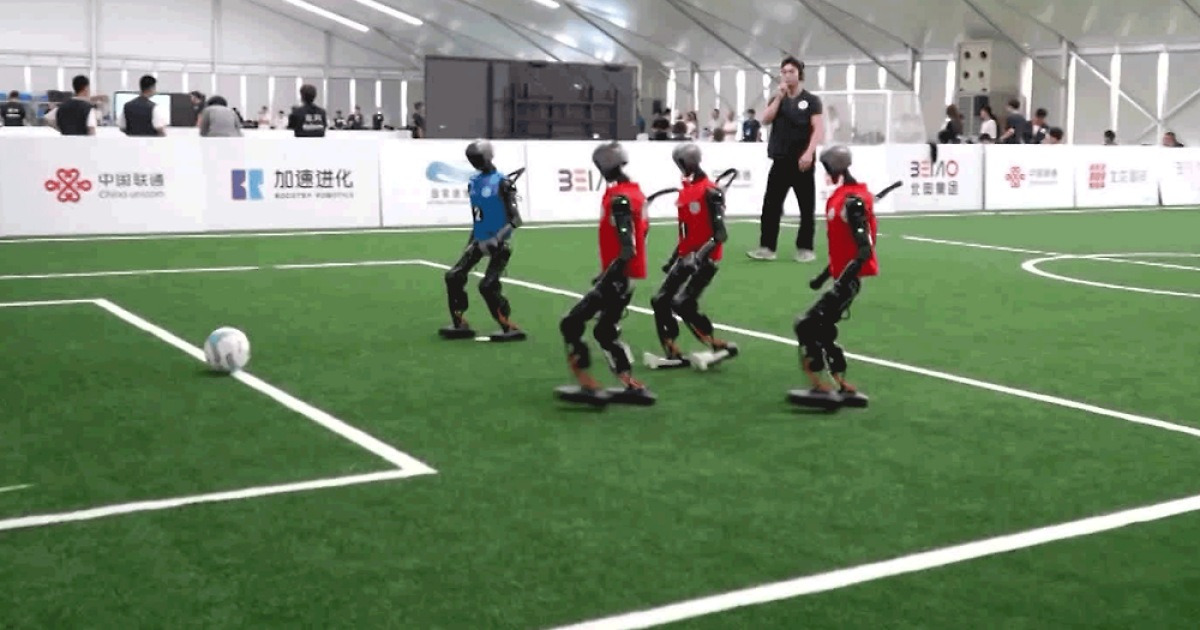
The robots looked ridiculous running down the track with their hands over their faces, as if embarrassed by the spectacle. A half-marathon record-breaking unit from Shandian returned to Beijing looking to add gold to its resume. Other machines tugged ropes, threw arrows at targets, juggled table tennis balls—all while engineers in the stands checked whether grip force, balance, and coordination metrics met factory-floor requirements.
The sports were never the point. This was always a stress test disguised as entertainment.
The second Humanoid Robot Olympics, which opened this week in Beijing, drew 2,050 machines from 16 countries. The event expanded beyond traditional track and soccer into disciplines demanding fine motor control and split-second decision-making: quoits, table tennis, tug-of-war. Each new category forces robots to handle real industrial variables—uneven terrain, unpredictable object trajectories, fatigue-resistant joint cycling.
Zhao Zhiping, co-founder of LinkerBot, told reporters that quoits competition required precise environmental reading and arm control. The message was plain: if your robot can thread a throw across distance and angle under pressure, it might one day assemble engines on a Chinese production line.
The Money Signal
While the medals were being tallied, the Shanghai stock market was sending its own verdict. Unitree, China’s largest humanoid robotics company, listed on the Shanghai Stock Exchange and sent shockwaves through Asian tech circles. On its first trading day, Unitree’s shares surged more than 600 percent above the offering price before stabilizing. The capital raise alone signaled institutional conviction that humanoid robots are entering a commercial inflection point.
That IPO wasn’t accidental. China’s robotics sector has operated under sustained state policy support for years—subsidies, talent programs, municipal industrial parks, procurement guarantees. The government treats humanoid robots the way it treated EVs a decade ago: as a strategic sector worth front-loading investment into, even before clear demand exists. The market is now confirming what policy set in motion.
What This Means for South Korea
The optics are stark for Seoul. South Korea has been the robotics bellwether for two decades. Samsung, Hyundai, and Doosan built global reputations on industrial arms and collaborative robots. LG and Sony still lead in consumer-facing robotics. But the humanoid segment—the one Unitree and competitors are sprinting toward—is where the next decade of value will accumulate.
China’s approach differs in tempo and structure. Beijing doesn’t wait for private capital to find product-market fit. It crowns national champions, funnels subsidies, and lets the market sort out winners after the infrastructure is in place. The 2,050-robot competition is itself an infrastructure play: it creates a public benchmark, accelerates iteration cycles, and gives international buyers a single venue to evaluate the field.
South Korea’s advantage remains in precision engineering, component supply chains, and decades of factory-floor reliability data. Its disadvantage is institutional—one the Chinese state has systematically exploited. When a national robot goes public and triples the valuation of an entire subsector overnight, private Korean competitors face pressure to scale faster or risk irrelevance.
The Manufacturing Chessboard
The implications extend beyond national pride. Humanoid robots are not just another automation tool; they represent a different relationship between labor and machinery. Unlike fixed robotic arms, humanoid form factors can navigate spaces designed for human bodies—stairs, narrow doorways, assembly lines built around human ergonomics. That compatibility is what makes them valuable in mixed human-robot factories, not just in fully automated cells.
China’s push signals where it intends to capture that transition. The robotics industry sits at the intersection of three strategic sectors Beijing controls: AI, advanced materials, and precision manufacturing. Each competition category tests overlapping capabilities—lightweight composites (the new leg materials mentioned by One Honor New Industry Incubator director Gao Siming), sensor fusion, real-time kinematic control. Winning the Olympics means proving you can deliver on all three simultaneously.
Who Wins, Who Loses
Chinese robot manufacturers win immediately—the domestic competition compresses iteration timelines and forces rapid capability gains. International buyers win secondarily, as prices fall and options multiply. Chinese factories win downstream, gaining access to humanoid labor that can plug into existing human-designed workplaces without reconstruction.
South Korean robotics firms face the sharpest pressure. They hold quality and reliability advantages but operate in a market where China is willing to subsidize losses for strategic positioning. Japan, similarly positioned, confronts the same structural challenge. The window to maintain premium pricing based on reputation alone is closing.
Global automation markets lose if China’s state-backed scale wins purely on cost. The long-term health of a diversified robotics ecosystem matters for supply chain resilience. A single-nation dominance in humanoid platforms creates dependency risks no manufacturing hub wants.
What Comes Next
The Beijing Olympics will produce medal counts and viral footage. But the real scoreboard is measured in IPO valuations, factory pilot deployments, and export contracts. Unitree’s listing is just the opening act. More Chinese robotics firms will follow public markets as the category matures.
For Seoul and Tokyo, the question isn’t whether humanoid robots matter—they already do. The question is whether institutions built for precision engineering can adapt fast enough to compete with a model that treats market entry as a national security exercise. China’s 2,050 robots on the track were never really about sport. They were a demonstration of industrial capacity that the rest of the robotics world now has to respond to.