China's Robots Just Left the Track and Walked Into Your Factory
Chinese humanoid robots broke human half-marathon records in 2026, but the real story isn't speed — it's precision hands now entering factories. China's state-backed robotics push is shifting from demo-stage spectacle to industrial deployment, and Korean rivals face a steeper climb.
The Half-Marathon Was Never the Point
When a Chinese humanoid robot named Flash crossed a Beijing finish line in 50 minutes and 26 seconds at the 2026 World Humanoid Robot Games, it wasn’t just beating a human record. It was crossing a threshold no one expected to come so soon.
The robot was developed by Chi Tian Da Sheng, a team backed by Honor, the Chinese smartphone maker. It ran the half-marathon course without a single engineer pacing alongside it — no tethers, no remote operators, no emergency interventions. That detail matters more than the time itself.
Two years earlier, at the first robot half-marathon in Beijing in April 2025, the scene was embarrassingly different. Dozens of machines collapsed mid-race. Engineers had to jog alongside them like trainers at a horse track, shoving fallen robots upright and resetting their gait algorithms when they tipped. Only a handful of the competing teams managed to finish.
By 2026, 47 of the 100-plus teams completed the course. Nearly half of all entrants demonstrated stable, autonomous locomotion over a 21-kilometer distance. That is not incremental improvement. That is an inflection point.
How China Built a Robot Racing Team
The transformation did not happen overnight, and it did not happen organically.
From 1999 to 2014, China’s humanoid robot competitions were essentially provincial university showcases. Fujian province and local industry associations sponsored small-scale events where wheeled bots followed pre-programmed routines — kicking balls, returning badminton rallies with rudimentary trajectory estimation borrowed from 1990s British defense research. The technology was charming but contained.
Everything shifted in 2015, when Beijing hosted the first World Robot Conference and President Xi Jinping publicly declared robotics a crown jewel of advanced manufacturing. The state elevated the sector to national priority status, and the funding followed.
Local governments began treating robot development as a prestige metric. Provincial subsidies, tax incentives, and supply chain support flooded the ecosystem. Component costs dropped as domestic suppliers — motors, reducers, sensors, controllers — scaled production alongside the robot makers themselves. The result was a price advantage that no Western or Korean competitor could match without equivalent state backing.
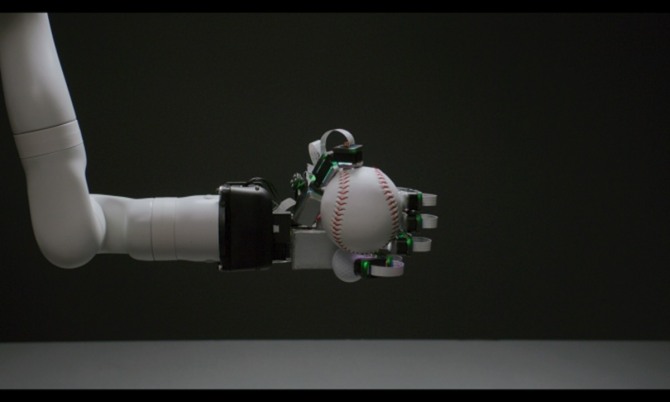
The Real Breakthrough: Hands That Can Hold a Screwdriver
The marathon victory is the headline grabber. The factory arrival is the consequential one.
Chinese robotics companies are now demonstrating precision hand systems capable of fine manipulation — gripping, rotating, assembling components with tolerances that meet industrial standards. This is the capability that separates a robot that can walk from a robot that can work.
A machine that completes a half-marathon autonomously has proven balance control and real-time terrain adaptation. A machine that can pick up a tiny screw, align it with a threaded hole, and tighten it without crushing the head has proven dexterity, force feedback, and real-time visual-guided actuation. Both require sophisticated AI. Neither is trivial. Getting both on the same platform is the gauntlet China is clearing right now.
The source material notes that practical reliability testing is already accelerating factory deployment. That means companies are moving beyond whitepapers and trade show demos into pilot lines where robots handle actual assembly, inspection, or material-handling tasks — with real consequences for downtime if the machines fail.
Who Wins, Who Loses
Chinese robot manufacturers win the most obvious advantage: cost. With a complete domestic supply chain for key components and government support that Western companies cannot replicate, Chinese humanoid robots are priced aggressively against Japanese and Korean counterparts. That price gap is the primary weapon in a market where manufacturing margins are already razor-thin.
Korean robotics firms face the hardest squeeze. Companies like Hyundai Robotics and Samsung’s research divisions have strong reputations for precision and reliability in traditional industrial robots. But humanoid robots demand a different skill set — full-body dynamic control, AI-driven perception, and software stacks that adapt to unstructured environments. China is racing toward exactly that capability while driving down costs. Korea’s advantage in servo motors and reducers, historically decisive in Cartesian and SCARA robots, becomes less differentiating when the competitive battlefield shifts to balance, dexterity, and AI.
Japanese firms are in a more comfortable middle position. Their strength in precision components and industrial integration remains formidable, and brands like Honda’s ASIMO lineage and Toyota’s WHILL platforms carry deep engineering credibility. But Japan’s robotics strategy has been slower to pivot toward general-purpose humanoids, and the cost structure has not kept pace with China’s state-supported scaling.
For global manufacturers, the implication is straightforward: automation becomes cheaper and more flexible faster than expected. Factories that previously required expensive, fixed automation cells now have the option of reconfigurable humanoid workers who can learn new tasks through software updates rather than hardware replacements.
What Comes Next
The next 12 months will reveal whether the precision-hand breakthrough translates into sustained factory deployment or stalls at the proof-of-concept stage. Two indicators to watch: whether Chinese robotics companies announce multi-robot installation contracts with major manufacturers, and whether Western or Korean firms respond with their own cost-reduction roadmaps or double down on niche applications where humanoids remain impractical.
If Chinese robots begin appearing in automotive assembly lines, electronics factories, and logistics warehouses at scale, the supply chain effects will ripple outward. Labor-cost calculations in Vietnam, Mexico, and India — all popular alternatives to China for manufacturing relocation — will need revision. A robot that costs a fraction of a human worker and can be deployed anywhere becomes a different variable in every location decision.
China’s marathon robots were always going to find their way to the factory floor. The question now is how much ground they cover before the rest of the world catches up.
The Finish Line Was Never the End