China's Robots Now Outrun Usain Bolt — and That Changes Everything for Korean Factories
A Chinese humanoid robot just sprinted 100m in 8.86 seconds, faster than any human. The real story isn't the race—it's what this acceleration means for labor markets in aging economies like Korea.
The Finish Line Wasn’t the Point
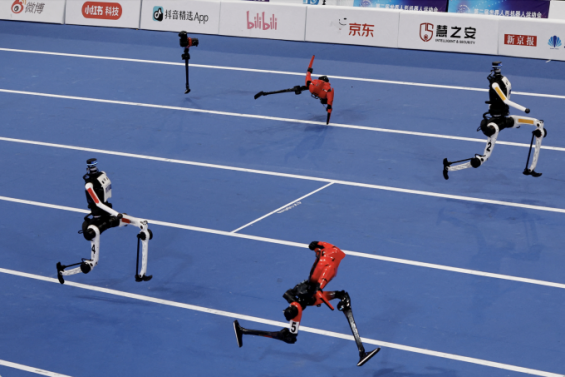
On June 25 in Beijing, the world humanoid robot games reached their final day and something quietly broke. A robot called Tiangong Ultra crossed the 100-meter finish line in 8.86 seconds. That is faster than Usain Bolt’s standing world record of 9.58 seconds, set in Berlin in 2009 — a record that stood as one of the last immovable benchmarks in athletics.
But the more important number was not the time. It was the gap between 8.86 and the previous year’s result: 21.50 seconds. In twelve months, this machine more than doubled its speed. That is not incremental improvement. That is a regime change.
Three days earlier, on June 22, Tiangong Ultra had already run 9.39 seconds and made headlines. Honor, the Chinese smartphone company that entered a robot called Lightning into the same race, took silver at 9.47 seconds — also faster than Bolt. By the final, both machines were left far behind the human era they had just passed.
The high jump told an even stranger story. Tiangong Ultra cleared 3.4 meters in the final. Javier Sotomayor’s world record of 2.45 meters, set in Mexico City in 1993, looked suddenly obsolete. The robot had more than a meter of clearance over the greatest human high jumper in history.
Then, as the robot crossed the finish line, it did not stop. It kept moving forward until it slammed into a thick crash mat placed beyond the track. Reuters reported sparks flying from its chassis. Another robot in a semifinal disassembled mid-competition, a limb separating from its torso. These are not polished demos. These are prototypes learning to exist in environments they were never built to handle.
Why This Matters Beyond the Track
The World Humanoid Robot Games, held in Beijing for only its second year, gathered 666 teams and more than 2,000 robots competing across 51 events. Soccer, dance, industrial tasks, track and field — the competition was designed to showcase the full spectrum of what humanoid machines can do, and this year the track events became the story.
What makes these numbers unsettling is the velocity of progress. Last year, Tiangong Ultra’s best time was 21.50 seconds. This year, 8.86. A human sprinter improving from Olympic elimination speed to world-record territory in a single season would be the greatest athletic leap in history. No human has ever done anything close to this.
The Beijing Humanoid Robot Innovation Center, which developed Tiangong Ultra, described the achievement as the result of “a dazzling moment” where hardware, motion control, and a full-stack intelligent system converged. That phrasing matters. This was not a single component upgrade. It was a systems-level breakthrough — the kind that rarely happens in isolation, and even rarer when it happens this fast.
The Korean Question
Korea is watching this closely, and not just out of curiosity. The country’s demographic trajectory makes this directly relevant to its economic future. Korea now has one of the world’s lowest birth rates and one of its fastest-aging populations. Factory floors, logistics centers, construction sites — all are facing a shrinking pool of workers at the same time that automation technology is accelerating.
The contrast is stark. While Chinese humanoid robots are breaking sprint records in Beijing, Korean manufacturers are negotiating with a labor shortage that deepens every quarter. The question is no longer whether automation will arrive in Korean factories. It is how quickly, and whether domestic companies can build the kind of systems that Chinese teams are now deploying.
Honor’s participation in the robot games is a case study in this shift. A smartphone company entering robotics competitions signals that the boundary between consumer electronics and industrial automation is dissolving. The same supply chains, the same silicon, the same design teams that build phones are now building machines that can run faster than Olympic champions.
What the Crashes Reveal
The image of Tiangong Ultra careening past the finish line and crashing into a mat is instructive. It reveals the honest state of this technology: extraordinary in isolated metrics, fragile in integration. Stopping a machine that has been trained to accelerate is harder than making it accelerate. Controlling deceleration, balance recovery, environmental adaptation — these are the problems that will define the next phase.
Reuters noted sparks from the robot’s body after impact. Another competitor fell apart mid-race. These are not failures of ambition. They are failures of maturity. The difference between a robot that can run 8.86 seconds and a robot that can run 8.86 seconds, stop cleanly, pick up an object, and return to its starting position is enormous. That gap is where the real engineering work lies.
Who Wins and Who Loses
The winners in this moment are clear: Chinese robotics companies, Chinese research institutions, and the capital flowing into the sector. The World Humanoid Robot Games, now in its second year and already attracting over 600 teams, signals institutional commitment at a scale that other countries are struggling to match.
The losers, if such a word applies, are the assumption that human physical performance remains a meaningful benchmark for machine capability. That assumption held for a century. It collapsed in 2025.
For Korea specifically, the urgency is economic rather than competitive. An aging workforce is not a theoretical problem — it is a current constraint on factory output, logistics efficiency, and construction timelines. If humanoid robots can now match and exceed human performance in speed and strength, the timeline for adoption shifts from decades to years.
The Real Race
The 100-meter dash was always going to be the easiest event to dominate. Force, power, stride length — these are relatively straightforward engineering problems. The hard events are the ones not on the track: navigating a cluttered factory floor, handling fragile objects without breaking them, adapting to unpredictable environments, working safely alongside humans.
Tiangong Ultra’s 8.86 seconds is a milestone. But the milestone that will matter more is the day a humanoid robot can walk into an unmodified Korean factory, find the task it was assigned, complete it without supervision, and go home. That is the race that has not started yet.
The one that just ended in Beijing proved that the machines are faster than us. The next question — whether they are reliable enough to replace us — remains unanswered. The answer will determine not just who wins at robot games, but who powers the economies of the next decade.