Chinese Robots Are Leaving the Factory Floor for Your Backyard
Chinese robotics firms are pivoting from humanoid hype to task-specific home robots at IFA 2026 — cleaning beds, mowing lawns, and filming sports without a human operator. The shift signals where global robotics competition is actually heading.
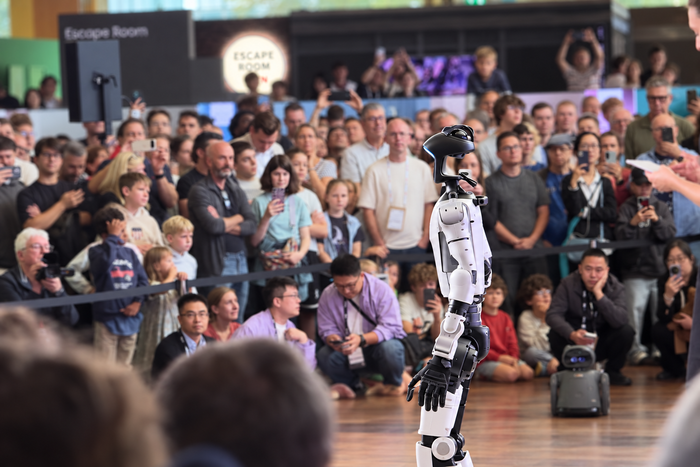
The robots at IFA 2026 didn’t try to look human — and that was the point
Walk the floor of IFA in Berlin this year and the dominant story wasn’t the humanoid robots that dominated headlines for the past three years. It was something quieter and, frankly, more consequential: Chinese companies showing off machines that do specific tasks in your home and yard with little to no human intervention.
A robot vacuums your mattress and shakes your bedding while running UV-C sterilization. Another reads your entire garden in 3D and mows the edges without buried wires or boundary markers. A third floats on your pool surface, scooping leaves while a fourth dives below to scrub walls and the waterline. A flying camera follows you through a soccer match and edits the highlights automatically.
These are not futuristic concepts. Several are already on sale or have launched in limited markets. The message from China’s robotics companies is blunt: stop building robots that look like people and start building robots that finish jobs.
The factory was only ever the training ground
For years, the robotics narrative ran in one direction. Start with the factory floor — dangerous, repetitive, precisely bounded work — then gradually extend the range until robots could fold laundry or walk into your living room. Boston Dynamics’ Atlas, Tesla’s Optimus, Figures AI: all gambled that the path to general-purpose robotics went through humanoid form factors.
China’s companies appear to be taking a different route. Rather than betting on the humanoid as the ultimate end state, they’re treating it as one possible architecture among many — and in many cases choosing wheels over legs, dedicated tools over universal hands.
Two industrial humanoid robots at IFA — MagicLab’s MagicBot D1 and XGSynBot’s XG Z1 — abandoned legs entirely. They run on wheeled platforms with articulated arms bolted on top. The logic is almost cheeky in its pragmatism: why build something that walks when what you actually need is something that transports parts between workstations?
“Most Chinese companies focused heavily on expanding the scope of what robots do at IFA 2026,” one China-based robotics executive told our correspondents in Berlin. “Through varied experiments, robots as well as home appliances and cars will evolve in directions that reduce human involvement even further.”
Who wins, who loses
The companies making this pivot are mostly Chinese or China-linked. Eufy (Anker), Aiper, WYBOT, Creatulize, YARBO, XbotGo — these are names most English-language readers won’t recognize yet. They’re also, importantly, not the companies that dominate Western conversation about robotics. That gap matters.
Western brands have been locked in a different race. Boston Dynamics and Agility Robotics pushed humanoids. iRobot owned the robotic vacuum category for two decades before Chinese entrants eroded its market share. DJI dominated drone photography but hesitated to double down on autonomous follow-cam technology until HOVERAir forced its hand at IFA.
The Chinese firms that showed up in Berlin share something their Western counterparts often lack: the willingness to ship products to real homes, not just demos to investors. Eufy’s garden robot has been selling in Europe since May. Creatulize’s bed-cleaning X1 Pro launched in Japan last month through the Mackakake platform. Aiper and WYBOT are already shipping pool robots that handle tasks earlier generations required multiple machines to complete.
Western humanoid startups, meanwhile, remain largely in the demo-to-production limbo. Figures AI has secured partnerships but hasn’t deployed at scale. Tesla’s Optimus has not been sold to consumers. The gap between announcement and installation is where Chinese robotics companies are building moats right now.
The task-completion metric
The conceptual shift at IFA was arguably more important than any individual product. The evaluation criterion for robots changed from “can it move like a human?” to “can it finish the job without a human stepping in?”
Consider the traditional robotic lawn mower. Older models required buried boundary wires and periodic manual trimming along edges — the very tasks that made them frustrating for homeowners. The new generation uses cameras and LiDAR to map gardens in 3D, identifies edges algorithmically, and cuts them without infrastructure. Segway Navimow does this by extending its cutting blade from the side of the unit. It’s a small mechanical change that represents a big philosophical one: the robot is adapting to the world, not demanding the world adapt to it.
YARBO went further with its M series, which uses a tracked chassis as a mobile base and swaps modular attachments for season-specific work — grass in summer, leaves in autumn, snow in winter. One machine, four months of yard labor. That’s the kind of value proposition that doesn’t require a humanoid face.
The sports-filming category follows the same logic. XbotGo’s Falcon recognizes ten or more sports types, tracks players and ball movement, rotates a 360-degree gimbal, records 4K video, and auto-edits highlights. A human camera operator does some of this. The robot does it without a break, without missing a play, and without calling in sick. That’s the real competitive advantage — not the AI recognition, but the relentless task completion.
Why this matters beyond Berlin
IFA 2026’s robot runway wasn’t just a product show. It was a declaration that China’s robotics industry has moved past the phase of trying to prove it can build human-like machines and into the phase of proving it can replace specific human labor — starting with the jobs nobody else wants to do.
This is significant for three reasons.
First, the addressable market is enormous and underserved. There are roughly 80 million swimming pools in the United States alone, hundreds of millions of lawns in Europe, and billions of beds worldwide. None of these have been meaningfully automated until now. The companies showing up in Berlin are targeting categories that Western robotics firms largely ignored because they weren’t sexy enough for venture capital.
Second, the supply chain advantage is real and compounding. China manufactures the vast majority of the world’s consumer electronics, actuators, sensors, and batteries. A company like Eufy or Anker doesn’t need to build a new supply chain to produce a robotic lawnmower — it already has one from its vacuum cleaners and submersible pumps. That integration speed is something Western startups cannot easily replicate.
- Third, the data flywheel is already spinning. Every robot that mows a lawn, cleans a pool, or follows a soccer game collects terrain maps, obstacle patterns, and failure modes. That data trains the next generation. Chinese companies are deploying at consumer scale right now. Western competitors are mostly still at the prototype stage. By the time the West catches up to deployment, the Chinese data advantage will be structural, not temporary.
What Western brands are missing
The blind spot isn’t technological genius. It’s strategic focus. Western robotics has been captivated by the humanoid as both metaphor and business model — the idea that one general-purpose body can do everything a person can do. That dream is not dead. But it is expensive, slow, and unproven at consumer scale.
The Chinese approach is less ambitious in appearance and more aggressive in execution. Build a robot that does one thing extremely well. Ship it. Collect data. Expand the category. Repeat across dozens of tasks until the product line looks like a household appliance catalog populated by machines that don’t need humans to operate them.
HOVERAir’s VERSA and DJI’s competing follow-cam demonstrate the point perfectly. Both took a concept that existed in prototype form for years — a camera that autonomously tracks a subject — and turned it into a shippable product. The technology wasn’t new. The willingness to ship it was.
The next move
The companies that win in consumer robotics over the next five years won’t necessarily be the ones that build the most human-looking robots. They’ll be the ones that build the most job-complete robots — machines that take a task from start to finish without requiring a human to pick up where the machine left off.
IFA 2026 showed that China’s robotics industry has found its rhythm in this new paradigm. The question for Western brands is whether they’ll keep racing toward humanoids or start building the machines that are already working in people’s backyards.