Chips Need Water Now More Than Ever — And the Supply Chain Is Nervous
SK Hynix and Samsung's joint presence at Korea's International Water Week is the first time the two giants have exhibited together in a water-industry forum. It signals a quiet but urgent admission: the chip boom runs on something the world is starting to run short of.
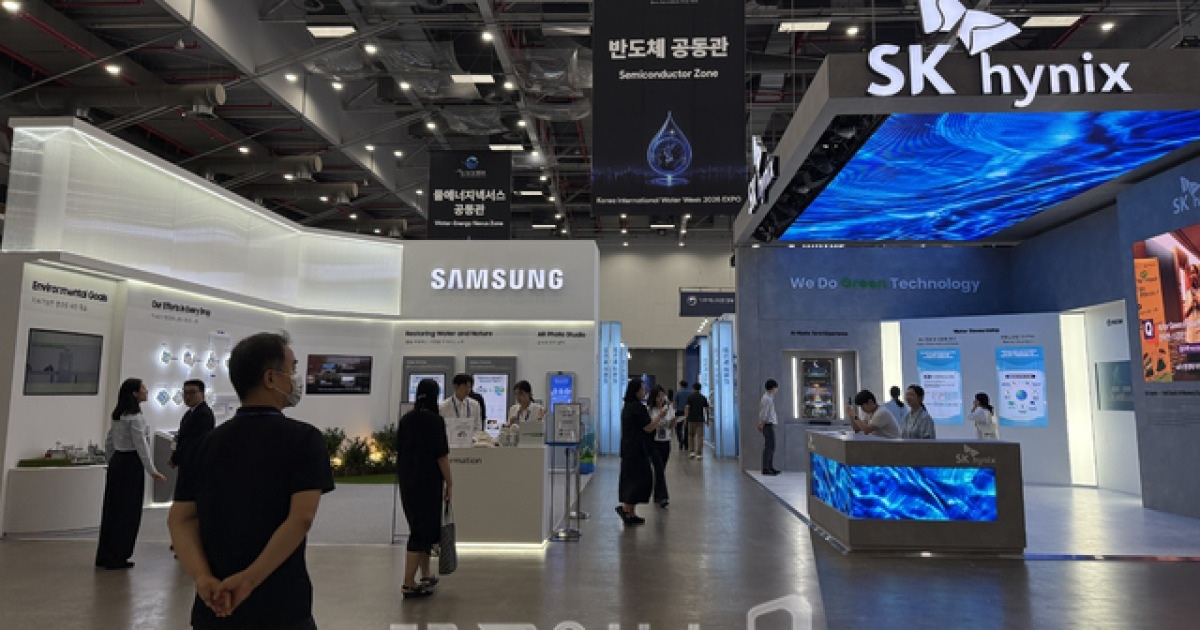
The Booth That Says Everything
At the entrance of the DAEX convention center in Daegu, the first thing visitors saw on September 9 wasn’t a water-treatment giant or a government pavilion. It was SK Hynix and Samsung Electronics, side by side, under a banner that read semiconductor enterprise hall.
This was the Korea International Water Week, an event historically rooted in municipal water infrastructure and environmental engineering. The fact that the two companies that dominate global memory-chip production would step into a water-industry forum as co-hosts for the first time is a signal worth reading carefully.
The theme this year was water, energy, and AI — three sectors that appear unrelated until you look at the input requirements of a modern fab. AI demands memory. Memory demands ultra-pure water. Ultra-pure water demands energy-intensive purification. And every link in that chain is now exposed to climate risk.
The Water Footprint Nobody Talks About
A single advanced-memory wafer requires roughly 1,500 to 2,000 gallons of ultra-pure water during fabrication. Samsung and SK Hynix together produce tens of billions of dollars in memory revenue annually. That translates to hundreds of millions of gallons per year across their Korean and overseas fabs.
The water isn’t just consumed — it’s contaminated at each step. Particulate removal, organic filtering, ion exchange, and reverse osmosis each leave behind brine, chemical sludge, or concentrated wastewater that must be treated before discharge. The recycling rates at leading fabs have climbed to 70 to 85 percent in recent years, but the remaining fraction still requires massive fresh-water intake.
Now add the expansion pipeline. SK Hynix is building a new campus in Icheon, south of Seoul. Samsung is breaking ground on a major logic-fab complex in Pyeongtaek. Both plans call for water-recycling infrastructure that exceeds current national industrial standards. That is why the Daegu event wasn’t just a trade show — it was a matching exercise between chipmakers and the domestic water-equipment suppliers who will build their recycle systems.
The Quiet Bottleneck
What makes this a strategic bottleneck rather than an operational inconvenience is geography. South Korea already faces periodic water stress. The Han River basin, which supplies much of the country’s industrial water, has seen below-average rainfall in three of the last five years. The southern provinces where SK Hynix and Samsung’s new fabs are being built sit in one of the country’s most drought-vulnerable agricultural zones.
The Korean government responded by designating semiconductor water recycling as a priority technology in its 2024 Green Growth Plan. But policy alignment doesn’t solve the physics. A fab that cannot secure reliable water supply during a drought will either curtail production or import water — and neither option scales.
This is the hidden risk for the global semiconductor supply chain. China’s SMIC and Huawei’s HiSilicon have been racing toward advanced nodes. The United States and Japan are reshoring capacity. Every new fab everywhere needs water, and the competition for industrial water permits is intensifying in Taiwan, Arizona, and Saxony alike. The Daegu water week was a Korean snapshot of a global pattern that hasn’t yet entered mainstream semiconductor commentary.
What SK Hynix and Samsung Are Signaling
By co-hosting a semiconductor pavilion at a water conference, both companies are making a calibrated statement: water readiness is becoming a differentiator. Buyers in the AI and high-performance computing space are starting to ask about a fab’s water risk profile alongside its node and yield metrics. Samsung’s memory division has already begun including water-recycling efficiency in its sustainability reports. SK Hynix announced in 2025 that it would achieve 90 percent water recycling across its Korean fabs by 2027 — a target that requires new membrane technology and process redesign, not just incremental upgrades.
The partnership with Korea Hydro & Nuclear Power, also a co-host this year, points to another dimension: energy-water nexus management. Desalination, large-scale reverse osmosis, and evaporation-based wastewater treatment all consume significant electricity. The more a fab recycles, the more power it burns to do it. The exhibition showcased pumped-hydropower and digital-grid integration as potential solutions — a reminder that water scarcity in the semiconductor era is also an energy policy question.
The Small-Company Play
Daegu’s local water-equipment firms stood to gain directly from this dynamic. The city organized matchmaking sessions pairing regional manufacturers with large constructors winning overseas plant contracts. Shinjeong Gikong, a valve and damper maker, said it had been exhibiting at the water week annually and was using the event to convert relationships into orders — particularly with public agencies that account for a large share of domestic water-infrastructure spending.
The city is also pursuing a U.S. National Sanitation Foundation research and testing laboratory in Daegu. Currently, Korean water-equipment manufacturers must ship products to the United States for NSF certification — a costly and time-consuming process that creates a barrier to entry in North American and European markets. A local NSF facility would compress that timeline and position Daegu as a certification hub for Asia-Pacific water firms as well.
That move would serve a second purpose: it locks the regional supply chain tighter to Korean fabs. If Samsung and SK Hynix source water-recycling equipment from Daegu-based vendors who benefit from local NSF testing, they reduce reliance on Japanese and European suppliers who have dominated the ultra-pure water market for decades. It is a subtle but deliberate push toward import substitution in a sector most people don’t realize is critical to chip output.
What Comes Next
Three developments will determine whether this signals a durable shift or a short-term publicity exercise.
First, whether SK Hynix and Samsung can actually hit their 90 percent recycling targets without compromising yield. Water recycling in semiconductors is a tightrope — pushing impurity levels too low increases defect rates on wafers, and defect rates translate directly into margin. The companies have a track record of hitting sustainability targets, but memory production is capital-intensive enough that any water-quality misstep would be immediately visible in earnings calls.
Second, whether the NSF lab gets approved. The Daegu municipal government has been lobbying for this since at least 2024. NSF certification decisions depend on funding commitments, facility specifications, and geopolitical calculus around where to locate critical testing infrastructure for the Asia-Pacific region. A decision this year would accelerate the entire Korean water-equipment ecosystem.
Third, and most broadly, whether the rest of the semiconductor industry treats water risk as a supply-chain factor worthy of board-level disclosure. The dauntless pace of AI-driven memory demand means new fabs are being planned faster than water-permit frameworks are being updated in most jurisdictions. The bottleneck is not yet a crisis — but it is moving from engineering footnote to strategic variable, and the international investment community has barely noticed.
The Daegu water week made one thing clear: the companies making the chips that power the AI revolution are now competing to show they can also manage the water that makes those chips possible. That is not just a Korean story. It is the next constraint on global semiconductor output — and the first sign that water may become the unfashionable limiter of the chip age.