AI's Precision Enzyme: Why Computationally Designed Metalloproteases
A Nature paper reports AI-designed metalloproteases that cut proteins on command — marking a leap from programmable binding to programmable catalysis. The implications stretch from precision drug activation to entirely new classes of molecular therapeutics.
The leap from scissors that find to scissors that cut
Protein design has spent the past decade learning how to make molecules that stick to things. Antibodies, binders, receptor antagonists — the pattern was always the same: compute a shape that nests into a target surface, validate the fit, call it a day. Enzymes were supposed to be harder. Catalysis demands not just a complementary pocket but a precisely positioned chemical mechanism — a metal ion, a proton shuttle, a transition-state geometry all arranged down to the angstrom.
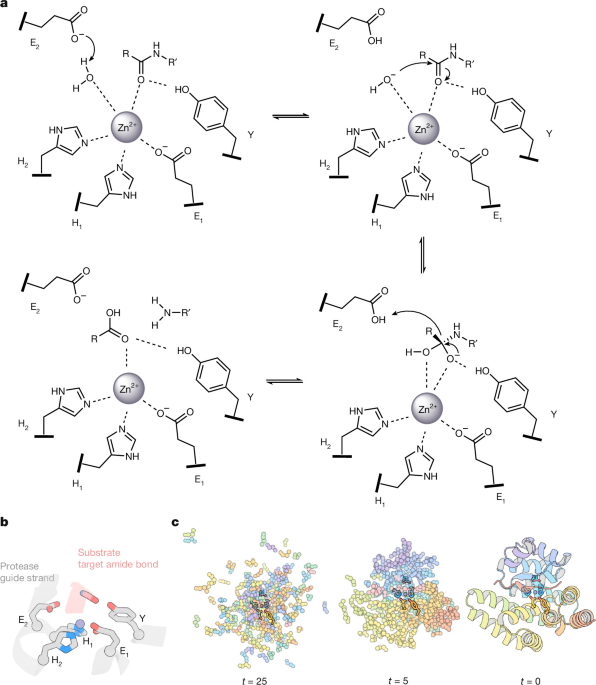
A paper published in Nature this year by researchers at the Institute for Protein Design, led by David Baker and colleagues, demonstrates that the gap is narrowing. The team computationally designed seven distinct metalloprotease variants — molecular scissors that cleave peptide bonds with catalytic turnover, anchored around a zinc ion coordinated in a geometry inspired by natural astacin and thermolysin families. Crystal structures confirmed the designs. The enzymes work.
This is not incremental improvement. It is a regime change in what programmable biology can do.
Why metalloproteases, why now
Metalloproteases are among the most important enzyme classes in biology and medicine. Matrix metalloproteinases regulate tissue remodeling. ADAM proteins process cell-surface receptors. Zinc-dependent hydrolases appear in everything from blood pressure regulation to neurodegeneration. Natural metalloproteases achieve rate accelerations of 10^6 to 10^12 over uncatalyzed hydrolysis — numbers that any synthetic alternative must contend with.
Previous attempts at de novo enzyme design, including the 2018 evolution of a highly active metalloenzyme from short peptides, achieved catalysis but required extensive laboratory screening and evolutionary optimization to reach useful activity. The new work bypasses much of that trial-and-error by embedding the catalytic machinery directly into a computationally optimized scaffold.
The crystallographic data — deposited at the PDB under accessions 11CE, 11CM, 11CP, 11CR, 11CU, 11CY, and 11DU — show that the designed active sites adopt the expected geometries. The zinc coordination spheres, the substrate-binding grooves, the positioning of catalytic residues all match the computational models. That agreement between prediction and reality is what makes this moment significant.
What changes when you can program catalysis
The most immediate implication is therapeutic. Protease-activatable prodrugs exist in principle — the idea is to wrap a drug or cytokine behind a peptide mask that only a specific protease can remove. In practice, the proteases used are natural enzymes with broad specificity and regulatory complexity. A computationally designed metalloprotease with custom cleavage specificity could change the game: activate a therapy only where and when you design it to.
This is not theoretical speculation. The paper’s reference list includes prior work on protease-activatable cytokine prodrugs and conditionally active miniprotein binders. The new designs provide the missing piece — a programmable cutting enzyme that does not exist in nature and therefore cannot be regulated by the body’s existing checkpoints.
Consider antibody-directed enzyme prodrug therapy, a strategy that has struggled for years with the challenge of delivering sufficient catalytic activity to tumor sites without systemic toxicity. A computationally designed metalloprotease offers a clean alternative: the enzyme itself is the therapeutic agent, activated only at the target site, with no reliance on viral expression systems or naturally occurring bacterial enzymes.
Who wins, who loses
The winners are the platforms. Institutes and companies that have invested in computational protein design infrastructure — the Institute for Protein Design, NVIDIA’s involvement through Kieran Didi, the various structural biology beamlines that made the crystallography possible — now have a validated workflow for catalytic enzyme design. The data and code are publicly available on Zenodo, which means anyone with computational resources can iterate on this approach.
The losers are the slow movers. Pharmaceutical companies that treated protein engineering as a screening problem rather than a design problem will face increasing pressure. The cost advantage of computing a custom enzyme versus screening millions of variants shifts dramatically when the computation is right the first time.
There is also a winner in the therapeutic space that has long wanted programmable proteolysis but lacked the tools. Targeted protein degradation, conditional cytokine activation, smart drug delivery — all of these concepts have stalled on the enzyme design problem. That problem is now partially solved.
What comes next
The designs reported here are starting points. Catalytic efficiencies will need optimization. Substrate specificity profiles need mapping across diverse peptide sequences. Immunogenicity of novel protein scaffolds in therapeutic contexts remains an open question. None of these are showstoppers — they are the normal progression from proof of concept to clinical candidate.
The broader trajectory matters more than any single application. This work extends a pattern: RFdiffusion designed protein structures in 2023, then binders in 2024, antibodies in early 2026, and now metalloproteases. Each milestone pushed the boundary of what computational design could achieve. The underlying message is consistent — the space of functional proteins is far larger and more accessible than anyone assumed.
The reference list tells its own story. Papers on phospho-tyrosine peptide binders, RFdiffusion-based biomolecular interaction design, TNFR antagonist generation, and atomically accurate antibody design all point toward the same conclusion: computational protein design is no longer a collection of isolated tricks. It is becoming a general-purpose engineering discipline.
The real breakthrough
The breakthrough is not a single enzyme. It is the demonstration that catalytic machinery — the most demanding functional element in protein engineering — can be placed into a de novo scaffold with atomic precision and retain function. That proof of concept removes a category of problems from the realm of natural evolution alone.
For an international readership, the story that matters is not the technical detail of zinc coordination geometry but the implication: we are entering an era where the molecules that cut, build, and reprogram biological processes can be designed rather than discovered. The metalloproteases in this paper are the first cut. What gets designed next is everyone’s guess.
All data, structures, and code from the study are publicly available, which means the next wave of designs will not come from a single lab but from anyone willing to build on what is now open infrastructure.