Conan's 30th Anniversary Special Signals Franchise's Next Chapter
Detective Conan's 30th anniversary two-hour special unites its largest-ever cast and marks Mai Kuraki's 29th theme song. What the production choices reveal about where this franchise is headed.
The Convergence Play
Detective Conan is 30 years old. In anime terms, that is not merely old — it is prehistoric. The series began in 1996, predating the internet boom, the smartphone era, and most of the creators currently shaping juvenile anime. Few properties in Japanese entertainment survive half a decade without reboots, recasts, or creative exhaustion. Conan is still going.
The 30th anniversary has been building since June, when the franchise pivoted from its usual Friday evening slot for a stretch of crossover specials. A Pretty Cure collaboration came first — a deliberate intergenerational handshake between two cornerstones of Japanese children’s television. Then a J.League crossover, then a Birdman Contest episode tying the show to one of Japan’s most enduring August broadcasting traditions. Each was a goodwill gesture to a different fan constituency. But none carried the weight of what arrives September 25: the two-hour “Case File No. 30” special on Friday Roadshow, accompanied by a new Mai Kuraki single.
This is not a nostalgia episode dressed in vintage aesthetics. It is a structural statement.
The Cast That Was Never Possible Before
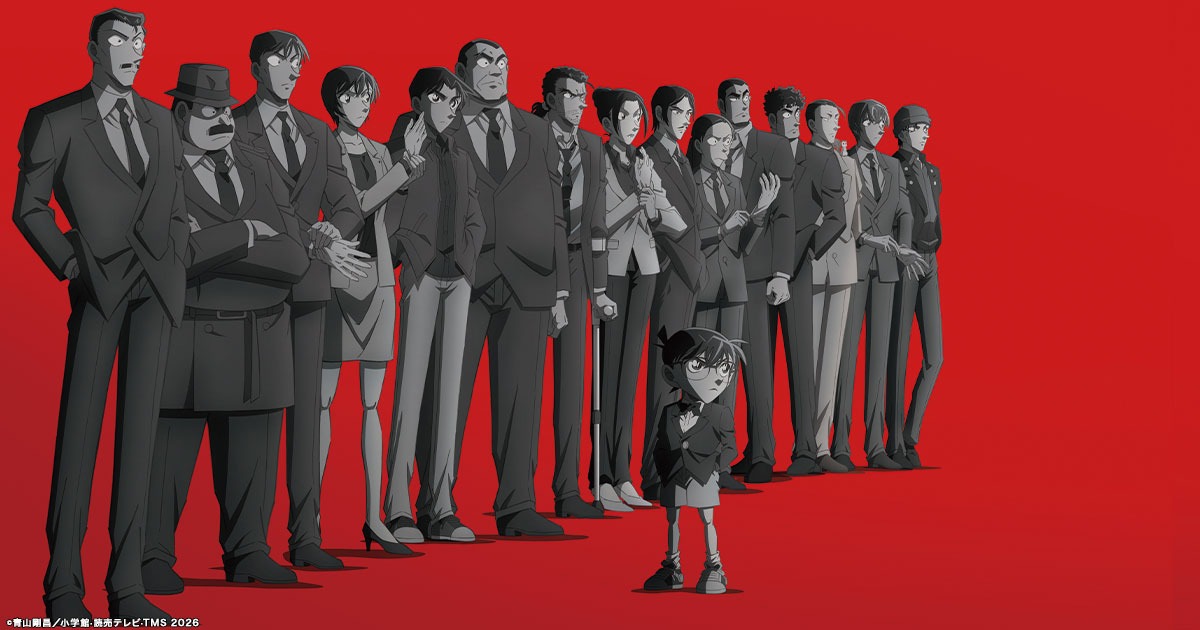
The main visual released this week depicts 16 characters — the largest ensemble ever assembled for a Conan special. The premise justifies the crowd: a counterfeit version of the new ¥10,000 note featuring Shinichi Kudo’s likeness circulates nationwide, prompting the National Public Security Agency and police from across Japan to converge on a series of currency printing facilities. Osaka, Shizuoka, Kanagawa, Nagano, Gunma — each location hosts a regional detective contingent.
What matters is not the geography. It is the fact that this many characters can now share screen time without the production collapsing into chaos. Conan has accumulated an ensemble larger than most television dramas across three decades, but it has rarely had the narrative space to deploy them all at once. The special format — two hours, premium Friday Roadshow slot — removes the constraint. The story required it, and the production delivered.
The voice cast confirmation reads like a roll call of the franchise’s history: Miina Tominaga returns as Conan, Rikiya Koyama as Kogoro, Ry Horikawa as Heiji, Akira Kudo as Akai Shuichi, and Eliza Ikeda as a special guest. This is not a replacement cycle. This is a continuity statement.
Mai Kuraki’s 29th Song and the Franchise’s Soundtrack
Mai Kuraki’s contribution to the special is a new song titled “Hallelujah.” This marks her 29th theme song for Detective Conan, a number that alone defines her position within the franchise. No other artist comes close. Her relationship with Conan spans nearly as long as the series itself — she has been the auditory signature of the property through multiple generational shifts in Japanese pop music.
Her comment on the song is worth quoting for what it reveals about how the franchise understands itself at 30:
“Even in any environment or situation, when you feel like giving up, believe in yourself, accept everything and love yourself — the fact that you exist as you are is a one and only shining star.”
This is not standard J-pop sentiment. It is a mission statement. Conan has always been, at bottom, about people who are isolated and afraid choosing to trust anyway. The Black Organization arc — the serialized backbone running through the entire series — is literally about characters living double lives, separated from everyone they care about, holding onto belief in a truth they cannot yet prove. Kuraki’s lyrics mirror that structure directly: loneliness becoming connection, isolation transforming into shared purpose.
The framing of “Hallelujah” as a song about accepting oneself and finding others through that acceptance is significant because it signals that the franchise is now consciously reflecting on its own mythology. Thirty years gives you that perspective.
The Osaka Arc Returns as Franchise Anchor
September 26 marks the start of a three-episode run adapting the popular Osaka-set arc “Akane no Senkraku,” drawn from manga volume 106. This is the Heiji Hattori and Kazuha Toyama episode, set at the Namba Harmonica building with the sunset viewpoint that has become one of the franchise’s most referenced romantic locations.
Why does this matter beyond fan service? Because the Conan franchise has always balanced two audiences: the mystery-solving casual viewer and the character-relationship obsessive. The Osaka arc serves both. The murder plot keeps the procedural engine running. The Heiji-Kazuha development gives the long-form serialization its emotional spine — a relationship that has been teasingly unresolved for over two decades.
The timing is deliberate. The special and the Osaka run are positioned as a single announcement block, suggesting that the 30th anniversary campaign is not a single event but a sustained push into the franchise’s strongest territory.
What Comes Next
The source material — Gosho Aoyama’s manga, still running in Weekly Shonen Sunday — has never officially ended. The central mystery of the Black Organization remains unresolved after 30 years and well over 1,100 chapters. The franchise exists in a permanent state of suspended escalation, and that is precisely why it endures: it is never closed, never final, always one case away from something bigger.
The 30th anniversary special does not announce a new direction. It announces confidence in the old one. The investment in ensemble casts, in Mai Kuraki’s continued involvement, in premium timeslots and crossover collaborations — all of this points to a franchise that has solved its own survival problem by becoming institutionally embedded in Japanese broadcasting culture. Conan is no longer just a TV show. It is a platform.
The real question is whether the central mystery will ever receive a resolution satisfying enough to justify three decades of investment, or whether the franchise will enter a new phase where the ongoing process itself becomes the product. Either outcome is already being planned for. The ensemble cast in the special visual suggests the former. The sheer scale of the 30th anniversary campaign suggests the latter is being prepared as a contingency.
For now, the fans have a two-hour event, a Mai Kuraki song, and 16 characters on screen. That is more than most franchises get in a single season.