Crimea Bridge Strike Reshapes NATO Strategy Ahead of Trump-Putin
Ukraine's successful missile and drone assault on the Crimea Bridge proves its long-range strike capability has matured beyond early-war limitations. The timing — days before Trump prepares to meet Putin and Xi — changes everything about how allies negotiate next.
Crimea Bridge Strike Reshapes NATO Strategy Ahead of Trump-Putin Summit
Ukraine’s attack on the Crimean Bridge was never going to be a routine operation. It was the proof of concept the West had been quietly waiting for.
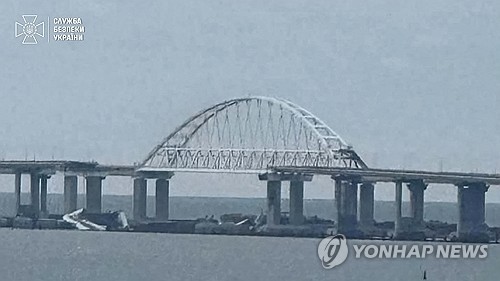
On November 17, Kyiv demonstrated with stark clarity that its indigenous long-range strike system — the Neptune and Flamingo FP-5 cruise missiles — can hit the most heavily defended infrastructure deep inside Russian territory. The seven-phase operation succeeded where earlier 2022–2023 attempts had stalled: a key section of the bridge sank beneath the sea, and roughly 200 meters of the roadway tumbled into the Black Sea. Photos taken from Crimea’s coast captured the skeletal remains of the bridge’s arch above water — the physical evidence that the structure is no longer invulnerable.
This matters because the Crimea Bridge is not just engineering. It is the linchpin of every Russian supply line feeding the southern front. Since Moscow’s 2014 annexation of Crimea, the bridge has been the primary artery through which ammunition, fuel, troop rotations, and equipment move from mainland Russia into the peninsula’s airbases, training ranges, and munition depots. Destroying even one span forces the entire Russian logistical architecture onto roads far less efficient than rail-through-the-bridge operations.
Russia lost ground quickly.
President Volodymyr Zelenskyy confirmed the weapons systems used in blunt remarks ahead of the conflict’s anniversary window. The Kremlin announced immediate reconstruction plans but cannot hide the operational disruption. Transport specialists estimate the full repair timeline at over twelve months — a year during which Russia must divert far more resources southward through vulnerable alternative routes, or accept slower resupply rates to the very fronts fighting in Donetsk and southern Ukraine.
So who wins here?
Ukraine gains something it lacked until this moment: a proven doctrine for hitting deeply fortified Russian logistics nodes. Earlier strikes on the Crimean Bridge in 2022 and 2023 cracked paint but did not penetrate load-bearing sections. Homegrown drones and cruise missiles developed throughout 2024 and 2025 gave Kyiv the range, accuracy, and saturation needed to achieve structural failure. That distinction separates theoretical capability from battle-tested capability — and it shifts NATO planning around future defense cooperation with Ukraine away from aspiration toward credible deterrence.
Britain’s Guardian noted the shift directly. BBC analyst Mark Mardell framed the bridge collapse as tangible proof that Ukraine now possesses the capacity to breach Russian defensive perimeters and threaten facilities Moscow itself treats as sacrosanct. The symbolism cuts across both domains: Putin built the Crimean Bridge as the ultimate monument to Russian restoration after the 2014 seizure, and it has just been struck harder than any symbol he has guarded since the invasion began.
Then comes the timing question that changes how the world reads this strike.
Donald Trump is preparing for face-to-face talks with Vladimir Putin and Chinese President Xi Jinping in the coming weeks. A strike of this magnitude, executed so close to those planned negotiations, introduces friction into diplomatic channels that were already tilted toward de-escalation language. Russia will feel cornered. Kyiv will feel vindicated. Europe will reassess whether NATO’s eastern flank can rely on Ukrainian battlefield success alone to sustain deterrence if American diplomatic leverage shifts suddenly.
China’s position deserves scrutiny too. Beijing watches Ukraine’s weapon development with interest precisely because it confirms something Shanghai does not publicly acknowledge: smaller states equipped with sufficiently advanced indigenous systems can degrade great-power logistical infrastructure without triggering direct confrontation. The lesson applies on Taiwan Strait scenarios as much as it does in the Black Sea. Neither capital will call it out explicitly, but the implication shapes procurement priorities and risk assessment alike.
Europe’s response will come fast and slow in equal measure. Germany and France have already signaled readiness to support continued long-range weaponry programs. Poland and the Baltic states are pushing for broader targeting permissions within NATO frameworks. Turkey — controlling access to the Black Sea — is recalibrating security posture based on how frequently Russian supply lines can now be disrupted from Ukrainian launches originating in western territories previously considered safe.
The bridge repair itself becomes a secondary narrative worth tracking. Even a partial tunnel-through operation, completed with Russian speed and Soviet-era improvisation, would restore limited capacity far faster than an eight-year original build. Expect modular concrete spans deployed incrementally while parallel rail detours carry the bulk of forward combat traffic. That means the physical bridge matters less than what the attempt reveals: Russia can absorb tactical losses but cannot reconstitute strategic infrastructure without severe resource diversion.
Kyiv’s message is clear. Moscow’s message will be denial followed by escalation rhetoric. Trump’s team faces the hardest calculation — whether to lean into pressure against Putin with visible Ukrainian successes, or use those same successes as bargaining chips during forthcoming summits.
NATO planners read the footage now and understand two things simultaneously: Ukraine’s strike capability is real enough to reshape Eastern European defense mathematics, and America’s diplomatic posture will determine whether that capability translates into negotiated leverage or contested stalemate.
The bridge didn’t fall because of one missile. It fell because years of indigenous weapon development converged with wartime experience into a usable strategic tool. What happens next depends on whether Washington interprets that outcome as encouragement to keep backing Kyiv’s offense — or as proof that diplomacy should replace firepower before either side exhausts it.