DMZ Landmine Blast Raises Stakes for Inter-Korean Ceasefire
A landmine explosion south of the DMZ has left South Korea certain the device was planted by the North — a finding that could force Seoul into a response the two sides swore off last year.
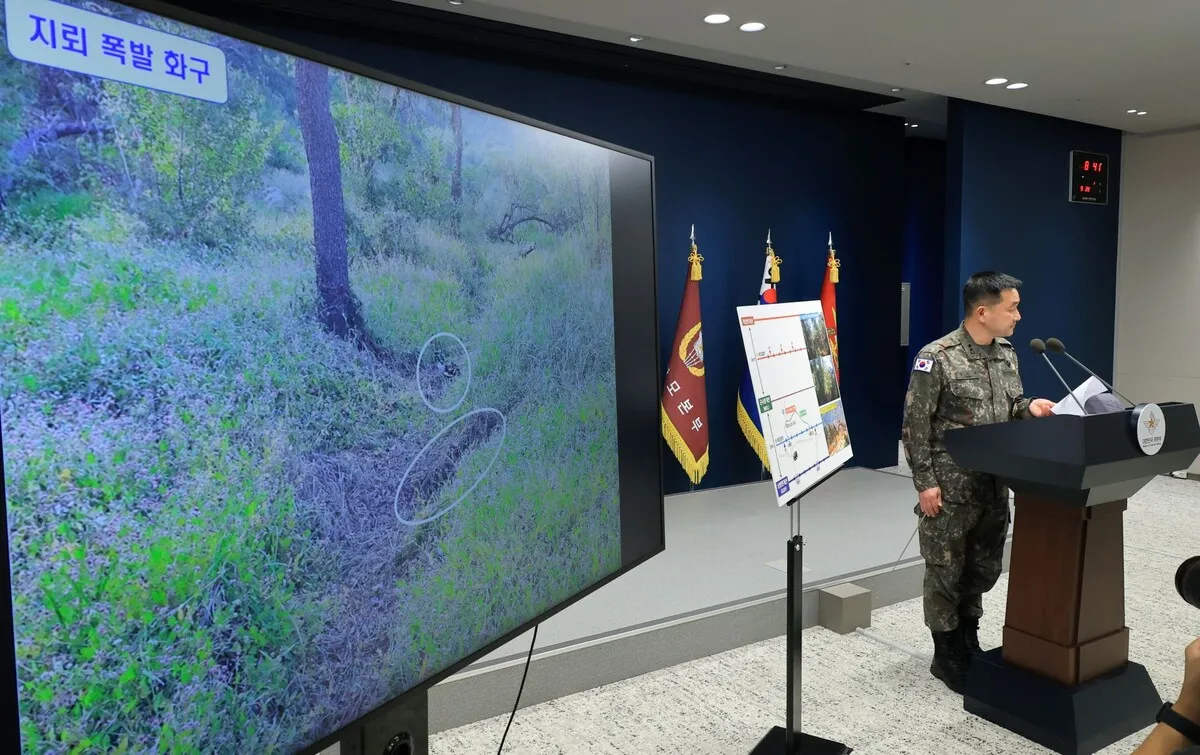
A Blast South of the Line
On the western front of the Demilitarized Zone, two landmines detonated within a South Korean military patrol. Two soldiers were injured. One additional device was found unexploded during the withdrawal. The Joint Chiefs of Staff announced its preliminary findings on the 28th, and the conclusion is stark: the mines were almost certainly planted by North Korea.
The forensic evidence is specific. The National Forensic Service detected TNT residues and brown-colored particulate matter at the blast site — consistent with the resin-cased anti-personnel mines the North has used for decades. South Korean service mines, by contrast, produce iron fragmentation signatures that were entirely absent here. There are no South Korean mine-laying records for the area. What does exist is a September 2025 observation by North Korean troops actively planting devices near the same sector.
The explosion point itself fell roughly ten meters south of the Military Demarcation Line — inside the zone where South Korean forces conduct routine operations but outside the immediate No-Fly/No-Drive corridors that both sides agreed to respect under the 2018 Panmunjom military accord.
What Happened Is Less Important Than What Comes Next
The more consequential detail in the Joint Chiefs briefing was not the forensic outcome but the language used to describe it. Acting JCS Chief Kwak Dae-won stated that if final investigation confirms the injuries were caused by North Korean-planted mines, South Korea will implement “appropriate and corresponding measures” — 한미동맹 대응 조치.
That phrase is deliberate. It signals that Seoul is preparing a response framework without yet defining its shape. The ambiguity is strategic: it keeps Pyongyang guessing while leaving Washington room to weigh in. But it also creates a timeline. Final forensic results are expected in coming weeks, and when they arrive, the clock on what Seoul calls a proportional response will begin.
The 2024 Agreement Now Under Stress
In May 2024, South and North Korea signed an agreement promising to observe a non-aggression pact along the western border and to cease all hostile acts, including the planting of propaganda leaflets and the firing of artillery across the MDL. That accord was already fraying. Incidents had been reported throughout 2024 and early 2025. But a confirmed landmine attack by North Korean personnel on South Korean troops — inside what both sides acknowledged as a reduced-tension zone — represents a qualitatively different breach.
If Seoul treats this as a violation of the non-aggression agreement, the question becomes whether the response should be military, symbolic, or diplomatic. A limited kinetic strike on the mine-laying position would carry escalation risk. A ceremonial military drill near the MDL would send a message without crossing a threshold. sanctions or suspension of any remaining cross-border channels would伤 the political relationship without endangering lives.
Each option carries its own second-order consequences. A kinetic response could trigger North Korean artillery retaliation toward civilian areas just kilometers from the border. A restrained response could be read in Pyongyang as weakness, encouraging further probing actions. Doing nothing risks normalizing the mincing of South Korean soil by North Korean devices — a precedent that undermines the entire post-armistice security architecture.
Who Wins, Who Loses
For Pyongyang, the calculus is opaque. The mines were planted in an area where South Korean patrols are routine. Deliberate placement near active patrol routes suggests either a warning shot — a demonstration of capability and willingness to violate the non-aggression pact without triggering full-scale war — or an operational mistake, where North Korean engineers misidentified the location of existing South Korean minefields.
The JCS has ruled out the South Korean-mine theory with reasonable confidence, but a small probability remains that the device was older, left behind from previous conflicts, and triggered accidentally during a routine patrol. The timing — near the anniversary of the Korean War armistice and amid heightened tensions over North Korea’s deepening military ties with Russia — makes accidental detonation less plausible but not impossible.
For Seoul, the political cost of inaction is high. The government faces domestic pressure to respond, particularly from conservative factions that view the 2024 non-aggression agreement as a concession that has been tested repeatedly. For President Yoon’s successor whoever that is the DMZ incident will serve as a test case for how firmly South Korea can uphold its side of a fragile border deal when that deal is violated.
What English-Language Readers Miss
International coverage of inter-Korean tension often treats the DMZ as a static frozen-conflict zone. The reality is that the western front remains one of the most actively monitored and occasionally manipulated sections of the border. North Korea has used mine-laying, balloon propaganda, and artillery drill rotations as calibrated signals — each designed to communicate resolve without crossing into open warfare.
This incident fits that pattern. The mines were placed in a location that maximizes political impact while minimizing the risk of immediate large-scale retaliation. Whether that strategy succeeds depends entirely on how Seoul responds, and whether Washington — which has not yet issued a public statement — influences the calculus.
What Happens Next
The JCS will complete its forensic review in the coming weeks. The final determination on responsibility will either confirm the current assessment or leave room for diplomatic maneuvering. South Korea’s “corresponding measures” framework will likely be activated regardless, because the political necessity of demonstrating resolve outweighs the strategic benefit of restraint in this context.
The non-aggression agreement signed in 2024 may survive this incident if Seoul chooses a measured response. It may accelerate into irrelevance if the retaliation is forceful and Pyongyang retaliates in kind. Either outcome reshapes the security landscape around the Korean peninsula in ways that extend well beyond the DMZ itself.
What is clear is that the blast was not an isolated event. It is a symptom of a border agreement that has been under sustained pressure for months, and a military posture on both sides that treats proximity to the MDL as a domain of continuous low-level competition rather than a zone of de-escalation.