DMZ Mine Blast Marks Possible North Korean Tactical Shift
Two explosions injured 18 South Korean soldiers near the DMZ on September 21, in what analysts say could be the most serious North Korean probing operation since the 2015 mine incident. The question now is whether Pyongyang is changing its rules of engagement along the border.
A Mine Blast in the Weeds
On the morning of September 21, 2026, a South Korean Army reconnaissance unit of 18 soldiers moved through dense brush along the western front near Paju, just south of the Military Demarcation Line. They were clearing a new patrol route — a routine enough task, but one that carries constant risk in a zone where North Korean forces have been laying mines for decades.
The first explosion hit at about 10:50 a.m., striking the sergeant at the very front of the column. He was a combat engineer, wearing a landmine-resistant boot and protective gear. The blast wounded him severely. The battalion commander, a lieutenant colonel, moved toward him to assess the situation — and triggered a second explosion.
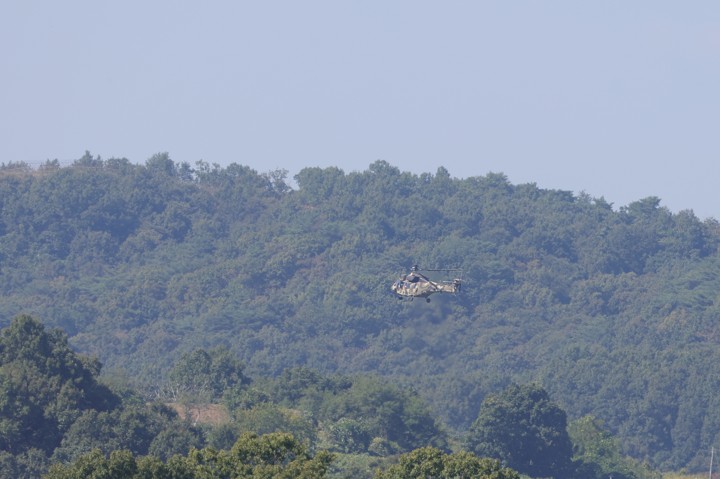
Two soldiers ended up critically injured and were hoisted by medical helicopter to Seoul National Military Hospital. Sixteen others walked back to the rear fence line and were flown out. All survived.
That the blasts occurred not inside the suspected North Korean minefield but dozens of meters south of it is the detail that matters most.
The Immediate Aftermath
What followed in the minutes after the detonations was a tense and chaotic sequence that has since been reconstructed from bodycam footage and radio transcripts. The unit’s medic, Sergeant Kim Jae-hyun, moved to the first casualty within twelve seconds of the explosion — a response time the military later cited as evidence of rigorous training. But the second blast came barely forty-five seconds later, catching the lieutenant colonel as he crossed the sergeant’s original position. Both wounded men were extracted by a pair of Black Hawk helicopters that lifted off from Camp Greaves under a blanket of low cloud cover.
The second helicopter carried the remaining sixteen soldiers out in a single rotation, a deliberate decision to avoid leaving any troops behind in a zone that could contain more ordnance. Two additional medevac choppers stood by at Paju Airbase on standby, but were not needed. The entire evacuation took seventeen minutes from the first blast to the last soldier clear of the site.
The Gap Between the Lines
South Korea’s Joint Chiefs of Staff confirmed the detonations happened in an area of thick brush, waist-high in places, which created a surveillance blind spot. The Thermal Observation Dome system that normally records everything near the DMZ captured nothing. What it did capture, officials said, was bodycam footage from the soldiers involved — currently under forensic review.
The location is significant. This was south of the MDL, in territory that South Korean forces patrol but that North Korea has long treated as its own buffer zone. The fact that mines were found so far south of the line — outside what Pyongyang would normally consider its planted area — suggests either carelessness or calculation.
There is also the matter of the mines themselves. South Korea uses the M14 anti-personnel mine, which the military says is largely defused by proper protective equipment like landmine boots. The injuries here were severe despite full gear, pointing toward a more powerful device — consistent with North Korea’s wooden-cased “mokhum” landmine, which has a reputation for causing devastating wounds because it lacks a metal casing and is harder to detect with standard mine-detection equipment.
Not every official is convinced the mines originated from North Korea. A Defense Ministry spokesperson noted that a stream runs through the area and that mines could have been washed downstream from upstream positions. That is a plausible explanation, but it does not explain why the suspected minefield was located so far south of the MDL in the first place.
What Comes Next
The Armed Forces Medical Science Institute has been asked to examine evidence — boots, protective gear, soil samples — to determine whether the explosives were North Korean or South Korean in origin. Initial results are expected next week.
Separately, the UN Command plans to send a joint investigation team to the site in early October, the first time such a team would have accessed this particular area since the incident. The military also said it notified the UN Command and the nearby North Korean side before inserting helicopters into the zone, broadcasting the message in Korean, Chinese, and English over loudspeakers from a guard post.
That broadcast — “부상자가 발생해 직승기가 들어간다” — was a deliberate act of transparency, not procedural formality. In the past, South Korea has faced international criticism for delayed or opaque medical evacuations across the DMZ. The difference this time is notable.
The 2015 Precedent
The last major mine incident on the Korean Peninsula occurred in April 2015, when a South Korean soldier was killed and three others injured after stepping on a North Korean wooden-cased mine in the western DMZ. That event triggered a major crisis: South Korea tore down propaganda loudspeaker sites along the border and suspended most inter-Korean cooperation, while Pyongyang denied responsibility.
What makes the 2026 incident different is scale and proximity to the line. In 2015, a single soldier was injured by a single mine. On September 21, a whole unit of 18 was targeted — or at least endangered — by at least two separate explosions in quick succession. That suggests a broader, more deliberate mine-laying campaign than the occasional planting that has characterized border activity in recent years.
Second-Order Effects
The incident is already reshaping posture on both sides of the border. South Korea’s Special Operations Command has been placed on heightened alert, and additional mine-detection sweeps have been ordered along the entire western sector of the DMZ — a process that could take weeks and require the temporary redeployment of troops from other posts. The U.S. Eighth Army, which oversees American forces in South Korea, issued a statement on September 22 expressing “grave concern” and calling for restraint, a measured tone that defense analysts interpreted as Washington urging Seoul not to escalate.
North Korea has not publicly commented on the blast. That silence itself is noteworthy. In 2015, Pyongyang denied any involvement within hours; the absence of a response this time could indicate internal deliberation or a deliberate choice to avoid adding fuel to an already volatile situation. Chinese state media has remained largely silent as well, though Seoul’s intelligence community has reportedly briefed Beijing on the incident through diplomatic channels.
Japan’s defense ministry issued a statement expressing deep concern and calling for North Korea to cease provocative acts, while the European Union released a brief remark urging both Koreas to exercise maximum restraint. The incident has also reignited debate within South Korea about whether the country should accelerate its acquisition of anti-personnel mine detectors and deploy drone-based survey units in the most sensitive sectors of the DMZ — options that have been debated but not fully implemented for years.
The Strategic Picture
This is not just a South Korean-Korean dispute. The DMZ remains the most heavily fortified border in the world, and any change in North Korea’s behavior there reverberates through the security architectures of the United States, Japan, and China. The UN Command’s planned October investigation is a small but symbolically important act — a reminder that the armistice still technically governs this space, even as both sides quietly erode its terms.
For now, the South Korean military is treating this as an active investigation, not a declaration of intent. But the pattern is clear: North Korea is testing how far south it can push its minefields without triggering a full-scale response. The question is whether South Korea and its allies treat each incremental violation as a separate incident — or as part of a coherent strategy.
The answer will shape the next chapter of stability on the Korean Peninsula. If the investigation confirms that Pyongyang deliberately placed mines south of the MDL, as most analysts suspect, it would represent the most aggressive border provocation in over a decade and likely force a recalibration of South Korea’s entire defensive posture. If the mines are determined to be residual from earlier plantings, as the Defense Ministry’s stream hypothesis suggests, the incident could still serve as a warning that North Korea is willing to exploit ambiguities in the armistice zone — a form of灰色地带作战 that has become increasingly common in the years since the last major crisis.
Either way, the soldiers who walked away from those two explosions carry a question that no amount of briefing or training can fully answer: how far is too far, and who decides?