Empty Space Is Not Empty: A 90-Year Prediction Finally Confirmed
A magnetar's trillion-times-Earth magnetic field has provided the strongest evidence yet that quantum electrodynamics predicted in 1936 — that empty space can act like a prism. The result opens a new window into physics at extremes no laboratory can replicate.
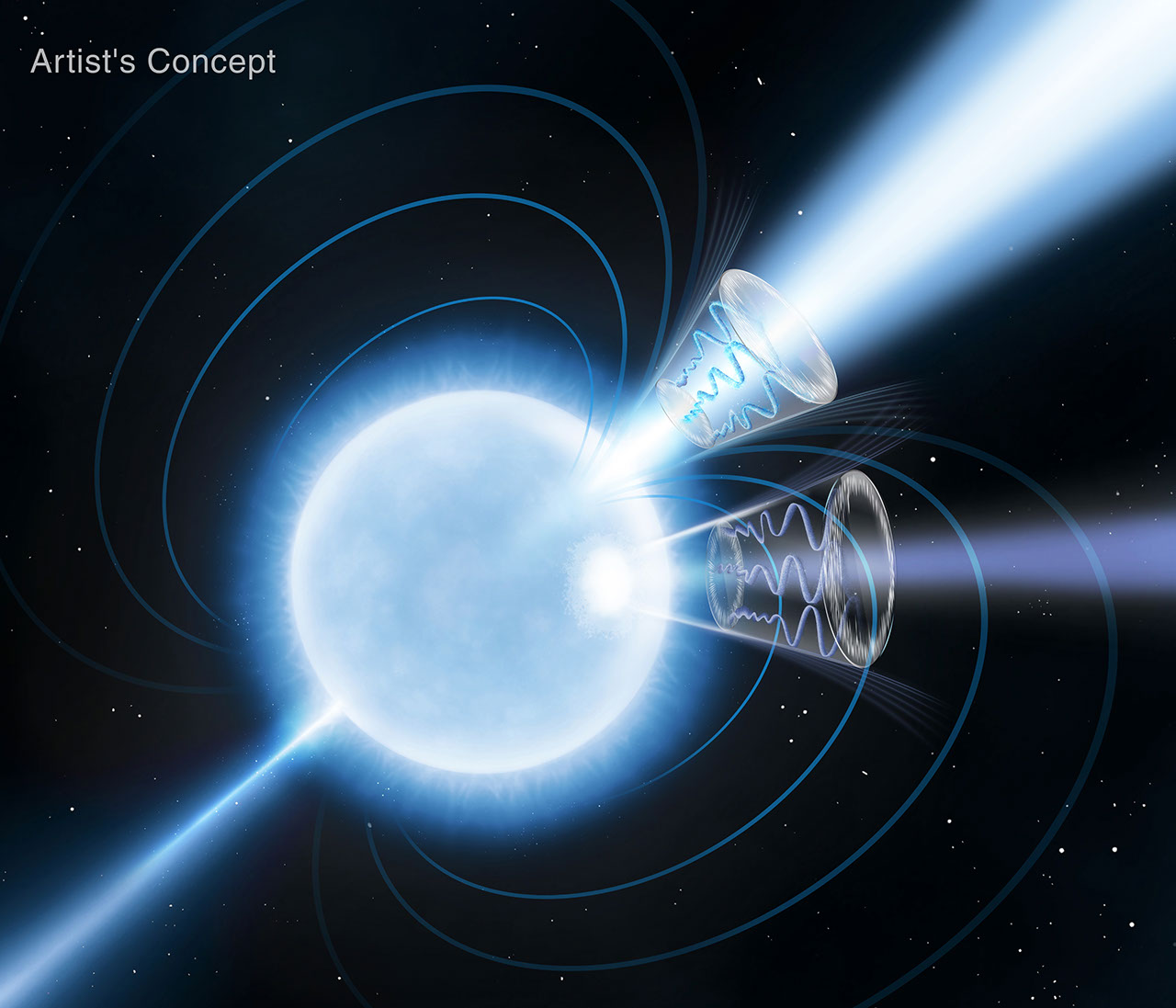
A Star That Turns Space Into Glass
For most of human history, empty space meant absence. No air. No matter. No medium at all. Light traveled through it cleanly, obeying Maxwell’s equations in their simplest form. Werner Heisenberg and Hans Heinrich Euler figured out in 1936 that this picture was incomplete.
They showed — before the modern formulation of quantum electrodynamics existed — that a sufficiently strong magnetic field would make the quantum vacuum respond differently to different polarizations of light. Empty space would acquire an effective refractive index, behaving like a crystal. Two polarization modes would travel at slightly different phase velocities. Light passing through would emerge altered.
They called it vacuum birefringence. Nobody could measure it. Not because the prediction was wrong — though age alone is never proof — but because no terrestrial magnet comes close to what a magnetar carries.
On August 5, 2026, a paper in Nature ended the long wait.
The Object at 13,000 Light-Years
The star is 1E 1547.0−5408, a magnetar located roughly 13,000 light-years away in the direction of the galactic plane. It is about the size of a city — a neutron star, the collapsed core of a massive star that died in a supernova long before humans existed. It packs more mass than the Sun into a sphere roughly 20 kilometers across.
Its magnetic field sits at the equator near 2.2 × 10^14 gauss, or about 22 billion tesla. For comparison, the strongest steady hybrid magnets on Earth produce 45 tesla. Pulsed laboratory fields briefly exceed that, but a magnetar is billions of times stronger. Its field exceeds the QED critical field — about 4.4 × 10^13 gauss, the threshold where magnetic energy spacing becomes comparable to an electron’s rest mass — by roughly a factor of five.
At that strength, the quantum vacuum is no longer a passive backdrop. The photon interacting with the magnetized vacuum acquires an effective refractive index that depends on how its electric field is oriented relative to the background field. Two eigenmodes — ordinary and extraordinary — propagate with slightly different indices. The vacuum becomes birefringent.
What IXPE Actually Saw
The Imaging X-ray Polarimetry Explorer spent more than 140 hours watching 1E 1547.0−5408 between late March and early April 2025. IXPE does not measure the speed of different polarizations separately. Instead, it counts X-ray photons and records the direction of the electrons they eject upon absorption in its gas detectors. From the preferred direction of many such tracks, researchers reconstruct the Stokes parameters that describe polarization.
Across its 2 to 8 kiloelectronvolt band, the phase-averaged X-rays came in at 46 ± 4 percent polarized. In the softer 2 to 3 keV band, the degree climbed to 59 ± 5 percent. A joint spectral model placed the thermal component at 65 ± 8 percent at 2 keV. When the data were sorted by rotational phase, the polarization peaked at 82 ± 15 percent in the 2 to 3 keV band.
Those numbers are striking, but polarization alone would not settle the question. Radiation emerging from a strongly magnetized neutron star atmosphere can already be highly polarized. A small hot region on the surface produces a different net signal than a full glowing hemisphere. The challenge is geometry — where the hot region sits, how the magnetic and rotation axes tilt relative to each other and to our line of sight, and what happens to the photons as they climb out through the magnetosphere.
The Radio Signal That Closed the Loophole
Here is where the observation became decisive. 1E 1547.0−5408 is also a persistent radio pulsar. Its radio beam sweeps across Earth every 2.09 seconds. The rotating-vector model applied to the radio polarization produces a characteristic sweep in polarization angle that traces the projected direction of the large-scale magnetic field.
Murriyang, the Parkes telescope in Australia, observed the radio pulses simultaneously with IXPE. This was the first coordinated radio and X-ray polarimetry campaign on a magnetar. The radio data revealed a smooth polarization-angle sweep. The X-ray angle made a similar sweep — offset in rotational phase and differing modestly in reference angle, likely because the X-rays escape from a different altitude than the radio, or because the field lines are somewhat twisted.
The radio beam matters because it fixes the geometry independently. Without it, X-ray polarization data alone would leave too many free parameters. A researcher could always find a favorable viewing angle and an implausible hot-region shape that reproduced the signal without invoking any new physics. The radio polarization ruled out those Convenient Fits.
When the team ran Monte Carlo radiative-transfer models including a strongly magnetized neutron-star atmosphere, relativistic light bending, and the QED vacuum response, the best description emerged from an offset, wedge-shaped hot region. The model reproduced the intensity and the polarization while remaining compatible with the nearly aligned magnetic geometry the radio constrained. When vacuum birefringence was switched off, the polarization fits degraded substantially, or the preferred geometry conflicted with the radio constraints.
How the Vacuum Preserves Order
The mechanism is subtle. A thermal hot region contains many emitting patches, each with its own local magnetic-field direction. General relativity bends some rays around the compact star, so an observer receives light from more of the surface than flat-space intuition would suggest. If every photon’s polarization direction froze immediately upon leaving its surface patch, the unresolved telescope would add together many differently oriented contributions. Much of the linear polarization would cancel.
In a birefringent magnetosphere, the two polarization eigenmodes remain decoupled and their orientations follow the changing local magnetic field adiabatically as the photons move outward. For the conditions in this analysis, this continues to a polarization-limiting radius tens to hundreds of stellar radii from the surface. By that distance, adjacent rays sample a larger-scale magnetic geometry whose directions are more coherent than the patchwork at the surface. Their polarization vectors become effectively fixed only after this alignment has been preserved.
The vacuum has not generated additional polarized photons. It has carried an ordered imprint of the magnetic field out through a region where ordinary propagation would allow the unresolved directions to wash one another out. IXPE detected that carried order.
Why This Matters Beyond a Single Star
The paper does not claim final proof. The inference rests on a chain — radio polarization constraining geometry, atmosphere models predicting surface emission, general relativity setting ray paths, magnetospheric calculations determining polarization evolution — and the best-fit geometries from different parts of the analysis are not identical. The authors discuss possible non-dipolar field structure and different emission altitudes, noting the discrepancy deserves more study.
That honesty is the signal’s strength. The earlier 2017 claim from the isolated neutron star RX J1856.5−3754, based on optical polarization, could not rule out alternative interpretations because the star’s geometry and emission mechanisms were poorly constrained. The 2022 IXPE measurement of 4U 0142+61 showed energy-dependent polarization consistent with QED effects, but that single magnetar did not provide the same geometric lock.
What 1E 1547.0−5408 offers is the convergence of three independent constraints — X-ray polarization degree and angle, their phase dependence, and the radio polarization sweep — all within a single model framework. That combination is far harder to imitate with surface physics alone.
The implications extend beyond magnetars. IXPE’s first polarization study of a white dwarf used the same basic observable to infer an accretion-column geometry too small to resolve directly. Polarimetry does not produce a conventional picture. It exposes orientation and order that intensity measurements hide. As the instrument suite grows and more coordinated campaigns accumulate, the quantum vacuum stops being a theoretical construct and becomes an observable medium.
The 1936 prediction has survived 90 years. The magnetar delivered the test it always needed — not because the physics was uncertain, but because the universe had to build the right instrument first.