Why Japan's Phobos Sample Return Could Rewrite Mars History
JAXA's MMX mission launches Oct. 20 to attempt the first-ever sample return from a Mars moon — a bet that could reshape our understanding of the Red Planet and Japan's place in the global space race.
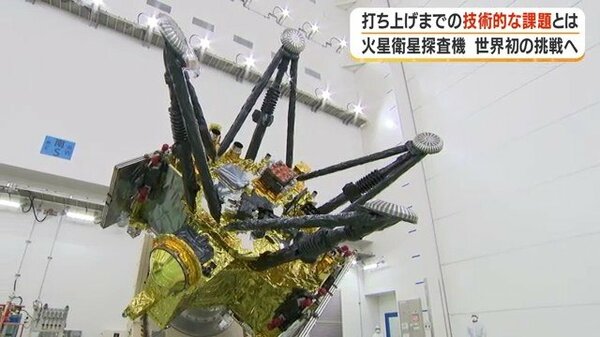
The Quiet Bet on Phobos
Japan is about to attempt something no nation has ever done: land on one of Mars’ moons, scoop up dirt and rock, and bring it home. The Mars Moon eXploration (MMX) mission launches Oct. 20 at 4:41 a.m. from Tanegashima Space Center in Kagoshima aboard an H3 rocket, and if everything goes to plan, a sample capsule will touch down on Earth sometime in 2031.
The destination is Phobos, a lumpy asteroid-like body roughly 20 kilometers across, orbiting just 6,000 kilometers above Mars’ surface. That’s a whisper compared to the 380,000-kilometer gap between Earth and the Moon, which makes Phobos an easier target in one critical sense — but harder in another.
The real difficulty isn’t getting there. It’s landing on something so weakly gravitational that a probe touching down could bounce like a balloon dropped on a trampoline.
Why Phobos and Not Mars?
The answer is simple physics. Mars has enough gravity to make a sample-return launch expensive in fuel and engineering. Phobos has barely any — roughly one-thousandth to two-thousandths of Earth’s gravity, according to JAXA project manager Yasuhiro Kawakatsu. A spacecraft can lift off with a fraction of the energy required to escape Mars itself.
But Phobos isn’t just an easier launchpad. It may also be a better archive.
Scientists believe Phobos’ surface is coated in material blasted off Mars by ancient meteorite impacts — a planetary skin graft of sorts. By analyzing that regolith, researchers could read about Mars’ ancient climate, geology, and possibly even its past habitability, without the immense challenge of landing on the Red Planet itself.
The mission targets two unresolved questions: Where did Phobos come from? And what did early Mars look like?
There are two leading theories for Phobos’ origin. One says it’s a captured asteroid — a cosmic stray pulled into Mars’ orbit. The other argues it formed from debris thrown into space when a massive object struck the young planet, the same kind of collision that likely shaped Earth’s Moon. A sample return could settle the debate definitively.
The Bouncing Problem
Landing on Phobos is unlike anything humanity has attempted before. The probe, MMX, stands about five meters tall and weighs 4.5 tons — a large machine going after a very small target.
Kawakatsu described the challenge bluntly. On Phobos, gravity is roughly one-2000th of Earth’s, he said, comparing the landing dynamics to a balloon bouncing around unpredictably when it hits the ground.
Engineers responded with a widened landing leg design that lowers the center of gravity and uses crushable shock-absorbing materials to dampen whatever impact occurs. The details weren’t fully disclosed in the source report, but the approach suggests JAXA spent years running simulations to map every possible landing scenario.
This matters because a failed landing ends the mission. There is no second chance at Phobos.
Japan’s Sample-Return Reputation Is the Real Payload
Perhaps the most significant outcome of MMX isn’t the science — it’s the diplomatic signal.
NASA and three other Western space agencies are contributing instruments to the probe. That cooperation didn’t happen by accident. It built directly on the success of Hayabusa2, JAXA’s 2020 return of samples from the asteroid Ryugu, which demonstrated precise autonomous landing, sampling, and Earth-re-entry capabilities at a level few expected any nation outside the U.S. and Russia to achieve.
Kawakatsu acknowledged the shift openly. Ten years ago, he said, proposing a Phobos sample return to international partners would have been dismissed as reckless. Today, the same proposal draws serious interest. “I think Hayabusa2 establishing sample-return technology made us the most trusted partner for this kind of mission,” he told reporters.
That trust is Japan’s currency in the current space economy, and it’s worth tracking. As NASA focuses on Artemis and the Moon, and China advances its own Mars sample-return plans (Tianwen-3, targeting a mid-2030s launch), Japan’s niche is precision sample return from small bodies. MMX is the test of whether that strategy holds.
The Local Stakes
Not every key team member is a veteran. One轨道 designer, Hitoshi Ikeda, grew up in Kirishima, Kagoshima — just kilometers from Tanegashima. He watched rocket launches on television as a child and joined JAXA because of it.
“Since I’m launching from my hometown, I’m really happy,” Ikeda said, admitting mixed feelings of excitement and worry. “I want to contribute to the probe getting there safely and coming back safely.”
That personal thread — a teenager from the shadow of a launch pad growing up to plot the trajectory of a Mars mission — isn’t just color. It’s evidence of how deeply Japan has invested in building a homegrown space-capable generation after decades of depending on international partnerships for access to orbit.
What Success or Failure Looks Like
If MMX succeeds, Japan becomes the third nation — after the Soviet Union and the United States — to return extraterrestrial samples, and the first to return material from a Mars moon. The scientific payoffs are substantial: a direct window into Martian surface history, a resolution of Phobos’ origin debate, and a proof-of-service record that strengthens Japan’s hand in future planetary missions.
If MMX fails — and the landing remains the greatest unknown — the cost isn’t just financial. Japan’s credibility as a standalone sample-return operator would take a hit at a moment when it’s trying to carve out strategic independence from NASA. The Chinese Tianwen-3 mission, by contrast, carries implicit state priority and funding certainty. A Japanese setback would widen that gap in perception if not in capability.
There is also a timeline risk. MMX was designed for the 2020s launch window and a 2031 return. Delays push the science past the window when competing data from NASA’s Mars samples — returned by the Perseverance rover and slated for Earth delivery in the late 2020s — may already dominate the field.
The Long View
Kawakatsu put it simply: “We’ve been running together with this probe for ten years, and now it feels like sending off a child.” When asked what he’d say to MMX, his response was almost casual — “Good luck, have fun.” But beneath the understatement was the weight of a decade of work, international negotiations, engineering sleepless nights, and a bet on Japan’s ability to lead rather than follow.
The October 20 launch is only the beginning. The journey to Phobos, the landing, the sampling, the long wait until 2031 — that’s where the real story plays out. But the fact that Japan is attempting a world-first sample return from a Mars moon at all should register as more than a national achievement. It’s a signal about where the next era of planetary science might be centered, and who gets to shape it.