ESO Warns 1.7 Million Satellites Could Blind Astronomy
A new ESO study says mega-constellation plans could deliver a devastating blow to ground-based astronomy. The math is simple: keep satellites below naked-eye brightness and cap the sky at 100,000 units. Current trajectories head far beyond both limits.
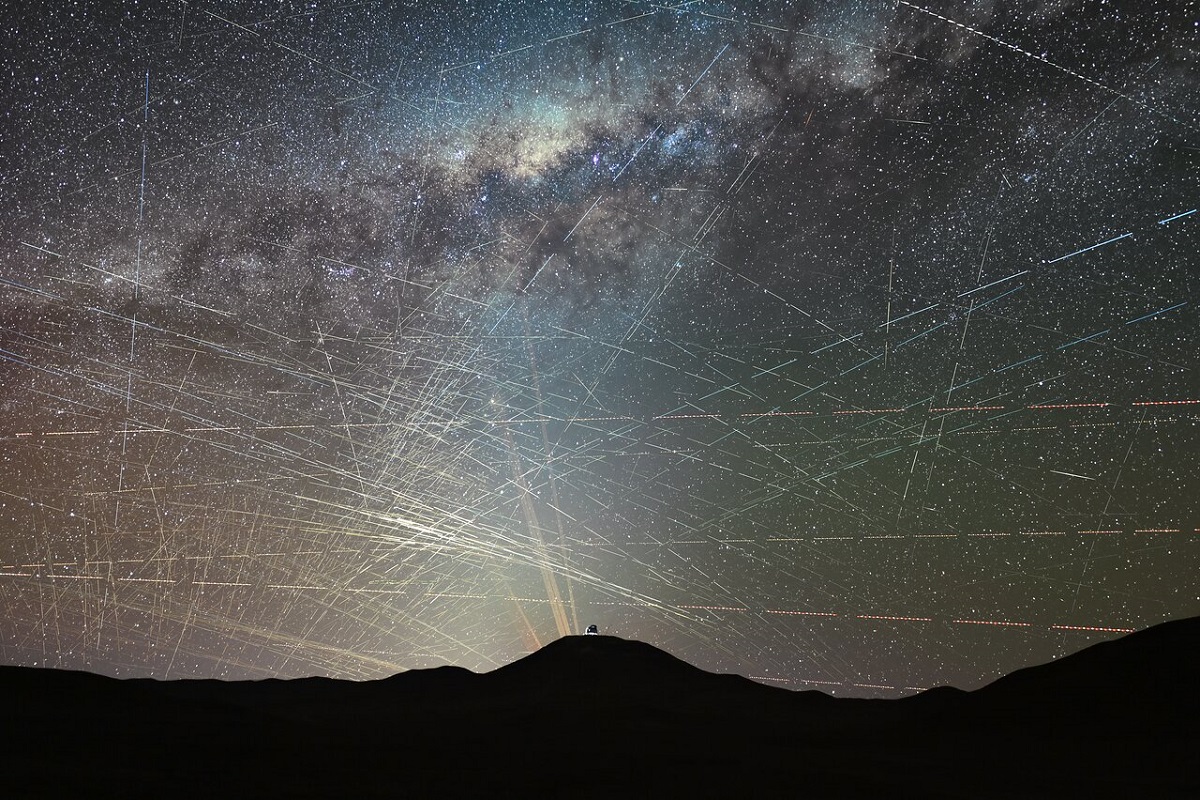
The Sky Is Getting Crowded. And Brighter.
In the Atacama Desert of northern Chile, where the air is thin and the dark is absolute, something is changing above the domes of the European Southern Observatory.
The Very Large Telescope and the under-construction Extremely Large Telescope point their instruments at a night sky that, just two decades ago, offered unprecedented clarity. Now that sky is traversed hourly by bright streaks — artificial satellites catching sunlight long after dusk has settled over the desert floor. A composite image from October 15, 2025, captured roughly two hours after sunset, shows trails cutting across the frame while the ELT dome sits silent below and the VLT’s guide lasers punch upward. The juxtaposition is almost cruel: humanity’s most powerful ground-based instruments, aimed at the deepest reaches of the cosmos, while a new kind of light pollution blazes overhead.
A study led by ESO astronomer Olivier Hainaut, accepted for publication in Astronomy & Astrophysics, quantifies what observatory directors have been saying informally for years. The conclusion is blunt: a fleet of more than 1.7 million satellites in low Earth orbit would deliver a catastrophic blow to ground-based astronomy.
The 100,000-Satellite Ceiling
The study’s prescription is deceptively simple. To protect astronomical observation, satellite operators need to keep their fleets below naked-eye brightness and limit the total number of operational satellites to 100,000. That figure is roughly one-seventeenth of what SpaceX alone has proposed deploying in the coming years.
Right now, according to tracking data from Orbital Radar, approximately 17,501 satellites are actively orbiting Earth. SpaceX’s Starlink constellation accounts for about 10,000 of them — more than half the total. Since 2019, the launch rate has accelerated relentlessly, and the trajectory has not bent.
SpaceX has filed plans to launch another 20,000 Starlink satellites on top of its existing infrastructure. But the Starlink network, already subscribed to in 164 countries by roughly 10.3 million customers, is only the foundation. The company has also submitted applications to place up to one million additional satellites in orbit — a proposal that would transform low Earth orbit into something closer to an orbital data center and wireless power station than a communications network. Reflect Orbital, E-Space with its Cinnamon satellite proposal, and China’s CTC-1 and CTC-2 mega-constellation plans could each add hundreds of thousands more.
The cumulative effect, as the ESO study calculates, is a measurable brightening of the background sky. That may sound abstract until you consider what the ELT is designed to do: image exoplanets, trace the distribution of dark matter, and peer into the epoch of reionization. Each of those science goals requires detecting photons that have traveled billions of years to reach a 39-meter mirror. When the sky background brightens by even a fraction, exposure times lengthen and sensitivity drops — sometimes irrecoverably.
Who Wins. Who Loses.
The economics are clear. The World Economic Forum projects the global space economy will grow from approximately $630 billion in 2023 to $1.8 trillion by 2035 — roughly double the pace of global GDP growth. That growth is built on low Earth orbit as infrastructure, not as wilderness. The commercial argument for massive constellations is rooted in real demand: global internet coverage, Earth observation data, and increasingly, the vision of orbital manufacturing and solar power beaming energy back to Earth.
The scientific loss is harder to monetize but no less real. The next generation of telescopes — the ELT, the Vera Rubin Observatory, the Nancy Grace Roman Space Telescope’s ground-based competitors — are being sited precisely because the Atacama and similar high-desert locations offer the darkest skies left on Earth. Those sites were chosen assuming the night sky would remain, for practical purposes, uncontaminated. The ESO study suggests that assumption no longer holds.
Astronomers who study transient phenomena — near-Earth asteroids, supernovae, fast radio bursts — are particularly exposed. These events demand rapid follow-up observation, and a brighter sky means longer integration times at exactly the moment speed matters most. Planet-hunting programs that rely on detecting tiny dips in stellar brightness face a different but equally damaging threat: scattered light from satellites can masquerade as or obscure the signals they depend on.
The winners, for now, are the companies building the infrastructure. The losers are the institutions that need darkness — and institutions, by their nature, cannot launch their own satellites fast enough to compete.
The Policy Gap
What makes this moment distinctive is that the regulatory framework simply does not exist to enforce the ESO study’s recommendations. There is no international standard for satellite brightness. There is no quota system limiting the total number of objects in low Earth orbit. The 100,000-satellite cap proposed by the ESO team is a scientific threshold, not a legal one — and without legal force, it is advisory at best.
Some operators have begun voluntary mitigation. SpaceX has darkened successive generations of Starlink satellites, and the company’s latest designs appear significantly less reflective than earlier versions. But mitigation that reduces brightness by a factor of two or three falls far short of the gap between current plans and the ESO ceiling. One million satellites, even if each were made nearly invisible, would still overwhelm the 100,000 limit by an order of magnitude.
The deeper problem is structural. Low Earth orbit is being treated as a commons with no rules of the road — a resource that any operator with sufficient launch capacity can claim, with no requirement to account for the externalities imposed on everyone else looking upward.
What Happens Next
The ESO study is the most comprehensive quantitative assessment to date of how mega-constellations affect astronomical observation. Its acceptance by Astronomy & Astrophysics gives it weight inside the scientific community. What it lacks is enforcement mechanism. The next chapter will be written not in peer review but in policy debates at the International Telecommunication Union, the Committee on the Peaceful Uses of Outer Space, and national regulatory bodies that currently govern satellite deployments with little regard for their cumulative sky brightness impact.
For astronomers, the clock is ticking faster than the treaty process. Every year of unchecked deployment moves the target further away — both literally and figuratively. The ELT is still under construction in the Atacama. When it finally begins operations, its scientists will inherit a sky that no previous generation of astronomers ever had to share.