The EU Just Made Its Biggest Bet on Ukraine — What It Changes
The EU's €6.1 billion defense package is its largest single commitment yet, but the real story isn't the money — it's what the scramble to fund it reveals about Europe's defense industrial base and whether it will be enough to change Russia's calculus.
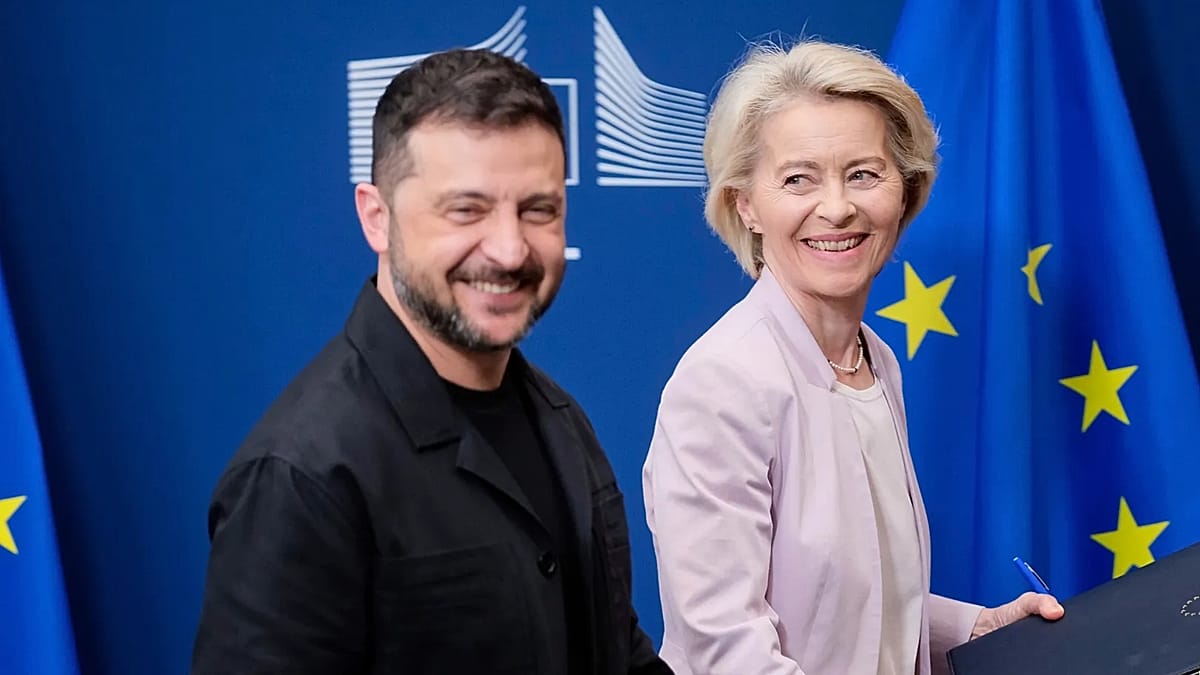
A Number That Should Not Be Normal
The European Union has approved €6.1 billion for Ukraine’s next round of defense procurement. On paper, it is the bloc’s single largest military aid package to date. Tucked inside the broader €90 billion loan facility, it pays for air and missile defense systems, missiles, ammunition and radars — exactly what Kyiv is being pounded with as Russia launched 376 missile strikes in June alone.
But the headline number is almost secondary to what it implies. Europe is no longer debating whether to fund Ukraine’s war of attrition. It is scrambling to figure out how to fill the orders fast enough.
Who Gets the Money, and Why It Matters
The European Commission made clear that most of the procurements will go to European defense companies. This is not incidental. For years, Brussels has preached strategic autonomy while its member states bought more American hardware than anything else. That pattern is shifting, and not quietly. The pressure is literal — Russia’s intensified barrage of ballistic missiles and jet-engine drones has turned “buy European” from a political slogan into an operational requirement.
The timeline explains the urgency. The Coalition of the Willing meeting convenes in Kyiv on 24 August, the same day marking 35 years of Ukrainian independence. European Council President António Costa called solidarity “unwavering” — a word chosen carefully, because the evidence for it is being tested every day. Finland’s President Alexander Stubb and Luxembourg’s Prime Minister Luc Frieden are flying in. Britain’s new Prime Minister Andy Burnham is making his first trip to Ukraine under the framework, and reportedly carrying blueprints for long-range missiles that Kyiv would build itself.
That last detail deserves attention. Britain handing over missile designs for Ukrainian domestic production is not a new idea, but the fact that it is being discussed at the cabinet level signals a qualitative shift. It moves the relationship beyond donor and recipient toward co-production — a structure that changes what happens when Western political winds shift.
The Industrial Base Problem
Here is what the packages make visible, and what English-language coverage usually flattens: Europe’s defense industrial base is not built for this pace of output. Companies like Rheinmetall, MBDA, and Bazalt are running multi-year order books, but scaling production of artillery shells, interceptors and drone-countermeasures takes capital, permits and supplier networks that do not expand overnight. The €6.1 billion commitment will be absorbed by those contracts before it ever reaches a Ukrainian frontline.
This is the gap between announcement and delivery that matters. Germany and France have both admitted their own stockpiles are depleted. The EU is now asking its companies to fill orders for Kyiv while simultaneously restarting lines that were idled after the post-Cold War drawdown. The two tasks pull in opposite directions on factory floor space.
That tension is why the emphasis on European sourcing is both a strategic choice and a risky one. Sourcing locally means longer political supply chains and smaller batch runs than the United States can offer. But it also means the money stays inside the European economy — circulating through German, French, Polish and Czech defense firms, creating jobs, and slowly building the industrial capacity the bloc has lacked since the 1990s.
What This Does to Russia’s Calculus
Russia’s strategy has been built on the assumption that Western support will fray under the weight of its own logistics. Moscow has bet on three things: that European ammunition lines cannot keep up, that political will in donor countries will erode, and that Ukraine cannot survive on whatever trickles through.
The €6.1 billion package does not erase any of those bets. It changes their arithmetic. Thirty-seven6 missile strikes in a single month is a rate of fire that makes attrition a material cost for Russia too — unless Kyiv’s air defenses hold. That is the pivot point. Every interceptor that leaves a European factory floor is a missile that does not hit a Ukrainian power plant, a hospital, a residential block. Every radar system installed buys time for civilian infrastructure to reinforce itself before winter.
The war has always been fought on two fronts: the battlefield and the factory. Europe is now treating them as the same front.
What Happens Next
The immediate test is delivery speed. If the €6.1 billion translates into systems on the ground before the Russian offensive cycle accelerates again, the package works as intended. If it becomes another series of press conferences followed by six-month delays, the signal flips — and Moscow reads it as proof that European commitments are louder than their logistics.
The second test is domestic politics. Poland, the Baltics and Scandinavia are watching closely. A European defense industrial base oriented toward Ukraine is also a defense industrial base oriented toward European soil. NATO’s eastern flank will feel the spillover. The question is whether governments are prepared to frame it that way to their voters, or whether the narrative will remain fixed on Kyiv alone.
Burnham’s mission to Kyiv with missile blueprints suggests Britain is already thinking past the current government cycle. It is a small step, but it is the kind of step that compounds — co-production agreements become treaties, treaties become institutions.
The Signal and the Substance
Ursula von der Leyen’s statement was direct: “As Russia intensifies its attacks, we are stepping up.” Andrius Kubilius echoed it in plainer terms — “relentless aggression” met with “concrete action.”
The concrete action is €6.1 billion. The concrete constraint is what European factories can actually produce in the time remaining before winter. The package is significant because it is the largest single envelope yet, and because it forces the EU to choose between buying American or building European. It chose the harder path — and in doing so, it made a commitment that extends well beyond this war.
Whether that commitment proves durable depends on whether the money becomes missiles on time, and whether Europe is willing to accept that building them is now a national security priority, not a budgetary footnote.