Europe's school-bomb hoax reveals new hybrid-war playbook
Coordinated bomb-threat emails hit 6,300 Italian schools and dozens of flights across Europe this week — without a single real device. The campaign exposes how cheap digital terror is becoming, and who pays the price when institutions scramble.
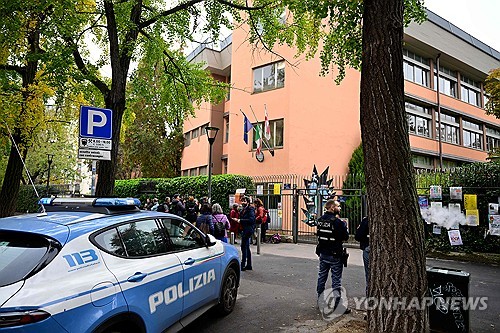
A Hoax That Cost Millions
Not a single explosive device was found. But this week’s wave of bomb-threat emails across Europe triggered real disruption — and a costly one that will ripple through budgets and public trust for years.
Italy’s education ministry confirmed roughly 6,300 schools received the messages on November 11 alone. Scotland’s figure came to around 470; Northern Ireland added another 300 or so. At least 300 Italian schools emptied their classrooms entirely. Parents rushed to campuses across the country, many reporting they had been called away from work without warning. Teachers stood in hallways with students, some holding children for hours after the all-clear was given. Traffic piled up outside school gates in cities from Rome to Milan. In several cases, local police had to manage crowd control as anxious families converged on neighborhoods already tense from previous threat waves.
Between November 2 and 6, approximately 50 passenger flights bound for, out of, or across Europe also received identical threats. None carried devices. Airlines still cancelled, diverted, or grounded aircraft. Ground staff ran exhaustive bag searches. Air traffic controllers dealt with complex rerouting decisions. Every delayed flight meant crews running into duty-time limits. Every diversion burned fuel and upset connecting passengers. The cumulative cost — every empty classroom, every stranded traveler, every emergency response activated — runs into the tens of millions across the continent.
That is the point. Not a bomb. The panic itself is the payload.
How the Attack Worked
The emails came signed by a figure called Mikhail Andropov, described as leader of a group named Vilayat of Misoginistan — a portmanteau that blends references to the Islamic State’s regional affiliates with a deliberate, almost satirical nod to misogyny. The name is opaque by design. It signals something but identifies nothing. Investigators can trace the domain infrastructure behind the messages, but the sender’s true affiliation remains obscured.
Italian media reported the emails originated from accounts registered on Taiwanese domains. Andropov is not new to this pattern. He appeared in threat emails sent to Irish public broadcaster RTÉ and Bulgarian broadcaster Nova back around November 6. Before that, he had been linked to threats against airlines crossing European airspace in the days leading up to it. The pattern stretches further back still: similar signatures have surfaced in threats targeting government buildings, transportation hubs, and critical infrastructure across the continent over the past eighteen months.
The technical chain is straightforward enough — register disposable domains, send bulk emails with incendiary content, disappear into proxy servers. The barrier to entry is near zero. What once required terrorist financing, communications equipment, and operational planning now requires a browser and an afternoon. Domain registration costs roughly five dollars. Email blast services can reach thousands of recipients for less. The economics are brutal in their simplicity: an attacker spending perhaps fifty dollars can force a state to expend hundreds of thousands in emergency response.
Who Is Behind It
This is where the investigation gets tricky. Andropov’s signature has appeared across at least three distinct target categories — airlines, broadcast media, and educational institutions — over nearly two weeks. The consistency suggests a coordinated campaign rather than a copycat chain letter. The timing, too, appears deliberate: threats escalated ahead of key dates and throughout periods when institutions would be most vulnerable to disruption.
Several questions remain open. Is Andropov a solo operator? A small cell? A front for a more organized group? Has he worked with intelligence services before? Public statements from Italian Prime Minister Giorgia Meloni stopped short of attributing responsibility, saying only that investigators had found “no signs of concrete danger” and characterizing the operation as a calculated strategy to generate fear.
Meloni also addressed a second claim in the emails — that explosives had been planted in her motorcade’s engine. Italian authorities investigated and found nothing. The claim itself, however trivial upon inspection, demonstrated the reach of the campaign: even the prime minister’s personal security was targeted, forcing her office to divert resources to an investigation that concluded with no result whatsoever.
The Vilayat of Misoginistan branding echoes a pattern seen in Eastern Europe: groups that borrow jihadist terminology while operating from Western jurisdictions, sending threats that deliberately provoke overreaction from target states. Some analysts have drawn comparisons to earlier campaigns originating from or routed through Moldova and Ukraine, where similar low-cost digital pressure operations have been observed targeting schools, hospitals, and municipal governments during periods of heightened geopolitical tension.
Whether there is a direct line between those earlier incidents and Andropov’s latest spree is unconfirmed. What is clear is that the playbook — exploit bureaucratic caution, force expensive defensive responses, leave no physical evidence — works every time.
The Institutional Response Problem
European schools and airports operate under layered security protocols designed for worst-case scenarios. When a bomb threat arrives, even from a known troll address, protocol demands action. Lockdowns. Evacuations. Bomb disposal units. Flight groundings. These procedures exist because ignoring a potential threat is catastrophic if the threat is real. A single failure to act could cost lives. The burden of proof rests entirely on the side of caution.
The problem is that malicious actors now understand the asymmetry intimately. A fake email costs pennies to produce. A full-scale school evacuation costs thousands — in lost instructional time, emergency labor, transportation logistics, and parent absences from work. An airline grounding ten flights for screening costs millions. Do this repeatedly across a continent, and the cumulative burden becomes enormous even if nothing ever explodes.
The second-order effects extend well beyond immediate costs. Students miss learning days. Teachers report burnout from repeated false alarms. Parents lose wages. Schools face mounting insurance premiums as risk assessments incorporate the new threat landscape. Airport delays cascade through supply chains. Every evacuated building represents a day of disrupted commerce and civic life.
This is not abstract. Schools in Italy, Scotland, and Northern Ireland responded exactly as their protocols require. That they were manipulated does not mean the response was wrong. It means the system was gamed — and the game reward is measured in disruption, not destruction.
What Comes Next
European governments will likely respond with tighter email screening, faster threat-sharing between education ministries and interior departments, and possibly clearer guidance about which messages warrant full lockdown versus investigative triage. Some institutions may begin requiring two-source confirmation before triggering evacuation protocols for digitally-originated threats. Technical countermeasures — domain blocking, sender authentication requirements, AI-driven spam filtering tuned to threat patterns — will improve incrementally.
But none of those measures eliminate the core vulnerability: as long as caution is the default response to ambiguous threats, the threat makers win every time they press send. The attackers do not need to succeed. They only need to force responders to assume the worst. One successful hoax among thousands of legitimate threats is enough to justify permanent institutional paralysis.
Andropov’s next campaign will probably arrive before the investigations this week conclude. The infrastructure is cheap. The targets are everywhere. And no European capital has yet figured out how to make its guard-dog protocols bite back.
The deeper lesson from this week extends beyond any single campaign. Europe’s institutions were built for a world where threats required resources, coordination, and physical presence. They are struggling to adapt to a world where terror can be dispatched from a laptop in any timezone, where the weapon is attention itself, and where the only thing an attacker needs to win is your willingness to take them seriously. Predictability, in the age of automated恐吓, is the most exploitable weakness of all — and exploiting it costs almost nothing.