Schools Join Aviation and Retail as Targets in Europe’s Hybrid Assault
Coordinated bomb-threat emails hit hundreds of schools across Italy, Britain, and Ireland — the latest expansion in a hybrid attack playbook that has already gripped European airports and supermarkets.
The Target Shift
Schools arrived late on the hit list, but their inclusion changes everything about what these attacks mean.
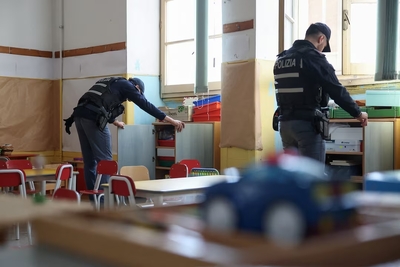
On November 11, Italian authorities confirmed that at least 300 schools across the country received bomb threat emails. Students were evacuated from classrooms. In Rome, police and explosive ordnance disposal teams swept buildings. No devices were found.
Within hours, parallel confirmations emerged from Northern Ireland — over 300 schools affected — and from Scotland and the Republic of Ireland. The emails shared identical formatting, identical sign-offs, and the same patently absurd signature: “Mikhail Andropov, Supreme Leader of the Vilayat of Misoginistan.”
Authorities in London, Belfast and Dublin quickly dismissed the threats as empty. But the speed of the coordinated rollout across three countries, targeting nearly identical institutions within the same window, points to something far more organized than a prank.
The Playbook, Expanded
This is not an isolated incident. It is the next chapter in a campaign that has been methodically targeting European civilian infrastructure since autumn.
Aviation came first. Airports across the continent — including hubs in Milan, Frankfurt, Paris, and Amsterdam — were hammered with bomb threat emails throughout October, triggering cancelled flights, terminal chaos, and thousands of stranded travellers. Then supermarkets and grocery chains became targets, striking at the kind of everyday institutions that make people feel safe walking down an aisle. Blood banks followed, a move that struck at both public service and psychological comfort simultaneously.
Schools are the logical next rung, and the progression reveals a calculated testing of each sector’s defensive maturity.
Airports have hardened protocols. Supermarkets have crisis communications teams. Schools do not operate with the same institutional reflexes, and that gap is exactly what makes them attractive. Many schools lack dedicated cybersecurity staff. Incident response plans vary wildly between districts. Some still rely on paper-based evacuation procedures. The attackers understand this landscape better than most European education ministries do.
Italian Education Minister Giuseppe Valdigrima acknowledged the uncertainty openly, telling reporters the number of affected schools could still climb. Prime Minister Giorgia Meloni framed the attack plainly as an attempt to manufacture fear and instability across the nation, and she convened an emergency cabinet meeting the same day. Police began tracing email origins immediately.
Northern Ireland Police confirmed the messages originated from outside the United Kingdom but concluded there was no evidence of a genuine public safety threat. Scotland’s police service reached the same assessment. Irish authorities noted a pattern of similar false threats in recent weeks but determined no evacuation was necessary.
That consensus among authorities does not neutralize the disruption. Hundreds of schools closed. Hundreds of children sent home early. Hundreds of parents pulled away from work or called in sick to collect their kids. The economic and social cost lands before any investigation produces results, and the aggregate daily figure across three countries is substantial even if no single lost hour can be traced to the attacker.
The Signature That Tells You Everything
“Vilayat of Misoginistan.” A fictional state fused with a deliberately insulting portmanteau designed to provoke. “Mikhail Andropov,” a name combining two Soviet-era family names into something that sounds plausible to someone not paying close attention.
This is not al-Qaeda. This is not Hezbollah. The signature is almost certainly engineered to be recognized as ridiculous by anyone familiar with online threat culture, while carrying enough institutional weight to trigger panic in those who are not.
The same sender reportedly claimed responsibility last week for bomb threat emails sent to media outlets in Ireland and Bulgaria — another hybrid attack pattern that targets information ecosystems alongside physical ones. The overlap between media and school targeting suggests a deliberate strategy: undermine the institutions that shape public narrative and the institutions that shape future citizens, both in the same operations window.
The duality is revealing. Real terrorist groups want credit. They want the world to know who did it and why. These messages are engineered differently. They want the institutions to flinch without providing anything substantive behind the threat. The humor is incidental. The paralysis is intentional.
Who Wins, Who Loses
The attackers win on three metrics simultaneously.
First, disruption. Every school that closes, every flight that sits on a tarmac, every supermarket that locks its doors generates economic friction and erodes public confidence in institutional competence. Teachers miss instructional time. Parents miss wage hours. Emergency services absorb costs they did not budget for.
Second, distraction. Law enforcement and intelligence services must deploy real resources — bomb squads, cybersecurity forensics, diplomatic coordination across borders — to respond to hoaxes. Those resources cannot be spent monitoring actual threats or investigating serious crimes elsewhere.
Third, normalization. Each successful wave raises the baseline anxiety. Parents begin checking phones during school hours. Airport security procedures absorb new layers of screening that may never be tested by a real threat but cost real money to maintain. Over time, the population becomes conditioned to expect disruption, and expectation itself becomes a form of control.
The losers are the institutions that look vulnerable. Schools are especially exposed because they serve populations — children, elderly teachers, support staff — that command immediate sympathy and rapid response. An attacker does not need a credible threat if the institution cannot afford to ignore even an absurd one. The asymmetry is the weapon.
The Second-Order Effects
Beyond the immediate disruption, these attacks produce ripple effects that compound over months. When parents learn that a fake email can close a school, they adjust their behaviour. Some begin preparing children to return home independently. Others reduce extracurricular participation, worried about pickup logistics. School governors face pressure to invest in verification systems that small rural districts simply cannot afford, widening the gap between well-resourced and under-resourced schools.
Emergency services are another second-order casualty. Bomb squad units deployed for school sweeps in one morning cannot respond to other incidents that afternoon. Training exercises get postponed. Morale erodes when officers repeatedly sweep empty buildings and return to nothing.
Education outcomes take a hit too. The loss of a half-day of instruction per student multiplies across tens of thousands of children. Catch-up sessions require teacher overtime that budgets do not cover. Vulnerable students — those already falling behind or dealing with unstable home lives — lose the structure and routine that school provides, even when that routine is disrupted by a hoax.
What Comes Next
The Italian government’s investigation into email origins will likely trace routing through multiple jurisdictions before landing on dead ends or compromised servers. That pattern is predictable and well-established in cybercrime attribution. Expect results to remain frustratingly vague for months.
The more consequential question is institutional adaptation. How do schools and other public institutions distinguish between actionable threats and performative chaos? The current default across Europe has been to treat every email as potentially real until disproven — a stance that guarantees maximal disruption for minimal investment by the attacker. Breaking that default requires either new technology, new protocols, or both, and neither exists at scale today.
Some form of standardized verification protocol would help, but none currently exists across the EU or UK. Border coordination is ad hoc. Intelligence sharing between national police forces is functional but slow. The gaps are systemic, not accidental.
What this episode exposes is not a new weapon but an old tactic applied with increasing precision: use asymmetric cost imposition against symmetric institutions. The attacker spends nothing. The defender spends enormous amounts — in euros, in trust, in institutional credibility. The Vilayat of Misoginistan does not exist. But the fear it generated across three countries on a single Tuesday is very real, and it will outlast the news cycle by months.