The Fake Yalta Summit Shows Who Really Sets Terms Now
Trump, Xi, and Putin spent 80 minutes at Qilin Villa pretending to redraw the world. A South Korean newspaper called it "counterfeit Yalta" — and was right. The trio lacks both the military weight and political freedom of FDR, Churchill, and Stalin, yet their diplomacy still risks abandoning smaller allies.
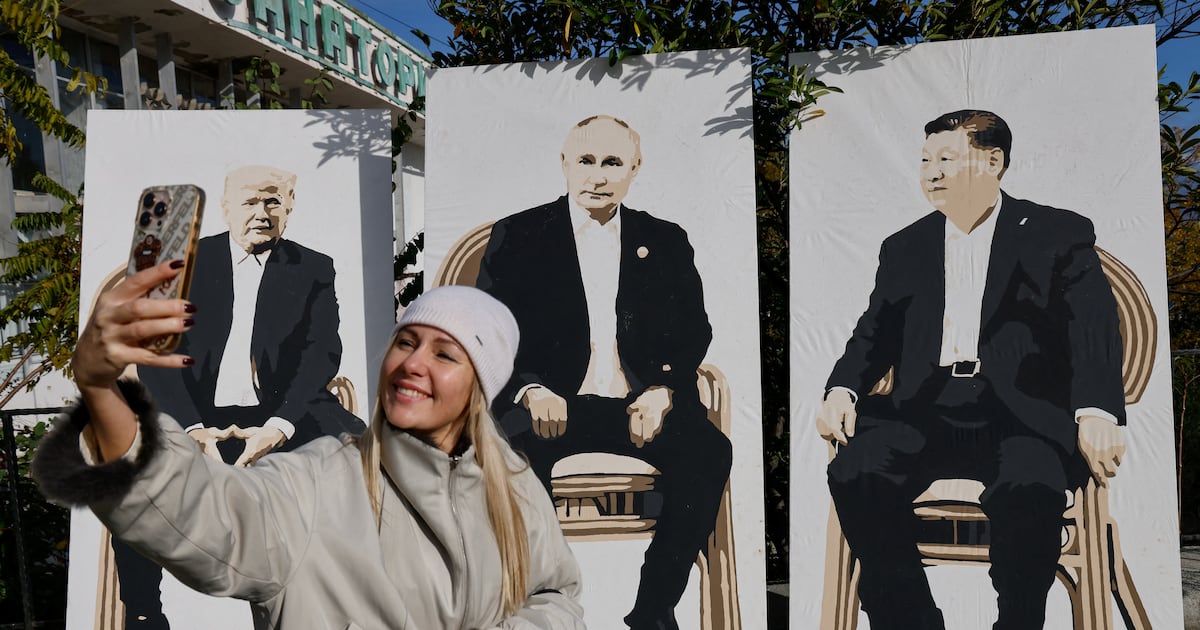
The photo shoot that wasn’t a summit
In February 1945, the Allied victors converged on the Livadia Palace on Crimea’s coast and spent eight days mapping the ruins of war into something resembling order. Berlin would be divided. Poland’s eastern border would shift westward. The United Nations would rise from the wreckage. Small nations had no seat. Their fates were discussed while they waited outside.
Eighty years later, on Nov. 19, 2026, Donald Trump, Vladimir Putin, and Xi Jinping stood together for 80 minutes at Qilin Villa outside Shenzhen. The result: a joint statement that softened language about Ukraine and Taiwan without committing to anything anyone had to implement, and a picture of three men posing as if they commanded the world. The Financial Times noted dryly that we no longer live in an age where the Big Three can impose terms on everyone else. Chosun Ilbo went further, calling the whole exercise counterfeit Yalta — not a new settlement but a pantomime of one.
Western outlets treated the briefing as a curiosity. Seoul understood it for what it was: a symptom of a strategic system fraying at its edges, with smaller countries bearing the risk.
What made Yalta real
The original conference worked because military outcomes preceded diplomacy. By February 1945, American forces had already pushed deep into Germany. Soviet troops were three months from Berlin. Britain held a vital role as the gateway to Europe. And six months later, the United States demonstrated its terminal advantage by using atomic bombs against Japan. The combined GDP of the US exceeded that of Britain and the Soviet Union put together. America fielded 12 million soldiers. The Soviets had 11 million battle-hardened ground troops. Britain contributed another 4.5 million. The war-torn continent had lost its ability to negotiate from strength.
None of those conditions exist today. Russian GDP accounts for just 2.2 percent of global output, compared with 25.5 percent for the United States and 16.8 percent for China. Russia ranks 62nd in per-capita income and continues sliding. Its oil refining capacity dropped 45 percent last year. China faces a property crisis, deflationary pressures, youth unemployment, and trade friction driven by overreliance on overseas markets. The United States has suffered a strategic failure in Iran paralleling Afghanistan and now finds itself politically constrained heading into midterms. All three leaders carry wounds.
The resistance of the supposedly irrelevant
Ukraine offers the clearest proof that Yalta-style arrangements cannot simply be imposed anymore. Zelenskyy commands no army comparable to the Wehrmacht or Red Army, receives aid from a fractured transatlantic alliance, and sits geographically between two nuclear powers. Yet he has resisted every territorial demand since February 2022. Ukrainian drones strike deep into Russian territory. NATO members continue supplying ammunition despite fatigue. The war has pinned Russian forces in eastern Ukraine for over four years — ten months longer than the Soviet Union fought Nazi Germany.
Iran presents another case. The United States entered the confrontation expecting quick capitulation. Instead it faced protracted insurgency, regional proxy warfare, and domestic political damage that cost Trump the midterm elections. Taiwan remains technically unconquered after decades of Chinese pressure. The distance between mainland Fujian and the island is 160 kilometers, easily bridged by modern missiles, but conquest requires more than reach. Drone technology has democratized battlefield intelligence and reduced the advantage of sheer mass.
Mao Zedong dismissed the American atomic bomb as a paper tiger in 1946. In September 2025, Trump posted on social media that Russia appeared to be one. Putin replied with an invitation to test the claim. The British press ran with the image: three self-styled superpowers looking increasingly hollow.
European alarm
While the Shenzhen meeting unfolded, NATO allies gathered separately and issued statements reaffirming support for Ukraine. Poland’s Prime Minister Donald Tusk declared plainly that Putin is not and will never be a friend. Germany’s Friedrich Merz branded the summit a photoshoot and gifted European leaders fragments of the Berlin Wall as a reminder of what division looks like. Emmanuel Macron warned that the world must not accept being rearranged from above. One EU foreign minister invoked the Munich Agreement of 1938, when Britain and France sacrificed Czechoslovakia to appease Hitler. The comparison drew immediate pushback. Ukraine refused to occupy the same position as prewar Prague. But the anxiety behind it was legible.
The real concern isn’t merely rhetorical nostalgia. If Washington and Moscow decide arrangements behind closed doors, Brussels and Tokyo have no veto. That dynamic matters for Korea far more than it does for Spain or Sweden.
Why Seoul’s label cut deepest
Chosun Ilbo’s distinction between real and counterfeit Yalta mattered because it named a structural truth most American commentary sidestepped. In 1945, the three powers could deliver on their promises because victory gave them the leverage to enforce them. Today, none of them can fully deliver for themselves, let alone dictate outcomes to everyone else. The summit produced symbolism — Xi gained the ceremonial prestige of hosting equals; Putin secured a photo with Trump that contradicted his isolation narrative; Trump acquired a headline.
But no borders moved. No treaties locked in. No security guarantees bound any third party. Kevin Rudd, former Australian prime minister and president of New York’s Asia Society, told the Wall Street Journal that no region gained or lost territory through the meeting. Chinese diplomacy traditionally prefers minimal agendas, scripted presentations, and null results when the objective is visibility. Wang Yi called the encounter a historic milestone. Putin described it as a new chapter. The Guardian reduced it to a smallish footnote in twenty-first-century history. Daily Telegraph dismissed it as a -pound knockoff.
The Korean calculus
For Seoul, the counterfeit Yalta carries specific hazards. Washington’s willingness to entertain great-power accommodation suggests that alliances may become bargaining chips rather than ironclad commitments. Beijing gains legitimacy through association with American presidents without purchasing responsibilities toward smaller neighbors. Moscow escapes diplomatic pariah status incrementally, enough to sustain its war effort in Ukraine.
Korea’s own security architecture rests on the assumption that external powers will honor their commitments regardless of bilateral fluctuations. The Shenzhen summit tested that assumption and found it strained. Not shattered. Strained.
The lesson isn’t that the world has abandoned order. It’s that the architects of whatever order replaces the post-Cold War settlement lack the power, patience, and domestic freedom to build one that sticks. A summit of lame ducks produces laminate declarations. The paper tigers are still breathing fire, just not enough to guarantee compliance everywhere. Smaller states learn quickly which threats are performative and which are real. That discrimination now determines survival.