Why France and Spain Riots Signal a New Southern European Unrest
Coordinated youth-led protests across France and Spain with over 1,100 arrests reveal a transnational anti-system movement that goes beyond isolated incidents of civil unrest.
A Slogan Traveled. The Anger Did Too.
Six months before France chooses Macron’s successor, and while Spain’s government wrestles with its own unrest, a shared language of dissent is crossing borders it rarely traverses so seamlessly. The slogan is “Institut Indignats” — a play on the student movements that rocked France last year and the broader anti-establishment impulse sweeping Spain’s streets.
On Saturday, masked demonstrators set fire to street furniture around Barcelona’s Plaza de Catalunya, looted shops in central districts popular with tourists, and forced shoppers to barricade themselves inside department stores. Catalan Interior Minister Núria Parlon reported more than 30 fires and 14 shops vandalized or looted. Roughly a quarter of the 100 people arrested were minors. Barcelona’s mayor, Jaume Collboni, warned that guardians of those minors would face legal consequences.
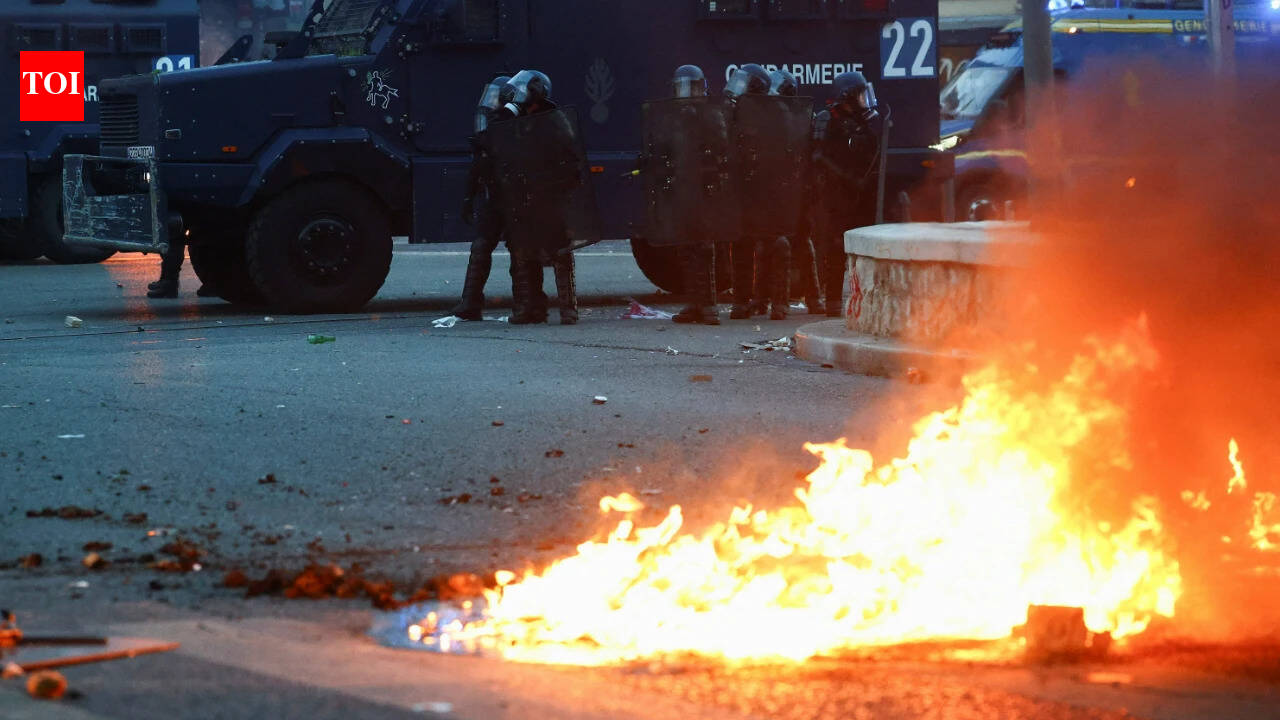
In France, nearly 1,000 people were detained across a wave of protests stretching from Marseille to Lille to Bordeaux and Toulouse. Interior Minister Laurent Nunez had opened the day with a blunt warning: “We will not tolerate any violence or any disturbance of public order.” Police responded with tear gas, sound grenades, and water cannons as masked protesters threw fireworks and objects near the eastern endpoint of the Paris march.
The French interior ministry estimated 410,000 participants nationwide, including 110,000 in Paris. The CGT union put the numbers higher — nearly 800,000 nationally and 250,000 in the capital. Either way, turnout dropped from the previous weekend, when 550,000 had taken to the streets and 2,700 were arrested. The Louvre, Musée d’Orsay, and the Picasso Museum closed. A PSG-Lyon football match was postponed. Seventy thousand security personnel were deployed across the country.
Why This Isn’t Just Two Bad Weeks
The surface reading is straightforward: cost-of-living anger in France, anti-establishment fury in Spain. The details resist that framing.
Both protests were promoted on social media under the same banner — “against the system.” The “Institut Indignats” label explicitly linked the French student protests of recent weeks to a broader current. Videos showed hooded demonstrators in black smashing windows and taking goods, sometimes encouraged by people watching from their phones. Footage spread of customers trapped inside an El Corte Inglés department store after shutters were lowered to block looters.
This is not a coincidence. It is a coordination pattern.
The Indignados movement that shook Spain in 2011 — the 15-M protests that occupied Puerta del Sol for weeks — has been dormant in mainstream politics. What is emerging now is a younger, more digital iteration, one that treats national borders as permeable and mobilizes through shared hashtags rather than traditional party structures. The fact that roughly a quarter of Barcelona’s arrested were minors is telling. These are not veteran activists. They are students who learned organization online and are translating it into street action.
The Second-Order Fallout Already Mounting
The immediate casualties are predictable: shop owners, tourists, public institutions. But the deeper losses are political and economic, and they compound faster than officials can respond.
Insurance claims from Saturday’s violence will pile onto the tab from the previous weekend’s 2,700 arrests and widespread looting. Parisian retail districts already grappling with post-pandemic foot traffic declines now face another round of shattered windows and abandoned storefronts. Barcelona’s tourism board — which projects that visitor spending accounts for nearly a fifth of Catalonia’s GDP — has quietly begun urging hotels to reinforce front-desk protocols after the Plaza de Catalunya attacks. The damage is not measured solely in boarded-up shops but in a slow erosion of confidence among people who decide where to live, invest, and vacation based on calm.
On the political side, the movement’s refusal to articulate demands is precisely what makes it dangerous. Traditional protest movements can be bargained with, absorbed, or outlasted. An anonymous network operating under a single viral hashtag has no negotiator to call, no concession to extract, no manifesto to critique. That structural ambiguity is a gift to governments that want to criminalize the unrest — it also makes resolution impossible.
For Macron, the calculus is especially fraught. The 2027 presidential race is shaping up as a three-way contest between a center without a coalition, a far right hungry for momentum, and a fragmented left struggling to define itself. This formless anger does not need to coalesce behind a candidate to matter. It只需要 destabilizes the terrain. Every arrested teenager and every closed museum deepens the narrative that France is ungovernable — a narrative Emmanuel Macron has spent seven years dismantling and now cannot afford to lose.
Sánchez faces a parallel vulnerability. His government has already managed the Catalonian independence crisis through a combination of legal prosecution and negotiated concession. Saturday’s events return Barcelona to a posture of containment rather than dialogue, a signal that could either reassure hardliners or reignite separatist sentiment depending on how Madrid responds. The Interior Ministry’s stated intention to prosecute minors as adults is already drawing criticism from human rights groups and Catalan prosecutors’ offices alike.
The EU Dimension Nobody Is Naming
The European Union’s political fracturing is usually discussed in terms of elections, court rulings, or trade disputes. This is a different kind of stress test. When the same slogan travels from Paris to Barcelona in hours, and when the participants share grievances about economic precarity and political irrelevance, the EU’s internal cohesion faces a strain that no summit can easily address.
European integration was always built on the promise that prosperity and participation would neutralize alienation. The current wave of unrest suggests that for a growing cohort of young Europeans, that promise has expired without a replacement. The EU’s institutional response mechanism — coordination through the Council, the Commission, the Parliament — operates on timescales that are irrelevant to decentralized digital mobilization. By the time a joint statement is drafted, the next action has already happened in a different city.
Who Wins and What Comes Next
No traditional party benefits from this. Not Macron’s centrists, not Sánchez’s Socialists, not the French far right, not Spain’s Vox. The movement’s anonymity — masked faces, decentralized organizing, shared digital platforms — makes it structurally resistant to capture. Extremist groups have tried, publicly and privately, to insert themselves into the narrative. None have succeeded in directing it.
What happens next depends on whether the indignation finds institutional expression. The student movements that spawned “Institut Indignats” have shown they can sustain pressure on education policy. If that energy pivots toward broader economic demands — rent, wages, cost of living — the governments on both sides of the Pyrenees face a sustained challenge rather than a weekend of headlines.
The previous weekend in France produced 2,700 arrests and widespread looting. This one produced roughly a tenth of that number but crossed an international border. The trajectory is not yet clear. The coordination pattern, however, is.
Watch for the slogans. Watch for the next act. The systems these young protesters claim to reject are learning, slowly, how to respond to an enemy that has no list of demands and no central office. The question is whether those systems will still be functioning when the next message goes viral.