How Gen Z Unlocked a Pan-European Protest Wave
A synchronized wave of protests has swept across European capitals, driven by Gen Z organizers on issues from pensions to housing. What looks like chaos is actually a coordinated movement reshaping European politics.
The pattern behind the protests
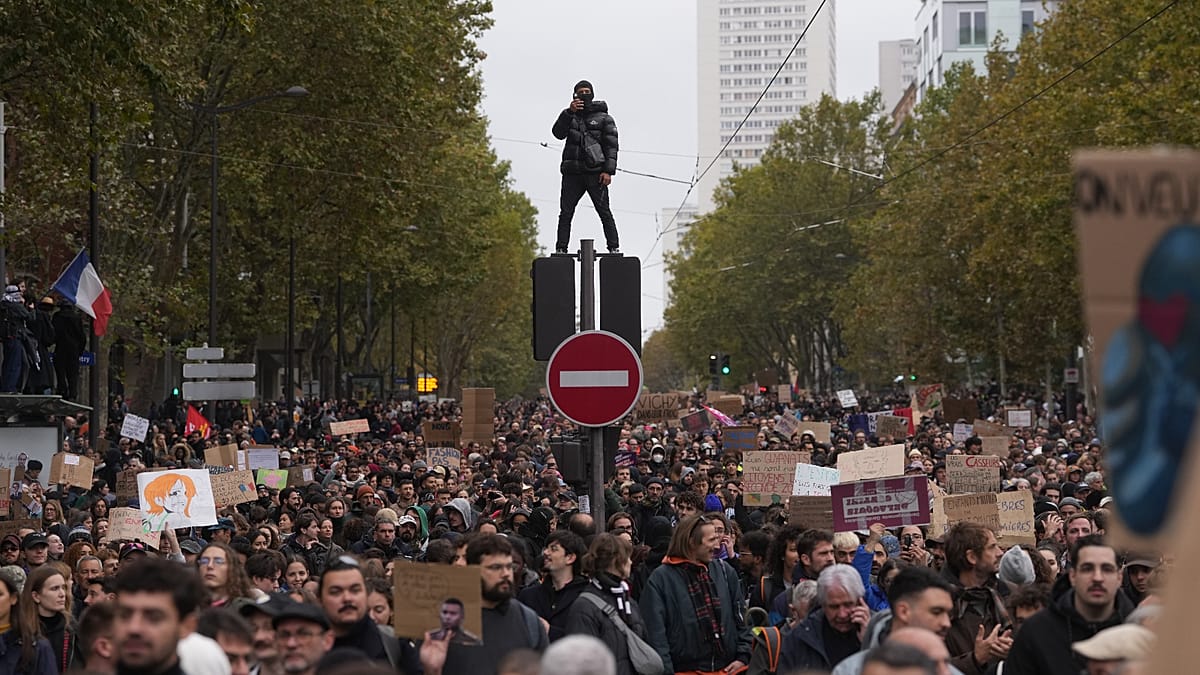
Western outlets are covering the European protests as a series of separate stories — riot police in Paris, scuffles in Rome, demonstrations in Madrid. That framing misses the point entirely. What is happening across at least a dozen capitals from Tirana to Lisbon is not coincidence. It is a synchronized movement, and the people organizing it are largely under 30.
The raw numbers are alarming. Around 2,400 arrests in France. Nearly 1,000 security forces injured. Over 300 injured in Albanian clashes alone in Tirana. In Italy, police detained 371 people across eight cities, and 110 of those were minors. These are not fringe gatherings. They are large, sustained, and spanning the full geographic breadth of Europe — from the EU core to its Balkan periphery.
Who is driving this
The protests are being led by young people and student organizations. In Italy, the presence of over a hundred minors among those detained is telling. In Albania, students and artists have joined opposition parties in confronting police who fired tear gas at government buildings. In France, young people have been at the forefront of the confrontations that resulted in the highest injury and arrest figures.
This is not a spontaneous eruption. Gen Z organizers have years of experience coordinating climate strikes, housing demonstrations, and tuition protests across borders. The tactics, messaging, and timing carry the fingerprints of networks that learned to move faster than traditional political institutions after the climate movement showed them how.
The grievances may differ by country, but the architecture is shared. Pensions are under pressure everywhere as populations age. Housing is unaffordable in every capital city. Corruption scandals dominate headlines in Albania and have haunted governments across southern and eastern Europe. Opposition to wars occupies the same slot for young Europeans that civil rights movements held for earlier generations.
Why the timing matters
The protests are surfacing at a moment when European governments are stretched thin. Several countries are grappling with coalition instability or electoral fatigue. The war in Ukraine continues to drain resources and political will. Economic growth remains sluggish across much of the continent. A coordinated challenge that does not target a single government but instead links demands across borders is harder to dismiss as domestic unrest.
That is precisely why governments have responded with bans, heavy policing, and tear gas. Authorities understand intuitively that containing one protest is manageable but containing a synchronized wave across their neighbor and two others is not. The strategy so far has been national containment. The movement is deliberately transnational.
What each country is fighting
The demands vary but reveal a common structure:
France remains the epicenter of escalation, with the largest arrests and injuries. The violence suggests a population already fractured over the cost of living and distrust of institutions.
Italy saw protests in Milan, Rome, Turin, Naples, Bologna, and Florence — six cities in a single day. The involvement of minors signals deep youth engagement across the peninsula.
Spain is focused on pension rights: linking increases to actual inflation, raising the minimum pension to match the minimum wage, closing the gender pension gap, and protecting the public system from privatization. These are specific, measurable demands that cut across age groups but are being amplified by younger voters who face the long-term consequences of whatever pension system they inherit.
Portugal centers on affordable housing, a crisis that mirrors Spain’s and threatens to destabilize a government already sensitive to economic inequality.
Albania stands apart in character. This is not primarily an economic protest. It is an anti-government movement with opposition parties, students, and artists confronting state authority directly. The attacks on government buildings and the volume of injuries suggest a political crisis that has found a new vehicle.
What happens next
The most important question is not whether these protests will escalate but whether they will coordinate further. If Gen Z organizers can maintain synchronized timing across borders while adapting demands to local conditions, they create a template that is extremely difficult for any single government to neutralize. Sudden mass actions in multiple capitals on the same weekend multiply the cost of a repressive response. Each country watches the others and learns.
European institutions should take note. The EU has struggled to respond coherently to domestic political crises within member states. A movement that treats the European project as a platform rather than a constraint creates a new category of political pressure that Brussels is not equipped to handle through existing channels.
Governments will face a choice. Co-opt the demands with targeted policy changes, or deepen the crackdown. History suggests the latter rarely works against a youthful, connected, and internationally synchronized movement. The former risks empowering organizers who can repeat the exercise on a larger scale.
The second-order implications
This protest wave could reshape European social policy for a decade. Pension systems that fail to account for inflation and gender disparities will face repeated challenges. Housing markets that exclude young people will become permanent political liabilities. Corruption in countries like Albania will no longer be contained within domestic politics but will feed into a broader regional narrative about accountability.
The movement also exposes a generation gap in European politics that no party has learned to navigate. Older voters reward stability. Younger voters, facing unstable conditions, reward disruption. The protesters are forcing a confrontation between those two logics across the entire continent.
If the protests remain coordinated, they could push pension reform, housing policy, and anti-corruption measures onto every European agenda within months. If they fragment, they still leave behind a blueprint that any future grievance can replicate. Either way, the era of treating European protests as isolated domestic events is over.