From Spy Satellites to Dark Energy: What Roman’s Launch Really Signals
NASA’s Nancy Grace Roman telescope is launching with a primary mirror originally built for a classified spy satellite. The repurposed hardware and Korean scientific partnership reveal a deeper shift in how defense and civilian space budgets are converging.
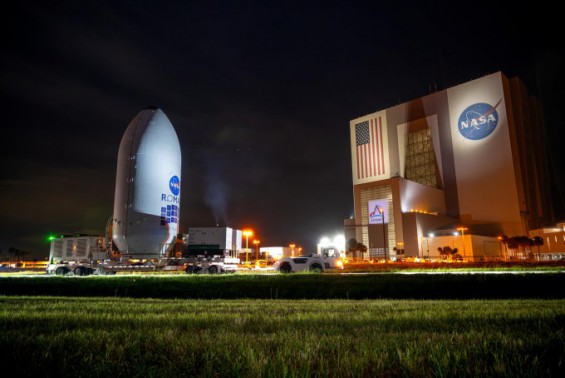
The Mirror That Was Never Meant to Look This Way
The primary mirror of NASA’s Nancy Grace Roman Space Telescope was not built to study the universe. It was manufactured for the National Reconnaissance Office — the secretive Pentagon agency that runs America’s espionage satellite fleet — and then set aside, unused, when the mission it was meant for never materialized.
That mirror now sits aboard a Falcon Heavy rocket at Kennedy Space Center, preparing for a launch on June 30. When Roman reaches its destination 1.6 million kilometers away at the Sun-Earth L2 Lagrange point, it will sweep the sky with a field of view at least 100 times wider than Hubble’s, all in infrared. The spy satellite’s eye, redirected, will now chart dark energy, dark matter, and more than 100,000 exoplanets.
The headline fact — that defunct NRO hardware found a second life — is remarkable but incomplete. The real story is what this repurposing reveals about the structure of American space investment, and who benefits from it.
A Defense Asset, a Civilian Payoff
The Roman mirror is not an isolated curiosity. It is evidence of a systemic pipeline: hardware designed under classified defense contracts, sometimes built to specifications far exceeding civilian needs, and then – when military priorities shift or budgets stall – transferred to agencies like NASA. The NRO has long operated at the edge of public knowledge. Its budget is not separately line-itemed in the federal appropriations process. Transferring its assets to civilian use is one of the few ways that opaque spending becomes visible.
This is not mere recycling. It is an indication of how much excess capability sits quietly in the defense estate, and how little the public knows about its dimensions. A 2.4-meter infrared-capable mirror is not a commodity item. The fact that the NRO produced one and then did not need it suggests either a cancelled intelligence program or a deliberate over-specification strategy – both of which carry implications for how much is being spent on reconnaissance versus what is actually deployed.
For astronomers, it is a windfall. For transparency advocates, it is a question mark.
The Korean Dimension
What Western coverage has largely missed is the depth of South Korea’s involvement in Roman – and what it signals about the broader trajectory of US-Korea technology cooperation.
Researchers at the Korea Astronomy and Space Science Institute (KASI) are not merely contributing data or participating as distant collaborators. Dr. Hong-gyu Mun and Dr. Byung-kon Park, both senior scientists at KASI, have been central to framing the telescope’s scientific output and planning the follow-up observations that will define its legacy. Mun’s comments to DongA Science emphasize that Roman’s role extends well beyond dark energy and exoplanets: the telescope is also expected to catalog hundreds of thousands of asteroids, thousands of Kuiper belt objects, and over a thousand near-Earth objects.
This is not symbolic inclusion. Korea is helping shape the science case for a $3-4 billion facility. And the plan does not stop at Roman. Park explicitly links Roman’s infrared survey capabilities to future ground-based observation with the Giant Magellan Telescope (GMT), a project in which Korea is a contributing partner. The vision is a coordinated sky survey – infrared from space, optical from ground – that no single country could execute alone.
In an era defined by US-China strategic competition, this kind of deep scientific integration with an allied nation carries weight beyond astronomy. It locks in a technology corridor. It creates shared expertise. It makes decoupling harder.
The Falcon Heavy Factor
Roman is launching on a Falcon Heavy, not a conventional expendable vehicle. That choice matters. SpaceX has flight-proven the Heavy variant, and reusing boosters on this class of mission drives down cost in a way that traditional launch contracts do not. NASA has increasingly turned to commercial launch providers for heavy-lift needs, and Roman is a case study in that transition.
But there is a subtler point here. The Falcon Heavy was itself developed with Department of Defense contracts in mind – it was designed, in part, to carry classified payloads for NRO and other intelligence agencies. The rocket that launches this former spy mirror into the heavens is itself a product of the defense-commercial symbiosis that makes Roman possible.
The circle is nearly complete: military investment produced the mirror and the launch vehicle; civilian science now operates both.
What Comes Next
Roman will not deliver answers in months. The telescope arrives at L2, undergoes commissioning and calibration, and will not release its first images until early 2027. Full scientific results on dark energy — whether its pressure is constant or evolves over time – will require years of accumulated data. The exoplanet census, the most ambitious its kind, will similarly unfold gradually.
What Roman will do quickly is demonstrate that a telescope built from surplus defense hardware can outperform facilities designed from scratch for civilian purposes. That is a message with budgetary consequences. If NRO surplus can fund world-class science, then the argument for transferring more classified assets to civilian use grows stronger – and the argument for keeping them locked away weakens.
It is also a message for international partners. Korea’s role in Roman is a template for what deeper scientific alliances can look like when defense-origin technology and civilian ambition align. The GMT collaboration that follows will test whether that model can scale.
The mirror was never meant to see what it will see. That is the point.