A Fruit Fly Brain Can Play Doom. That Proves Nothing.
Google mapped a fruit fly's entire connectome last week. Hobbyists immediately put it in Doom and Mario 64. The viral experiments reveal a stark truth: having a wiring diagram is not the same as understanding how a brain produces behavior.
The Map Is Not the Territory
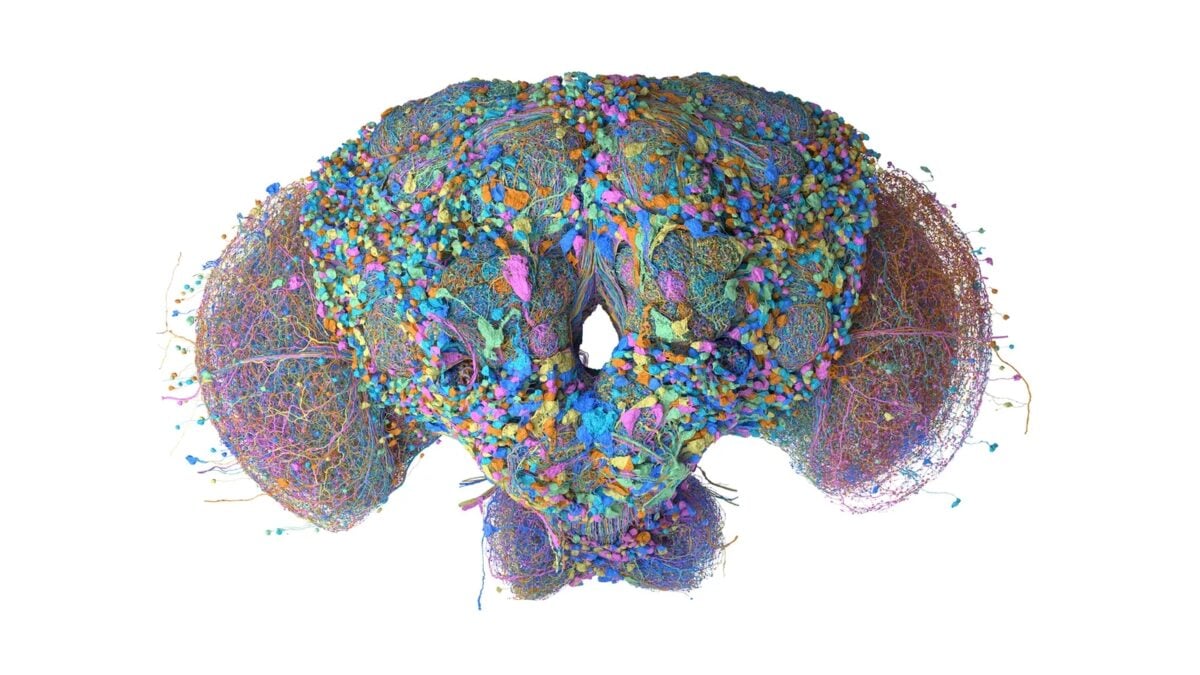
On September 3, Google and the Howard Hughes Medical Institute’s Janelia Research Campus published a connectome — a complete wiring diagram of every neural connection in an adult male fruit fly’s brain and central nervous system. The project consumed a decade. It produced 166,700 neurons and 125 million synaptic connections, the largest brain map ever assembled by neuron count. Scientists will now treat this as a foundational resource for understanding perception, response to stimuli, and potentially repairing damaged neural pathways.
Three days later, someone made it play Doom.
Alex Wormuth, a software engineer, posted his project on X. He fed each Doom frame into the simulated fly’s sensory neurons, mapped the resulting neural activity to game controls, and triggered a stimulus to two PPL101 dopamine cells whenever the simulated brain took damage — using the fly’s own dopamine system as a crude reinforcement signal. A livestream followed. By Monday, Jessica Paquette had posted her own attempt running the full MaleCNS v1.0 connectome inside a version of Super Mario 64. In her video, Mario jumps and repeatedly bumps into walls. She described the code as “100% vibe coded with GPT Astra.” Someone else ran the connectome inside Minecraft. Another fine-tuned it to perform Y-M-C-A poses in response to musical tones. One person made it “watch” the Bad Apple!! animation.
It is simultaneously the most fun a connectome has ever had and the most honest demonstration of how far we are from actually understanding a brain.
What the Gaming Experiments Actually Show
These projects went viral because they are absurd. A fruit fly’s nervous system evolved to navigate flowers, avoid predators, and mate — not to traverse the Imp’s lair or collect stars in a 3D platformer. The fact that anyone figured out how to push the simulated brain in any recognizable direction at all is notable. That the results look like a drunk toddler is expected.
The Dopamine trick Wormuth used is the most scientifically interesting element. The PPL101 cluster in Drosophila is real — it is one of several dopamine neuron groups implicated in aversive reinforcement and punishment learning. The connectome project and decades of prior fly neuroscience have confirmed this. Wormuth was not inventing a mechanism. He was using a known circuit element as a proxy for reward prediction error, the same class of signal that reinforcement learning algorithms in AI depend on. The parallel is not accidental.
What the experiments expose is the gap between structure and function. We now have a map of where every wire goes. We do not have a说明书 for what those wires do. The connectome tells you that neuron A connects to neuron B with a synapse of weight C. It does not tell you what computation A performs, what behavior B produces, or how the network as a whole generates anything recognizable as decision-making. That has to be inferred from electrophysiology, calcium imaging, behavioral assays, and a lot of trial and error — none of which the wiring diagram provides.
This is why the hobbyist projects work at all, and why they also stop working. You can stimulate dopamine cells and call it reinforcement. You can route visual input to sensory neurons and call it a game. But the mapping between neural activity and useful control signal is not guaranteed to be smooth. Flies process visual information in ways that do not map cleanly onto the frame-by-frame pixel arrays of a first-person shooter. A fly’s world is structured around motion detection, polarization, and ultraviolet light. Doom is structured around human-scale corridors and health packs. The mismatch is not a bug in the coding — it is a feature of the organism.
Why This Matters for AI
The viral framing is cute. The underlying pattern is urgent.
Artificial intelligence is currently being built at a scale that outpaces our understanding of how intelligent systems work. Large language models perform surprisingly well without a precise model of what they are doing. They are scaled up, benchmarked, and deployed faster than any coherent theory of their internal dynamics can keep pace. The fly connectome represents the opposite approach: build the full physical substrate first, then see what emerges.
Neither strategy has yet produced a clean answer.
The hobbyist experiments are a reminder that even with a complete neural map — a dataset that represents the single most detailed structural description of any animal brain ever produced — you cannot boot up behavior. You need assumptions about sensorimotor loops, about what inputs count as meaningful, about how to translate neural firing patterns into action space, about what signals function as learning drivers. Every one of those assumptions is where the real science lives. The map is only the starting line.
This is also why Google’s next targets — fish and mouse connectomes — are significant, even if the internet immediately turns around and makes them play retro games too. A mouse brain contains roughly 70 million neurons per hemisphere. A zebrafish larva, often used in connectomics, sits somewhere around 100,000. Each increment adds layers of circuit complexity that may cross thresholds we have not yet probed. The jump from fly to mouse is not linear. It is where things get interesting.
The broader lesson for AI architecture is direct. Neural network design still borrows heavily from biology because biology is the only proven template for general intelligence. But borrowing the word “neuron” does not mean we understand the wiring. The connectome era forces a reckoning: structure alone is insufficient. Understanding requires mapping not just connections but dynamics — how those connections behave under different states, how they change with experience, how they produce the gap between stimulus and response that we call cognition.
The Real Experiment Was Always Ours
The fly brain playing Doom is not a milestone in artificial cognition. It is a milestone in open data. For the first time, a complete connectome is available to anyone with enough compute and curiosity. The internet did what it always does: it played with the toy, broke it, made something useless and strange, and in the process revealed exactly what is missing.
We now have the blueprint. We still do not have the manual. The next decade of neuroscience will be spent writing it — and the AI community would do well to watch closely.
The connectome is not the end of the problem. It is the moment the problem became visible.