Gangnam's Billion-Won Buildings Can't Be Tokenized — And It Costs Korea Everything
South Korea's token-securities law opens next February, but it covers financial claims, not physical assets. While the US and Japan push tokenized Treasuries into repo markets, Korea's real estate owners are stuck — and the gap is already showing in collapsing domestic issuance.
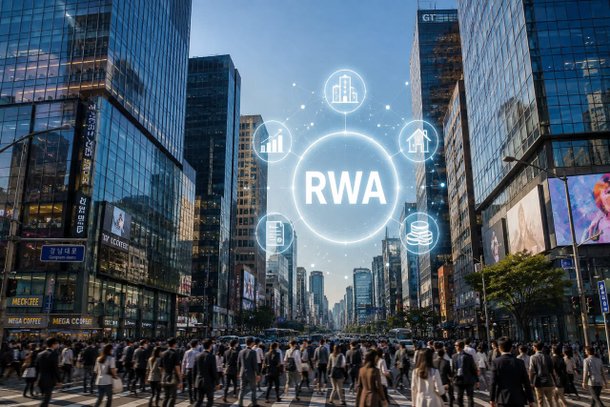
The question every Gangnam building owner is asking — and getting no answer to
Park Yong-hyun, founder of INSIGHT3 Inc., says his phone hasn’t stopped ringing. Owners of multi-billion-won buildings in Gangnam — Seoul’s most valuable real estate district — want to know if they can slice ownership into tokens and raise capital without selling the property outright.
His answer, every single time: not in Korea today.
That one word — not — opens a window onto a regulatory gap that is becoming increasingly expensive for South Korea to ignore. The country’s token-securities law takes effect in February 2025, yet it covers only financial claims, not the underlying physical assets themselves. Gold tokens, which already represent one of the largest categories of on-chain real-world assets globally, are excluded from day one. Carbon credits are out too. The law treats a token as a wrapper for a security, never as a direct representation of a physical asset.
The math on domestic demand is already moving against the status quo.
Fractional investment issuance in Korea — the closest domestic equivalent to what tokenization promises — collapsed from 60 deals totaling 27.2 billion won in 2024 to just 14 deals and 4.9 billion won this year. That is a sixth of the volume. Casa Korea, the country’s first real estate fractional-investment platform, has halted new offerings and moved to sell off assets. Funble closed its doors in May after failing to meet its own capital requirements. Two platforms, two deaths, one clear signal: when the legal foundation is unstable, even early adopters fold.
What the rest of Asia and Wall Street are doing while Korea debates
The global story is not about whether physical assets can be tokenized. It is about how fast tokenized assets can move through collateral and payment systems — and Korea is absent from that conversation.
The three clearest signals are coming from institutions that define global financial infrastructure:
Broadridge’s blockchain repo platform processed $75 billion in a single month in June, with daily volumes up 68 percent year over year. This is not a pilot. It is the largest blockchain project on Wall Street, and it is happening inside the most conservative corner of finance — government bond lending.
The DTCC, the central depository and clearinghouse for US markets, announced in December 2024 that it would tokenize a portion of its Treasury holdings and target commercial deployment by the second half of this year. The institution that settles trillions in daily US securities volume is building a token layer.
Japan’s JSCC, the central clearing counterparty, launched a live demonstration in April with Mizuho and Nomura to transfer Japanese government bonds as tokenized collateral in real time. Tokyo is not waiting for comprehensive legislation. It is building the infrastructure and letting the law catch up.
On-chain data from rwa.xyz puts total tokenized physical assets — excluding stablecoins — above $38.1 billion as of early August. US Treasuries dominate at roughly $162 billion. But the more important number is the utilization rate. Analysts estimate that only $20 billion of the $380 billion in issued tokenized assets is actually being used as collateral or moving through settlement systems. Most tokens sit idle.
Issuance is the easy part. Getting tokenized assets to circulate as collateral, settle across chains, and cross borders is the hard part — and exactly where Korea’s framework is weakest.
The structural trap inside Korea’s own law
Even the narrow slice of tokenization that Korea permits next year rests on shaky ground. The revised Electronic Securities Act and Capital Markets Act create two categories of non-standard token securities: investment-contract securities and non-cash trust-benefit certificates. The January revision addressed investment contracts but left trust-benefit certificates untouched.
Several major brokerages built their token platforms around the trust structure. That means a significant portion of the infrastructure deployed for February’s launch lacks a clear legal basis for the very product it was designed to trade.
The nextCapital Markets Act amendment is expected to reach the National Assembly’s Justice Ministry subcommittee on September 2, its fifth appearance. Working backward through implementation-rule drafting and product-design timelines, the September parliamentary session is effectively the last window to supply products before February. Miss it, and the cycle repeats.
This is not a failure of demand. It is a failure of sequencing — infrastructure ahead of law, and the law itself incomplete.
Who wins and who loses
The winners in this standoff are already identified: Korea Investment Securities has publicly positioned itself as a global RWA hub. Mirae Asset and other large brokers are quietly reviewing structures and pre-positioning assets. When the door opens — and insiders believe it will — the firms that spent the last year preparing will move first. Foreign platforms with existing custody and legal frameworks will also have a structural advantage in any future cross-border product.
The losers are harder to name but easier to feel. Gangnam building owners seeking liquidity without selling. Domestic startups that folded because the legal environment gave them no runway. Younger investors priced out of Seoul real estate because the tokenization pipeline that could have fragmented ownership never materialized. The 27-billion-won domestic market that shrank to 4.9 billion is evidence enough.
There is also a broader institutional cost. The Bank of Korea has floated the idea of a unified ledger for reserve funds, commercial bank money, and government bonds — the kind of architecture that requires domestic precedent. Without a functioning real-world-asset tokenization market, Korea becomes a consumer of someone else’s infrastructure rather than a builder.
What changes — and what likely won’t
The seminar scheduled for August 28 at the National Assembly Library auditorium, titled “After Token Securities (STO): Exploring RWA Legislation Challenges,” will focus on exactly which provisions are deferred to subordinate regulations. That is where the real fight will happen — not in the framework law itself, but in the implementation rules that determine whether tokenized assets can serve as collateral, settle in real time, or move across jurisdictions.
Park’s argument is straightforward: the issuance foundation exists, but the design that lets tokens function as collateral, payment instruments, and cross-chain assets has not been built. That design work is legislative, not technical.
The global trajectory is already set. Wall Street is tokenizing Treasuries for repo. Japan’s central clearinghouse is running live bond-transfer trials. The question for Korea is not whether it will participate but whether it will arrive as a participant or an observer.
Gangnam’s building owners are not asking for speculation. They are asking for liquidity. The technology works. The regulatory willingness is the bottleneck — and it is already costing the country both market share and credibility in a race where the starting line keeps moving.