Genesis GV90 Is Redefining Luxury SUV Design — and Anxiety in Stuttgart
Genesis unveiled the GV90 Neolun at the Palace of Fine Arts in San Francisco, boasting a pillarless coach-door design and interiors inspired by Korean culture. Global auto media have piled on the praise — and German rivals may be listening.
A Luxury SUV That Refuses to Bow
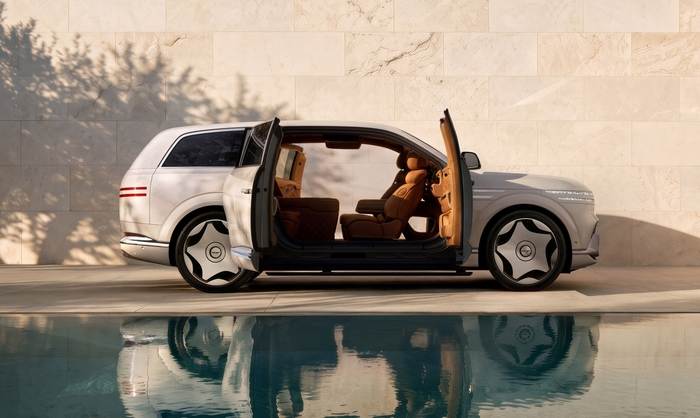
The Palace of Fine Arts in San Francisco is a place for spectacle, and on August 19 Genesis made sure it got one. The GV90 Neolun — its first full-size flagship electric SUV — stepped onto the stage with no B-pillar, no compromise, and a pair of doors that open toward each other like wings. It is, by any honest measure, the most dramatic non-limousine entrance a mainstream luxury brand has attempted in recent memory.
International auto media responded with something unusual for a Korean marque: genuine astonishment. MotorTrend called out the dual-motion hinge and hidden rollcage, noting that the design manages to pair the elegance of a traditional luxury sedan with modern safety rigidity. Car and Driver and Auto Express highlighted the same thing from a different angle — the seamless integration of the “wing face” MLA lamp signature with the flowing body lines that reportedly draw inspiration from Korean moon jars.
That last detail matters more than it might sound. Korean car designers have spent the past decade borrowing visual vocabulary from Europe and America. The GV90 flips the script. It is not asking for permission. It is setting a standard.
Why the Coach Doors Matter More Than They Appear
A pillarless SUV with forward-opening front doors and rear-hinged back doors — often called coach doors — is not new. Rolls-Royce has done it for over a century. But Rolls-Royce operates in a tax bracket all its own. TheGV90 is attempting to make that experience accessible to a wider, yet still premium, clientele, which raises the engineering stakes enormously.
Without a B-pillar, structural rigidity falls on the roof rail, floor pan, and the hinge system itself. The dual-motion hinge that MotorTrend praised is the key innovation here. It allows the front door to swing outward and forward in a wider arc before settling into the open position, reducing the chance of the door clipping objects or passengers during entry and exit. The hidden rollcage integrates crash safety without interrupting the glass expanse that defines the look.
This is not merely aesthetic bravado. Coach-door configurations have plagued concept cars for decades because量产 (volume production) tends to strip them away — cost, safety certification, and manufacturing complexity combine to push engineers toward conventional doors. The fact that Genesis is presenting this as a production-ready vision suggests the company has solved problems most rivals would rather leave in the render phase.
The Interior as Cultural Artifact
If the exterior is a statement, the interior is an argument. Genesis has gone all-in on Korean design references: underfloor radiant heating inspired by ondol warmth systems, warm wood flooring, and 180-degree swivel seats that turn the rear cabin into a lounge configuration. Jalopnik went so far as to call the cabin a “private art gallery.”
The cultural angle is deliberate. In a segment where Mercedes, BMW, and Audi dress their vehicles in a shared language of brushed aluminum, ambient blue light, and minimalist Scandinavian sterility, Genesis is offering warmth — literally and figuratively. The ondol-inspired floor heating is a particularly sharp differentiator. Most luxury EVs rely on conventional forced-air HVAC; radiant heating is both more energy-efficient and a more distinctive sensory experience.
For Western buyers, the exoticism of Korean heritage is a novelty that fades quickly. For Asian buyers — particularly in China, Japan, and Southeast Asia — it signals that a Korean brand can compete on cultural sophistication, not just price. That is the market Genesis wants to expand into next.
Samsung Display’s OLED: The Quiet Engine Behind the Glare
One element the press releases emphasize less than the design language but deserves equal attention is the pop-up OLED screen technology sourced from Samsung Display. The GV90 integrates a display that rises from the dashboard on command, embedding a screen that disappears when not in use — a design move that eliminates the clutter of permanently mounted displays while preserving the high-contrast, deep-black visuals that OLED is famous for.
This is significant because it ties Genesis directly to one of South Korea’s most formidable technology export industries. Samsung Display has been investing heavily in automotive-grade OLED panels, and the GV90 is one of the first volume-production applications to showcase that capability at scale. The competition between LG Display and Samsung Display for automotive display contracts is intensifying, and every OEM that locks in a supplier early gains an edge in component availability.
The implication for the industry is straightforward: the supply chain advantage that Japan and Germany enjoyed for decades — dominated by Denso, Bosch, and Continental — is eroding. Korean electronics firms are now supplying core components to Korean automakers, and theGV90’s interior is a product of that convergence.
What Stuttgart Should Be Worried About
Edmunds captured the underlying tension when it wrote that Genesis, barely ten years old as a standalone brand, is giving century-old luxury marques genuine reason to stay awake at night. Forbes described the GV90 reveal as the moment Genesis finally “prepared to make its dream a reality.”
The uncomfortable truth for Mercedes-Benz, BMW, and Audi is that Genesis is not trying to beat them at their own game. It is reframing the game. The traditional German approach to luxury prioritizes driving dynamics, build quality, and understated prestige. Genesis is prioritizing emotional impact, technological theatricality, and cultural authenticity.
In the SUV segment — the segment where margins are thinnest and volume is highest — this matters most. The Mercedes EQS SUV, the BMW iX, and the Audi Q8 e-tron are all credible products. None of them have coach doors. None of them are making a cultural argument as aggressive as Genesis is making here.
TheGV90 is, at this point, still a concept in many markets. Production specifications, pricing, and availability remain uncertain. But the trajectory is clear. Genesis has demonstrated that it can design a vehicle that generates genuine global excitement — something no Korean brand has consistently achieved in the luxury segment before.
The Next Move
Genesis has set a benchmark. The question now is whether it can deliver. Coach doors on a mass-produced vehicle are mechanically complex and expensive. The swivel-seat configuration raises safety and packaging questions. The pop-up OLED, while stunning, adds another layer of potential failure points to an increasingly software-heavy vehicle.
What is certain is that the German luxury brands can no longer assume the hierarchy is fixed. Genesis is approaching the flagship SUV space with a willingness to take risks that their competitors, weighed down by legacy architectures and brand caution, have largely abandoned.
The GV90 Neolun may be the most important Korean car launch in a decade — not because it will outsell a Toyota RAV4, but because it proves that a non-German brand can redefine what luxury looks like on its own terms.