Google's Gemini 3.8 Flash Is Betting Everything on Coding Speed
Google just shipped Gemini 3.8 Flash three weeks after 3.7, claiming it closes the gap on Claude Opus 5 in coding while holding price steady. The rapid cadence and selective benchmark wins reveal where the competition is actually happening.
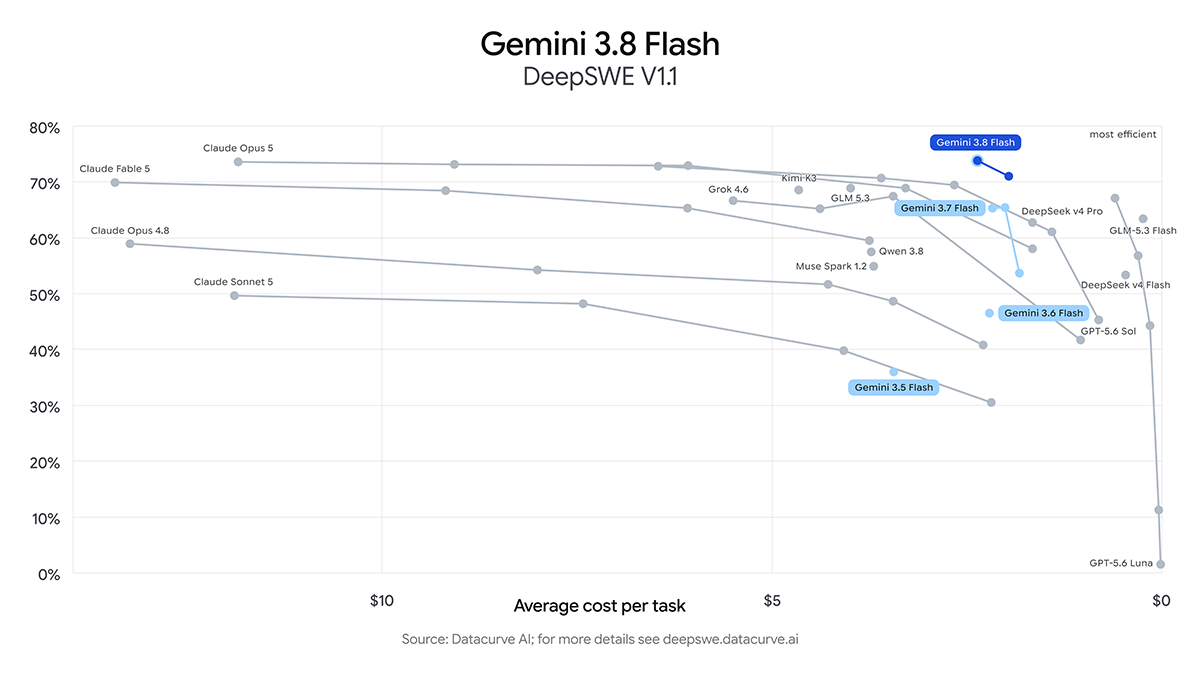
Google moved faster this time.
Three weeks separated Gemini 3.7 Flash from 3.8 Flash. Six weeks separated 3.6 from 3.7. Google is now shipping Flash-tier models at a cadence that most Western desks haven’t had time to properly digest, and the Japanese tech press was among the first to unpack what the numbers actually mean.
The headline claim is straightforward: Gemini 3.8 Flash is Google’s best performer in the Flash line for reasoning and coding, and it matches or edges Claude Opus 5 across several benchmarks while keeping the same price as its predecessor.
But the story is in the details — and in what Google chose not to highlight.
The coding gap is closing, but only in places
Google’sDeepSWE v1.1 score of 73.7% for Gemini 3.8 Flash is the kind of number that makes engineering teams take notice. It sits 0.3 percentage points behind Claude Opus 5’s 74.0%, a distance that would be noise in most contexts. More importantly, it represents an 8.4-point jump from 3.7 Flash’s 65.3%, suggesting Google found genuine headroom in long-horizon software development tasks, not just incremental tuning.
Terminal-bench 2.1 tells a slightly different story. At 89.4%, Gemini 3.8 Flash officially tops Opus 5’s 89.1%. That is a real win, but it measures terminal command execution — a narrow slice of the coding workflow. Vals Finance Agent v2 is another focused victory: 61.4% versus Opus 5’s 58.6%, good enough for first place among six compared models.
Then there is the rest of the leaderboard, and it is less favorable.
Terminal-bench 4.0, a broader general-purpose agent measure, posted just 19.1% for Gemini 3.8 Flash against Opus 5’s 51.8%. OSWorld-2.0, which tests autonomous PC screen operation, came in at 59.0% versus Opus 5’s 75.4%. And GDPVal-AA v2, Google’s own composite knowledge-work rating, gave Gemini 3.8 Flash an Elo of 1545 against Opus 5’s 1824. That is not a close contest.
The pattern is clear: Gemini 3.8 Flash is strongest in structured, domain-specific tasks where the rules are well defined and the evaluation is narrow. It struggles when asked to navigate open-ended environments or sustain complex multi-step autonomy.
Visual reasoning is the unexpected strength
Where Gemini 3.8 Flash makes the most distinctive claim is in visual tasks — an area where Google has historically lagged behind both OpenAI and Anthropic.
CharXiv Reasoning, which tests the ability to extract information from complex charts and graphs, scored 86.2%, beating Opus 5’s 83.7% and GPT-5.6 Sol’s 85.8%. LVBench, measuring long-form video understanding, came in at 87.8% with agent mode enabled, also leading the pack.
Both scores are credible signals. Visual reasoning has been a persistent weakness for many models, and crossing the 85% threshold on these benchmarks suggests Google invested meaningfully in multimodal capabilities within the Flash tier. The flip side: GDP.PDF, a test of specialized document comprehension, landed at only 35.0%, far behind GPT-5.6 Sol’s 40.0%. Google is winning in some visual domains while still falling short in others.
The pricing move is strategic, not generous
Google kept input and output pricing identical to 3.7 Flash: $0.75 per million input tokens and $3.75 per million output tokens through December 31, 2026. After that, both rates double. That is a deliberate window — long enough for developers to integrate and benchmark, short enough to create urgency around adoption before costs climb.
For individual users, the Gemini app bundles access to the model within Google AI Pro ($2,900 yen monthly, with a promotional $720 rate for three months) and AI Ultra ($14,500 yen monthly). These are not AI-only subscriptions; they include Google Drive and Photos storage upgrades, YouTube Premium benefits, and Gmail integration. Google is packaging model access as infrastructure, not as a standalone product.
The Cyber variant, Gemini 3.8 Flash Cyber, added a vulnerability-discovery score of 86.2% on CyberGym — ahead of GPT-5.5-Cyber’s 85.6% and Mythos 5’s 83.8%. But it is only available through the Fairwind Program, a restricted channel limited to government agencies, critical infrastructure operators, and vetted software maintenance organizations. You cannot simply sign up and try it.
What this signals about the competitive landscape
The three-week release cycle is the most consequential detail here. Google is treating the Flash tier as a continuous delivery platform rather than a product line with discrete versions. Each iteration is meant to close gaps before competitors can widen them, and the depth of the DeepSWE improvement suggests that strategy is working — at least in the coding lane.
For Western engineering teams, the immediate implication is that the cost-performance curve for production coding work is shifting faster than the benchmark reports from San Francisco and London suggest. Gemini 3.8 Flash is not beating Opus 5 everywhere, but it is competing within measurement error on the metrics that matter most to developers who ship code for a living.
The models that lose from this are the ones priced at a premium without equivalent gains in coding throughput. The models that win are the ones that can absorb Google’s pricing pressure and still deliver on the agent autonomy tasks where Gemini 3.8 Flash remains weak.
Google’s next move will likely come in another three weeks. By then, the industry will have had time to verify whether these benchmark improvements hold up under real workload conditions — something the Japanese coverage so far has not been able to do.