Murata's Artificial Skin Runs on One AA Battery for 30 Years
Murata's neuromorphic skin sensor achieves 2,500× faster response than conventional systems while consuming just 12 microwatts — potentially running for three decades on a single AA battery. The implications for soft robotics and implantable health monitors could be significant.
The battery life that breaks conventional logic
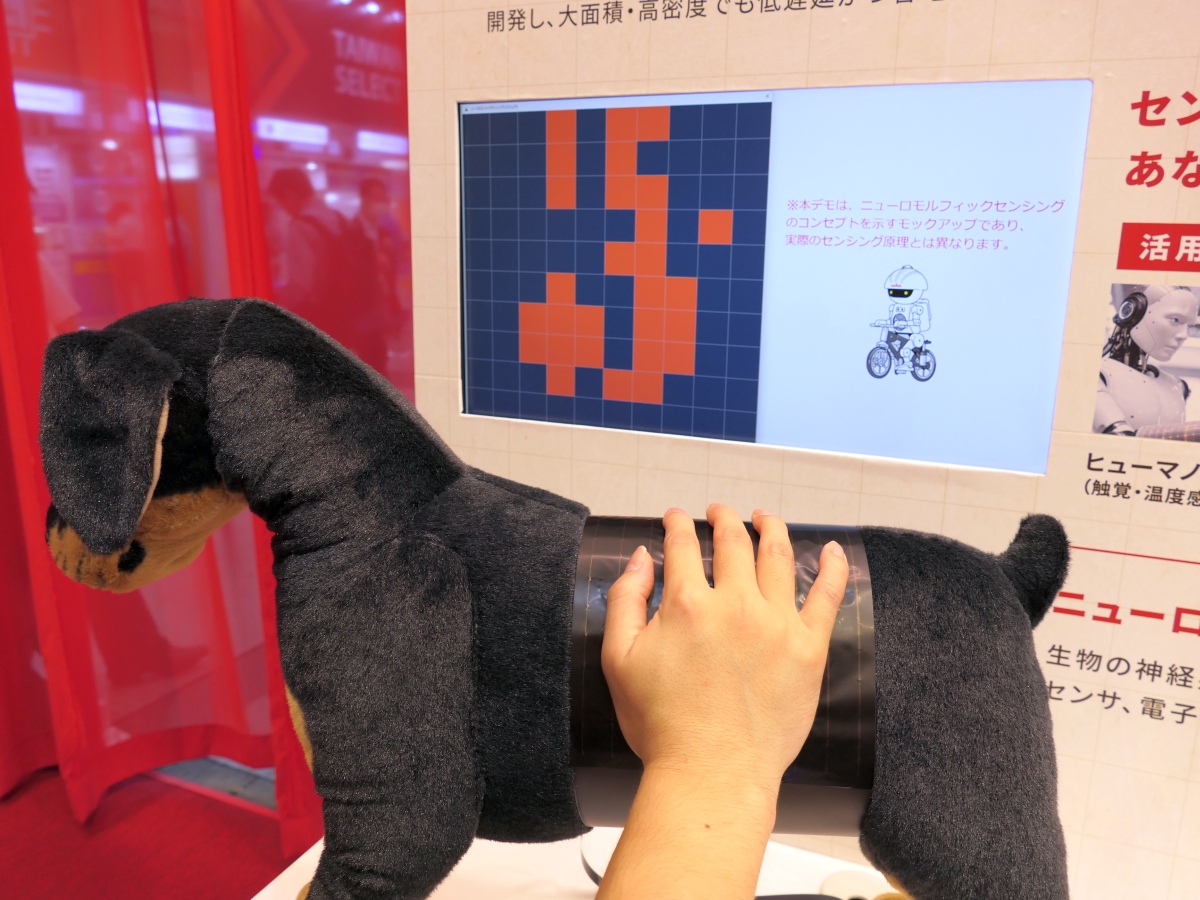
A single AA battery powering a sensor array for thirty years is not a speculative claim — it is the arithmetic result of a 12-microwatt footprint. That number arrived at CEATEC 2026 in Makuhari, where Murata Manufacturing (村田製作所) unveiled what it calls a neuromorphic sensing system, a sheet of artificial skin that detects relative temperature shifts across a dense grid, mimicking how human skin reports warmth and coolness without ever measuring absolute degrees.
The speed figure is more dramatic still. The demo sheet contains 1,024 five-millimeter film thermistors arranged in a 32-by-32 grid. Reading all 1,024 channels and producing a digital output takes 23 microseconds. Murata compares this to a conventional sensor system and lands on a 2,500-times improvement. Whether that multiplier holds against the slowest analog chains currently deployed in industrial equipment depends on the benchmark, but the raw throughput is undeniable.
Why the name invites confusion
Neuromorphic has become a catchword in computing circles, usually attached to brain-inspired architectures that perform inference at the silicon level. Murata’s system does not compute. It senses. The lab partner behind the work is Takehito Yajima (矢嶋赳彬), an associate professor at Kyushu University, and the published research frames the system as a direct biomimetic parallel to peripheral nerve endings in skin, not cortical processing.
That distinction matters because it sets the boundary of what this technology can do. It will not replace a vision sensor or a lidar unit. It sits closer to the human body — the thing that tells you a cup of coffee has cooled by half a degree between sips, or that a hand gripping your arm has tightened. Those are relative changes, and they are exactly what this sensor detects. It reports shift, not scale.
The circuit trick that makes both speed and efficiency possible
Conventional temperature sensing usually routes an analog signal through an amplifier and then through an analog-to-digital converter. Each stage adds latency and leakage current. Murata’s approach eliminates both stages for the sensing path. The film thermistor’s resistance changes steeply with temperature, and a digital readout circuit (DDRO) attached directly to the sensor array converts that resistance change into a digital signal at the point of detection.
The DDRO feeds straight into a digital cell array. No analog front end. No intermediate conversion step. The trade-off is the loss of absolute measurement — without an analog reference, the system cannot report a precise temperature in degrees Celsius. It can only say the thermal state at a given pixel has moved in a particular direction since the last sampling cycle. That is not a flaw in the Murata design; it is the intentional consequence of removing the analog path. Human skin works the same way.
Film thermistors also carry a smaller thermal mass than the chip thermistors common in electronics. Smaller thermal mass means faster response to a temperature change, which complements the digital readout and contributes to the 23-microsecond cycle time.
What this means for soft robotics
Gripping a fragile object with a robotic hand is hard when the feedback loop runs too slowly. A conventional tactile sensor reading a few hundred points at a few hundred hertz can already feel sluggish compared to a human hand, which processes thousands of sensory inputs continuously. Pushing the readout into the 23-microsecond window and multiplying it by over a thousand per second gives a robotic gripper something closer to the temporal resolution of biological touch.
The low power draw changes the form factor question too. A soft-robotics glove or sleeve that relies on battery power today must contend with frequent recharging or heavy cells. If a sensor layer draws microwatts rather than milliwatts, the energy budget opens up for actuators and controllers without expanding the power supply. Thirty-year battery life is mostly a thought experiment for a robot that needs maintenance; but even a fraction of that efficiency gain — months or years rather than weeks — shifts the economics of field-deployed soft robots.
The fact that the sensing element is a thin, flexible film also matters. Rigid sensor boards constrain the shapes robots can take. A sheet that wraps around a curved surface and still resolves 1,024 discrete points is closer to the geometry of real robotic limbs than a plate of hard-mounted probes.
What this means for implantable and wearable health monitors
Implantable devices live or die by their power envelope. Any sensor that can remain active on a coin cell or a small lithium pack for years rather than months represents a step change in what clinicians can monitor continuously. A皮下 (subcutaneous) patch that tracks local thermal patterns — inflammation signatures, blood-flow changes, graft viability — without demanding frequent replacement surgery is a concrete use case.
Wearable patches face a similar constraint, though less brutally. Current smart patches that track temperature, heart rate variability, or skin conductance typically need recharging every few days to a week. A sensor layer that consumes 12 microwatts while scanning a thousand points per second would let a patch report continuously for months on a single small battery, with the remaining power budget devoted to wireless transmission and onboard processing.
The relative-measurement limitation is less damaging in these contexts than it might appear. Inflammation does not announce itself as a specific Celsius reading; it registers as a sustained local warming relative to surrounding tissue. A surgical site monitored for post-operative fever patterns benefits from change detection more than from an absolute number. The sensor is tuned to the signal that matters.
The gaps worth watching
Several practical questions remain open. The demonstration sheet used 1,024 elements; it is unclear whether Murata plans to scale that density higher for production versions, or whether the DDRO architecture scales linearly. The system can, in principle, detect physical quantities other than temperature if the sensor element is swapped, but the breadth of compatible modalities has not been published. Manufacturing yield for large-area film thermistor arrays at volume remains to be seen.
The 2,500× speed advantage over “conventional sensor systems” is a relative claim. The denominator matters. If the comparison is against older multiplexed analog chains in legacy industrial equipment, the gap is real. If it is against modern high-end medical sensor systems already using direct digital readout, the multiplier shrinks. The press material does not specify the benchmark.
And the 30-year battery life assumes the rest of the device draws no power. A real implant or wearable would include a microcontroller, a radio, and perhaps an energy-harvesting circuit. Even so, the sensor layer itself is unlikely to be the dominant drain.
Why this arrives when it does
Japan’s manufacturing sector has been searching for differentiators beyond precision mechanics and materials science. Robotics, in particular, has felt the pressure from competitors who can replicate hardware at lower cost. A sensor that changes the feedback loop rather than the actuator targets a different layer of the value chain. It is not a better motor; it is a better nervous system.
Murata has built its commercial identity on passive components and ceramic multilayer capacitors, parts that sit quietly inside everything from smartphones to automotive inverters. Moving into sensing and neuromorphic architectures extends that position from supporting infrastructure to enabled functionality. The Kyushu University partnership provides the academic credibility; CEATEC provides the platform. Whether the company converts demonstration sheets into shipped products within the next three to five years remains the question that will separate this from another lab showcase.
The physics are sound. The efficiency numbers are exceptional. The path from a demo at Makuhari to a deployed soft-robotic gripper or an implanted health patch is shorter than most CEATEC announcements promise, but it is not yet traveled.