Google's TPU Satellite Experiment Signals a New Compute Frontier
Google launched a prototype satellite with four TPU chips in orbit to test whether AI hardware can survive in space. The one-year experiment could reshape how the company approaches its growing compute crisis.
Google Is Testing Whether AI Chips Survive in Orbit
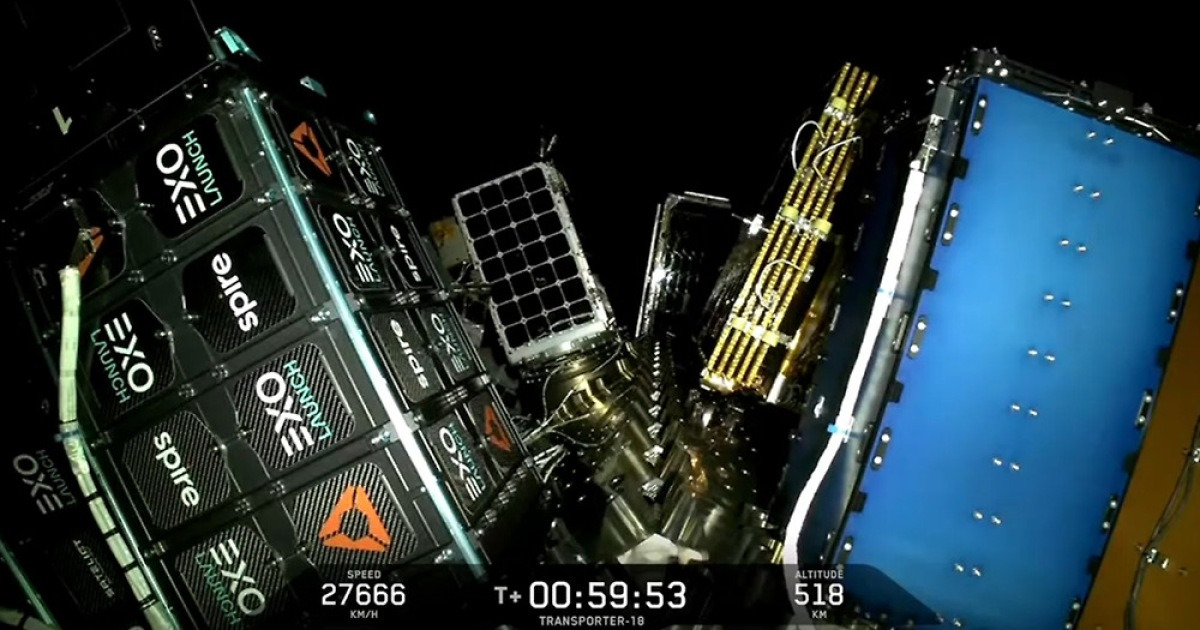
Google launched a prototype satellite on October 1 carrying four TPU chips into low Earth orbit. SpaceX’s Falcon 9 carried the payload from Vandenberg Space Force Base, and the satellite separated from the booster as designed. Rather than deploying solar panels or communication equipment, Google loaded the satellite with custom-designed experimental payloads focused entirely on measuring how AI hardware performs in the orbital environment. The satellite will now spend twelve months circling the planet at approximately 550 kilometers altitude, gathering data that no major AI company has collected before.
This is not a routine infrastructure stress test or a partnership announcement dressed in engineering language. It is a signal that Google is seriously considering whether its next generation of compute capacity will exist beyond Earth’s atmosphere. The decision to build and launch an actual satellite rather than simulate the conditions in a chamber suggests the company views the question as urgent enough to warrant direct empirical investigation.
The One-Year Experiment Has Stakes
The satellite will measure two interdependent variables over twelve months. First, it will track how ionizing radiation from cosmic rays and solar particles affects TPU silicon. Second, it will monitor thermal behavior in a vacuum where conventional convection cooling is impossible. Both questions have practical answers that matter directly to Google’s infrastructure planning, and both have no easy solutions on a chip optimized for Earth-based conditions.
Radiation in orbit causes single-event upsets in semiconductor memory. A single high-energy particle can flip a bit, corrupt a calculation, or trigger a latch-up condition that damages the chip. On the ground, Google deploys massive redundancy schemes, error-correcting memory, and scheduled maintenance cycles to manage these failures. In orbit, those strategies face fundamental constraints. Power is limited. Cooling is restricted. Repair is impossible without a crewed mission. If Google’s TPU chips show significant performance degradation over the year, the company will know it must either redesign the chips for radiation hardening or develop heavy shielding solutions that increase launch mass and cost. If they survive with minimal error rates, that removes one major technical barrier to orbital compute.
The thermal problem may prove even more difficult. Without atmospheric convection, heat can only leave a chip through thermal radiation and conduction through physical mounting points. Data centers rely on liquid cooling loops, precision air flow management, and often on-site water treatment for evaporation. A satellite has none of that infrastructure. Google will learn whether its current chip packaging and thermal interface materials can handle sustained AI training workloads in a vacuum, or whether the company needs to develop entirely new thermal architecture designed specifically for space deployment. The failure mode here is not catastrophic failure but gradual performance throttling as thermal limits force the chips into lower power states.
Why This Matters for AI Compute Strategy
Google’s motivation is almost certainly grounded in the escalating difficulty of building and operating data centers on Earth. Power availability has become a binding constraint across the industry. Utilities in Virginia, Ohio, and Texas are reporting that new data center applications are outpacing grid expansion timelines. Land near population centers and fiber routes is scarce and expensive. Water consumption for cooling draws regulatory scrutiny and community opposition. The economics of adding another 500-megawatt facility are worsening, and local governments are pushing back against the strain on infrastructure.
These pressures are not theoretical. Google’s parent company Alphabet reported in its latest earnings call that energy costs and availability were a material factor in capital allocation decisions. Competitors are making similar statements. The pattern across the industry suggests that the current model of scaling compute by building larger terrestrial data centers faces diminishing returns.
Space offers a different constraint set. Solar energy is essentially unlimited at orbital altitudes. The environment presents no land-use conflicts, no water rights disputes, and no local zoning opposition. But it is brutal for unshielded electronics. That tension between opportunity and hostility is precisely why this test exists. Google is not looking for an easier place to build data centers. It is testing whether the alternative is technically viable at all.
If the chips survive radiation and thermal stress, the next logical step is connecting multiple satellites into an orbital compute array. Google’s internal documents and public statements have not outlined that architecture, and the company has been deliberately vague about its long-term intentions. But the trajectory is unmistakable. The company would be testing whether distributed AI training can run above the atmosphere rather than below it.
Latency Is the Real Bottleneck
The most honest obstacle to orbital AI is not radiation or heat. It is latency. Light takes roughly thirty milliseconds to travel from low Earth orbit to the ground and back. For inference workloads that depend on real-time responses, that round-trip time is prohibitive. Training jobs that run asynchronously face the same constraint in reverse: training data must travel upward to the satellite cluster, and computed gradients must return downward. Bandwidth to orbit remains severely limited compared to fiber connections on Earth.
This means a space-based TPU cluster is unlikely to serve user-facing AI applications directly. Google would not replace its ground data centers for Search queries, YouTube recommendations, or Android updates. Instead, the viable use cases are narrower and more specific: batch training jobs that can tolerate delayed results, scientific computation that benefits from isolated high-performance environments, and perhaps future workloads that require massive parallelism more than immediate responsiveness.
The company may also be considering a hybrid architecture. Split non-time-critical components of large training runs across orbital nodes while keeping latency-sensitive workloads on Earth. That approach is technically feasible and would avoid the worst of the latency penalty while still accessing orbital capacity. Google has not confirmed this strategy, but it represents the most economically rational path if the satellite experiment succeeds.
What This Signals About Google’s Long Game
The experiment reveals something important about how Google thinks about infrastructure. The company treats compute capacity as an engineering problem with no inherent geographic boundary. It has already explored undersea cables for data transport, experimented with modular submerged data centers, and developed containerized server designs for rapid deployment. A satellite is a natural extension of that mindset, not a pivot into speculation.
It also signals that Google expects Earth-side capacity constraints to worsen before they improve. The more charitable interpretation is that the company sees a genuine long-term trend toward energy scarcity and regulatory friction. The less charitable reading is that Google views current expansion restrictions as surmountable obstacles and is preparing fallback options. Both interpretations could coexist.
SpaceX’s involvement matters significantly here. The partnership gives Google ride-hail access to orbit at launch costs that were financially impossible a decade ago. Without SpaceX’s reusable Falcon 9 rockets, this experiment would carry a price tag an order of magnitude higher and would require a government contract rather than a commercial arrangement. The commercial space launch market has fundamentally altered the calculus for companies considering orbital infrastructure.
The Hard Question Is What Comes Next
Google has not announced how many satellites it plans to eventually deploy. It has not disclosed which specific workloads it intends to move to orbit. It has not explained what the financial model looks like if the experiment succeeds and the company decides to scale. Those details will come later, if they come at all. The company appears to be treating this first year as a genuine scientific investigation rather than a product launch in disguise.
What is clear is that Google is willing to commit real hardware and real orbital slot to answer basic questions about AI in space. That commitment alone is noteworthy. Most technology companies would treat orbital compute as an academic exercise and move on. Google is building a satellite, paying for a launch, and waiting twelve months to see what the data says.
The result will determine whether orbital compute represents a viable path forward for the next phase of AI infrastructure or remains a technical curiosity. Either outcome provides useful information. A failure would tell Google precisely what not to attempt and could steer the company back toward terrestrial solutions with renewed focus. A success would open an entirely new domain of compute capacity that existed only in theoretical discussions until now.
For now, four TPU chips are circling the planet at 550 kilometers altitude, running diagnostic tests that no major AI company has conducted in orbit before. The data they return over the coming year will shape Google’s infrastructure strategy for the next decade. Whether the chips degrade or endure, the experiment itself marks a shift in how the industry thinks about where artificial intelligence can live.