GTA6 Trunk-Stream Mechanic Signals Rockstar's Post-Online Pivot
Rockstar's first 26-minute GTA6 gameplay reveal included a character live-streaming from a stolen car's trunk with real-time viewer comments—a design choice that reveals how seriously Rockstar is taking the live-service pressures reshaping the franchise.
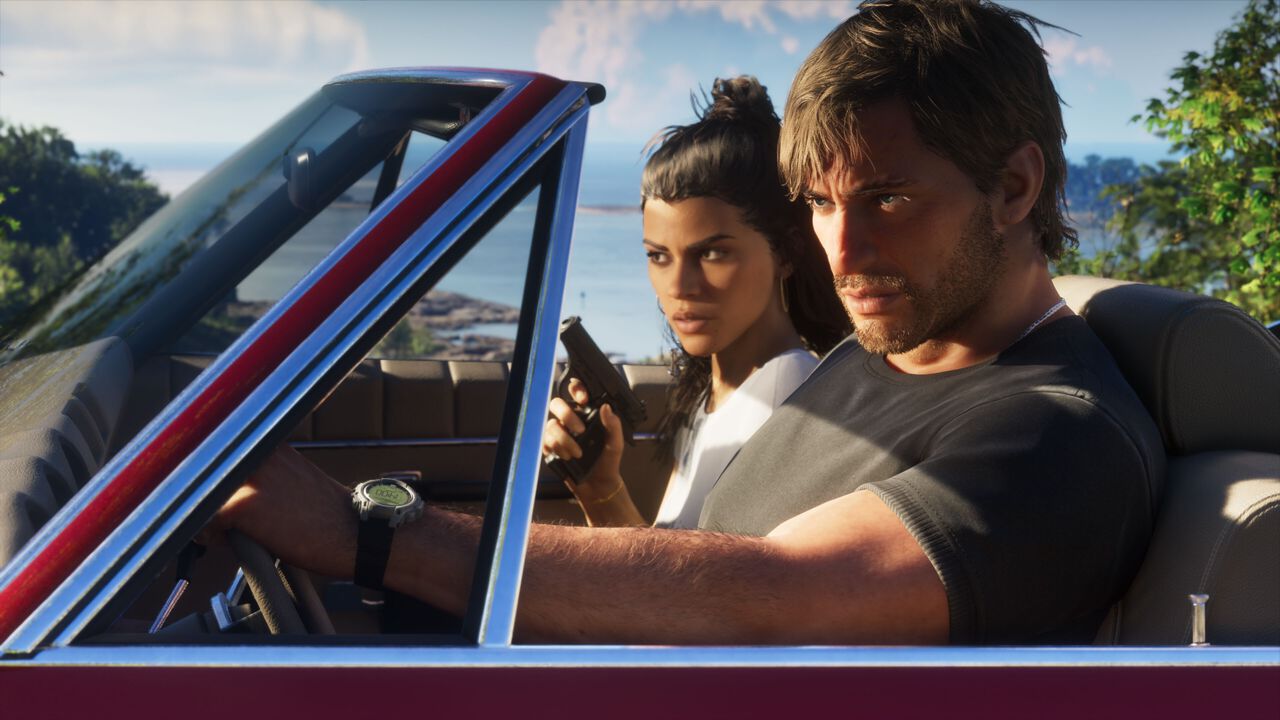
The Detail No One Is Talking About
Not the dog. Not the one-handed shotgun reload. Not even the dual-character switching mechanic with its pulsing heart icon. The most consequential moment in Rockstar’s first 26-minute GTA6 gameplay reveal happened in a stolen car’s trunk, where a character ignited a live stream and viewer comments scrolled across the screen in real time.
This is a social media mechanic built into the DNA of a single-player-open-world game at a level Rockstar has never attempted before. It is also, if taken seriously, evidence that Rockstar is engineering GTA6 to survive in a post-GTA Online world where the line between playing a game and broadcasting it has collapsed.
The video premiered on Netflix at 4 a.m. Japan time on August 28, followed by a YouTube and official site rollout at 10 a.m. All footage was captured on PS5 hardware. Famitsu secured an exclusive interview with Rob Nelson, Rockstar North’s Head of Development and Co-Studio Head, and reading that interview alongside the video clarifies what the footage is actually saying about the game’s direction.
A Game Designed for Screens Within Screens
The streaming-from-trunk scene is not a cutscene. It is a systemic interaction: you steal a car, climb into the trunk, and your character initiates a broadcast. The game renders viewer comments flowing live. This is emergent multiplayer logic masquerading as a goofy side moment—and that disguise is intentional.
Rockstar is acknowledging what every player already knows: the most watched GTA content doesn’t happen inside GTA. It happens on Twitch, YouTube, and TikTok, where streamers turn Randolf into a backdrop for personality-driven performance. By baking a streaming layer directly into the game’s world, Rockstar is closing the loop. The fantasy is no longer just living inside a satirical America. It is living inside an America where everyone is already performing for an audience.
The implication for game design is subtle but significant. Streaming mechanics like this create natural content-generation moments—unscripted, replayable, shareable—without requiring Rockstar to build a separate social platform or force multiplayer onto every session. It is live-service thinking applied to a fundamentally single-player experience.
The Monetization Shadow
GTA Online generated tens of billions in revenue after the base game shipped. That number created an impossible benchmark. Any new Rockstar release will be measured against a live service that has been running for over a decade, funded player salaries, and established expectations around constant content drops and microtransaction ecosystems.
Rockstar cannot simply release GTA6 as a premium boxed product and walk away. The market has moved. Players expect ongoing support. Publishers expect ongoing revenue. But Rockstar also cannot simply replicate the GTA Online model, which has grown increasingly brittle under the weight of its own success—fragmented lobbies, predatory pricing, and a feedback loop that rewarded grinding over play.
The streaming mechanic sits at the intersection of these pressures. It generates organic social content that drives discovery and retention. It mirrors the behavior of the existing player base without requiring them to log into a separate mode. And it could serve as a bridge to whatever multiplayer architecture Rockstar is building for the long term—without announcing it as such on day one.
What Else the Footage Reveals
The dog mechanic deserves mention. A “SCOLD” button appears during a scene where the character interacts with a stray dog, strongly suggesting a pet system with behavioral feedback rather than a cosmetic companion. This is the kind of detail that signals Rockstar is investing in environmental storytelling through small, repeatable interactions—the same philosophy that made GTA V’s world feel alive even in 2013.
The combat system has clearly evolved. Lucia fires a shotgun one-handed while moving. A bullet-time gauge appears during escort missions, suggesting tactical slow-motion is a core pillar rather than a novelty. The weapon wheel confirmed only eight slots—weapons, items, fists, and binoculars—which points to a deliberate curation strategy rather than inventory bloat.
Character switching between Jason and Lucia includes a heart icon displayed between their portraits, hinting at a relationship system that tracks and responds to player choices. This is Rockstar moving beyond the static partnership of GTA V’s Trevor and Michael into something with visible emotional state tracking.
Activities on display include airboats, basket diving, gym workouts, jet skis, sea kayaks, strip clubs, drag races, shooting ranges, and motocross. The game’s world feels denser and more vertically varied than any previous entry, with heli and aircraft traffic visible even in urban dining scenes.
Why This Matters Beyond the Hype Cycle
GTA6 has been the most anticipated game in the industry for years. A 26-minute gameplay reveal generates its own news cycle regardless of content. But the trunk-streaming detail is the kind of specific,系统设计-level choice that reveals Rockstar’s actual priorities more honestly than any press release or trailer.
The studio is building a game that understands its players are already living in a mediated, performance-oriented culture. It is designing for that reality rather than fighting it. Whether that approach sustains a live service model or simply makes the single-player experience more culturally resonant remains to be seen—but the instinct feels right for a franchise entering its second decade of dominance.
Release date is November 19, 2026. The question is no longer whether GTA6 will succeed. It is whether Rockstar’s vision of what the franchise should become will align with what the market actually demands.