Gulf States Bet on Iran as US Security Umbrella Falters
Gulf states are pursuing a security framework that includes Iran — a striking reversal that signals Washington's declining credibility as the region's guarantor and could redraw Middle Eastern alliance networks.
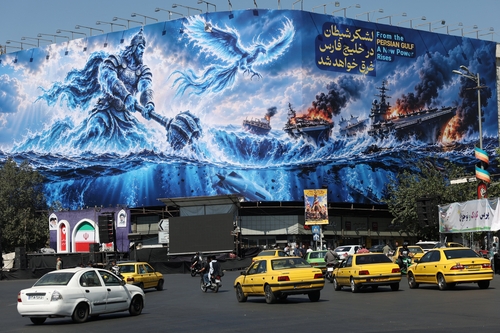
The Gulf Is Redrawing Its Security Map — And Iran Is Part of It
For decades, the American security guarantee was the invisible architecture of the Persian Gulf. It held — or at least, it held enough. Now it is cracking, and the Gulf states are not waiting for Washington to patch it. They are building something else.
According to a Financial Times report published September 22, Emirati, Qatari, and Saudi officials are actively exploring a regional security framework that brings Iran into the fold — not as a subordinate, but as a participant in a pact built on dialogue and mutual non-aggression. The implication is stark: the countries most vulnerable to Iranian missiles and drones are now the ones pushing hardest to institutionalize a relationship with Tehran.
That is not a normal trajectory. It is a signal.
A Wake-Up Call, Not a Policy Adjustment
Sheikh Mohammed bin Abdulrahman Al Thani, Qatar’s prime minister, put it plainly at the UN General Assembly. The recent Middle East war — the one that exposed the fragility of Gulf defenses against Iranian-capable strikes — was a “wake-up call” for a new regional order.
“Gulf states must act responsibly together at the regional level and maintain good relations with Iran,” he said. “If there is no security framework binding Gulf states and Iran so that neither threatens the other, this region cannot continue as it has.”
UAE presidential adviser Anwar Gargash offered the same geographic realism. “Iran is still our neighbor,” he said. “Geography gives us no alternative to engagement with Iran.”
These are not back-channel remarks. They are public declarations from leaders who have spent years positioning themselves as the region’s anti-Iran hardliners. Their tone has shifted because the conditions that produced that tone have shifted.
The Unspoken Truth: Deterrence Alone Isn’t Enough
The Saudi angle may be the most consequential. According to Middle East diplomats cited by Yonhap, Riyadh has been discussing a mutual non-aggression agreement with Iran and other regional states since the outbreak of the recent conflict. A formal pact of this kind would be the first of its kind between Riyadh and Tehran — a country Saudi Arabia has repeatedly called a destabilizing force and with which it fought a devastating proxy war in Yemen.
Samuel Bachalli, a research fellow at Chatham House, captured the strategic calculus in a single sentence: Gulf leaders recognize that without a reliable US anchor, they must manage their own security.
But “managing” security is different from building it. The Gulf states have spent years buying American weapons systems — F-35s from the US, Patriots, THAAD batteries — while relying on American intelligence and naval presence for deterrence. None of that insulates them from the realization that Washington’s commitment is now conditional, unpredictable, and increasingly reluctant to absorb regional conflicts on their behalf.
Who Wins, Who Loses
Iran wins by simply being brought into the room. A security framework that includes Tehran — even a minimalist non-aggression arrangement — legitimizes its regional role and gives its leadership a diplomatic trophy after years of isolation. No deal needs to resolve the core disputes over nuclear enrichment, proxy networks, or missile programs. Inclusion is the prize.
The Gulf monarchies win by hedging. They buy time to diversify their security partnerships — diversification that, notably, has already been underway through deeper ties with China, Turkey, and European defense industries. A non-aggression framework with Iran reduces the immediate risk of escalation and frees up political capital for those longer-term bets.
The United States loses in ways that go beyond a single neighborhood. If the Gulf — the region most critical to global energy flows and home to the world’s largest American military footprint outside Europe — concludes that American security guarantees are unreliable, the precedent radiates outward. Allies in Asia, partners in Eastern Europe, and clients across the Middle East will all measure their own commitments against the same question: Can you actually protect me when it counts?
Regional intermediaries lose. Countries like Egypt, Jordan, and Iraq — whose foreign policies have partially rested on mediating between Gulf rivals and Iran — could find their leverage diminished if the rival camp itself decides to lock in a bilateral truce. The mediators become unnecessary.
What Comes Next
The most likely scenario is not a grand treaty but a series of quieter understandings. Background channels between Saudi and Iranian officials are already active. Qatar has positioned itself as a host for back-channel talks for years — it mediated the US-Taliban agreement and facilitated broader Gulf-Iran de-escalation before. Expect Doha to play that role again.
The UAE is likely to pursue a dual track: public engagement with Tehran alongside continued defense modernization funded by American and European contracts. The kingdom will move more slowly, constrained by domestic ideology and the memory of the Yemen war, but the direction of travel is clear.
Energy markets should pay attention. The Gulf accounts for roughly a third of global oil production. Any reduction in the probability of major regional conflict — even an imperfect one — is a structural positive for supply stability. Conversely, the absence of a framework keeps the region one miscalculation away from disruption.
Defense contractors face a more ambiguous picture. American firms have dominated Gulf arms sales for decades. As Gulf states diversify their security posture, that market share is not guaranteed — though it is unlikely to evaporate quickly given the embedded nature of US systems.
The Bigger Pattern
This is not an isolated Gulf adjustment. It is part of a broader retreat from American-centric security architectures that has been accelerating for years. The Gulf’s pivot toward a multipolar security order — one where Iran is a participant rather than a pariah, where Washington is a partner rather than a guarantor — will test whether the United States can adapt its alliance strategy to a world that no longer assumes its permanence. If it cannot, the cost will not be measured in lost base rights or missed contracts. It will be measured in a Middle East that stops looking to Washington for its safety.