Hanwha's K9 Howitzer Breaks the US Army Gate, but the Real Battle Begins Now
Hanwha Aerospace won a $262 million prototype contract for the US Army's Mobile Tactical Cannon program, cracking a market long dominated by American and European firms. The path to a $7 billion production deal depends on a single, brutal metric: whether Korea can localize half its supply chain on American soil.
A Crack in the Iron Wall
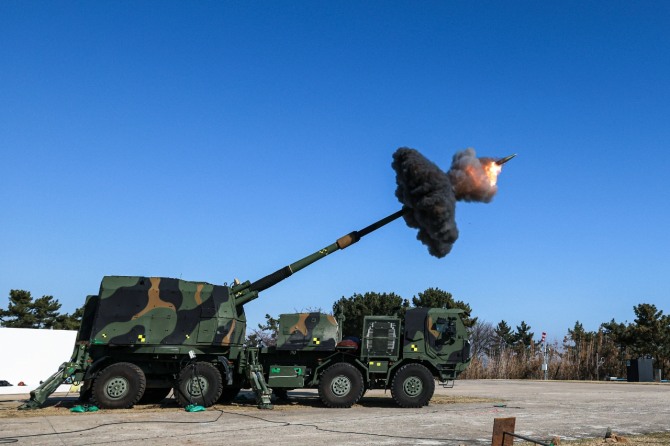
Hanwha Aerospace just did something the Pentagon’s most conservative procurement system rarely permits: a foreign company’s prototype was selected for the US Army’s next-generation artillery modernization program. The Mobile Tactical Cannon — or MTC — contract is worth up to $262 million. That number is not the story. The story is what sits behind it: a $7 billion mass production program that has never been awarded to a non-American manufacturer.
The K9MH, a wheeled variant of Hanwha’s already-exported K9 thunderbolt howitzer, was chosen over competitors in a selection that signals a shift. The US Army, long satisfied with domestic producers like BAE Systems and General Dynamics, has opened a door. Whether Hanwha walks through it — and stays — depends on a number that barely made headlines: 50 percent.
The Localization Mandate
Hanwha’s current supply chain for the K9 already sources roughly 40 percent of its components from American suppliers. That is respectable for an initial entry. It is not enough to win the long game.
Bloomberg Opinion’s Juliana Liu reported that Pentagon officials and congressional protectivists will expect Hanwha to push American content above the 50 percent threshold before any production contract is on the table. The logic is straightforward: Buy-American provisions exist precisely to prevent the kind of dependency that would see critical artillery systems built on foreign soil with foreign labor. A prototype contract is a test drive. The production contract is the lease — and the lease comes with strings.
Hanwha has already demonstrated it can localize aggressively. In Poland, it transferred technology, established local parts production, and spun up a guided-missile joint venture. In Romania, it opened a European hub factory targeting up to 80 percent localization. Those are blue-ocean markets with little incumbent competition. The US market is different. The incumbents are American. The political scrutiny will be intense. And the supply chain is deeper, more regulated, and far less forgiving.
The Hyundai-LG Warning
Korea’s manufacturing model — speed, precision, cost discipline — has won contracts across Europe and the Middle East. Transplanting that model to American soil is another matter entirely. The cautionary tale arrived last year when Hyundai Motor and LG Energy Solution’s massive battery joint venture in Georgia became the target of an Immigration and Customs Enforcement raid. Hundreds of Korean technical workers were detained. The project did not collapse, but the incident exposed how fragile cross-border industrial expansion can be when legal, political, and labor environments shift without warning.
Hanwha will study that episode closely. The lesson is not that localization is impossible in the United States. The lesson is that it requires a different rhythm than Korea’s domestic supply chain. You cannot simply import your most efficient workers and replicate Busan-style output in Alabama. You have to build, train, and certify a local ecosystem — and do it fast enough to remain competitive on price and delivery.
The Ukraine Effect
Hanwha’s ability to compete in the MTC program did not emerge from nowhere. It was forged in the artillery wars of Ukraine. Since Russia’s full-scale invasion in 2022, European stocks of Soviet-era and aging Western howitzers have been depleted. The Western defense industrial base proved too slow, too expensive, and too risk-averse to fill the gap quickly. Korea stepped in.
The K9 has become the benchmark — not because it is the most advanced system on paper, but because it is proven, priced competitively, and deliverable in months rather than years. South Korea’s decades-long preparation for a possible war on the Korean Peninsula created a mobilization infrastructure that European and American firms simply do not match. That infrastructure collided with Ukraine’s urgent demand and produced a structural advantage.
But Ukraine opened the European market. America is the strategic market. Winning there changes everything.
The Philadelphia Connection
Hanwha’s advance into the US defense apparatus is not limited to artillery. Hanwha Ocean — formerly Pohang Iron and Steel Co.’s shipbuilding division — acquired the Philadelphia Navy Yard and has been securing US Navy maintenance, repair and overhaul contracts. Bloomberg Intelligence noted that each successive win in the US market functions as a credibility guarantee for other NATO countries. A Korean howitzer in American inventory is a signal that travels far beyond the Pentagon.
If Hanwha secures the MTC production contract, the ripple effects would extend to ammunition supply lines, training programs, and potentially broader platform integration with US forces. That is the kind of entrenched position that makes replacement difficult — and valuable.
What Happens Next
Hanwha Aerospace shares have been climbing to record levels, pricing in expectations of massive overseas orders. The market is forward-looking. The question now is whether the fundamentals can sustain the valuation. A prototype contract is a milestone. A production contract is a business.
The 50 percent localization requirement is the gate. Hanwha has two paths: accelerate American supplier development while preserving the cost and speed advantages that won the MTC selection, or risk being positioned as a premium foreign alternative that cannot meet Buy-American thresholds.
The first path demands patience, capital, and political navigation. The second guarantees that Hanwha remains a supplier of last resort rather than a partner of first choice. The $7 billion program will not wait. Other bidders are already moving. And the US Army, for all its openness to new options, will ultimately choose the vendor it can depend on — not just on the range, but on the supply chain.