Hegseth Impeached by a Republican — What Happens Next
A Republican congressman has filed impeachment articles against Defense Secretary Pete Hegseth over unauthorized war powers with Iran, splitting Trump's own party just months after confirmation. The move reveals fractures inside the GOP on civil-military norms and raises questions about loyalty versus institutional guardrails.
A Republican Just Tried to Impeach Trump’s Defense Secretary
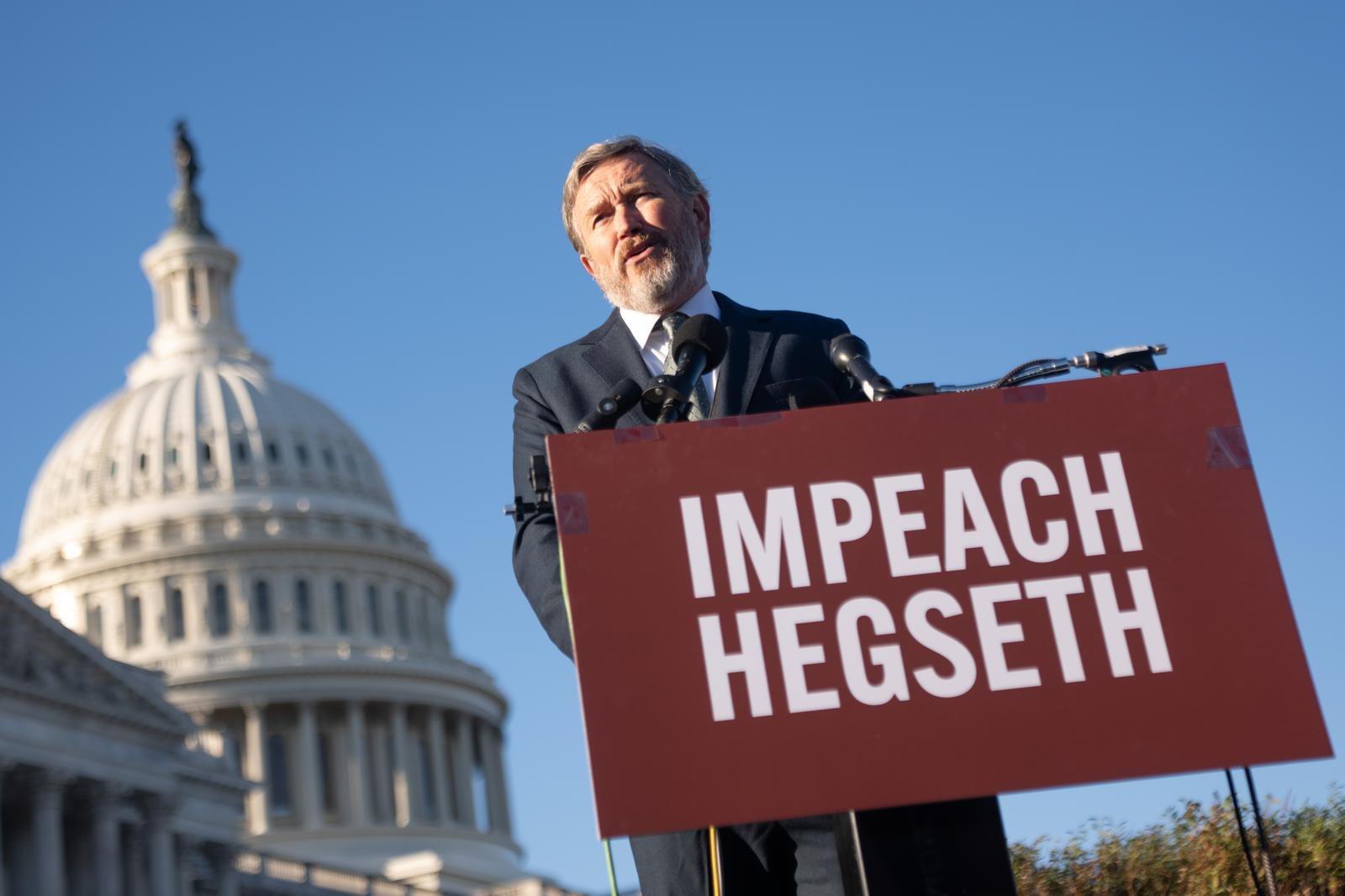
Thomas Massie, the Kentucky Republican known more for libertarian contrarianism than frontline governance, did something almost unthinkable this week: he formally introduced eight articles of impeachment against Defense Secretary Pete Hegseth before the U.S. Capitol.
The articles center on allegations that Hegseth authorized and sustained military operations against Iran without congressional approval, violated the War Powers Resolution’s mandated troop withdrawal timelines, and continued combat missions even as congressional leaders on both sides pressed for de-escalation. That Massie, a fellow Republican, initiated the process rather than any Democrat is the detail that should alarm anyone tracking the party’s trajectory under Trump.
Massie did not mince words at a press briefing outside the Capitol on November 9. He accused Hegseth of being “very capable” of killing schoolchildren in Iran and of carrying out what he described as extra-judicial killings. His language was deliberately incendiary — designed to force a vote fast and force colleagues to pick a side.
The Mechanics Are Moving Faster Than Expected
Massie used an expedited procedure to compel a floor vote within 48 hours, which means the House is expected to vote on November 11. The arithmetic is simple but fraught. Republicans hold 218 seats to Democrats’ 214. If even five Republican defectors join every Democrat, the resolution passes.
That number — five — is where the real story lives. Massie himself is one. How many others cross the aisle? The answer depends on whether rank-and-file Republicans prioritize party loyalty or constitutional restraint when it comes to presidential war-making authority. That question cuts deeper than any single impeachment vote; it goes to the structural future of congressional check-and-balance power.
Even if the House impeaches — and passing the threshold is far from certain — conviction requires two-thirds of the Senate. Republicans control the Senate now, making removal unlikely in the current Congress. But that timeline shifts dramatically once the next Congress convenes next year, especially if midterm election results flip chamber control. This impeachment is likely a long game, not a quick execution.
Hegseth Is Digging In — and Trump Is Backing Him Hard
Hegseth dismissed the proceedings as mere noise, telling reporters he has instructed his staff and the armed forces not to be shaken by what he called political chatter. He reaffirmed his position that action against Iran’s nuclear program was non-negotiable and that hesitation would have been dangerous. He is scheduled to hold a formal Pentagon press conference on November 10, the first in roughly six months, giving him a rare platform to address the accusations directly.
Trump offered equally blunt support. Speaking from the White House, he framed Hegseth as a two-war victor and questioned why anyone would impeach a general who wins conflicts. He called Massie a “stone-cold loser.” The president’s instinct remains clear: absorb the heat, protect the appointment, make the opposition look petty.
But here is where the situation gets messier than either public statement suggests.
Inside the Administration, Calculus Is Shifting
According to reports from The Washington Post, Trump’s incoming chief of staff, Stephen Miller, has raised private questions about how aggressively the White House should defend Hegseth through the entire impeachment gauntlet. One administration insider told the Post that options are being discussed — including the possibility that the White House cuts loose Hegseth sooner rather than later if the political cost becomes too steep.
This is the most consequential signal in the reporting. It suggests that even inside the innermost circle, defenders are weighing whether Hegseth’s survival matters more than preserving institutional credibility or managing fallout from an unpopular conflict. The Iran war has already been cited as a factor in midterm election losses. Protecting a secretary-of-defense embroiled in an impeachment battle over that same war may be seen as dragging the president’s brand further into the red.
What This Means Beyond Washington
For allies in Asia and Europe, this episode reinforces anxieties about the reliability of U.S. security commitments when they depend on a single executive’s discretionary war powers. Hegseth’s actions against Iran — whether viewed as decisive leadership or unilateral overreach — were justified on the grounds that congressional deliberation would have been too slow. That logic, repeated across multiple crises, erodes the very institutional framework that has underwritten alliance architectures since World War II.
In Korea and Japan, where U.S. troop deployments are foundational to deterrence postures, the image of a sitting defense secretary facing impeachment from his own party for conduct during active military operations is not reassuring. It suggests volatility at the top of the chain of command that adversaries like North Korea and China will note and potentially exploit.
Who Wins, Who Loses
Massie wins headline attention and positions himself as a constitutional checkpoint inside a Republican Party increasingly defined by personal loyalty over institutional fidelity. Hegseth survives so far but faces a political death spiral if defections multiply and Miller’s faction gains leverage. Trump consolidates short-term loyalty signaling but risks normalizing impeachment as a routine partisan weapon rather than a last resort.
Democrats gain ammunition for future electoral messaging regardless of the vote outcome. Independent voters and moderate Republicans face a harder choice between tribal allegiance and what they see as lawful governance.
The Iran conflict itself neither escalates nor de-escalates because of this impeachment — it simply continues under the cover of an executive branch that no longer finds unified defense behind its military decisions.
What happens next depends less on procedural outcomes than on whether five Republicans decide that protecting congressional war powers matters more than protecting a friend of the president. Until that count is known, no one should assume the default path runs straight to conviction or straight to dismissal.