Why Anno's Return to Yamato Is the Anime Story of 2026
Hideaki Anno and Yutaka Izubuchi are teaming up for a new Space Battleship Yamato theatrical film that will diverge from the ongoing 2199 series. Here's what the English-language coverage is missing about why this matters.
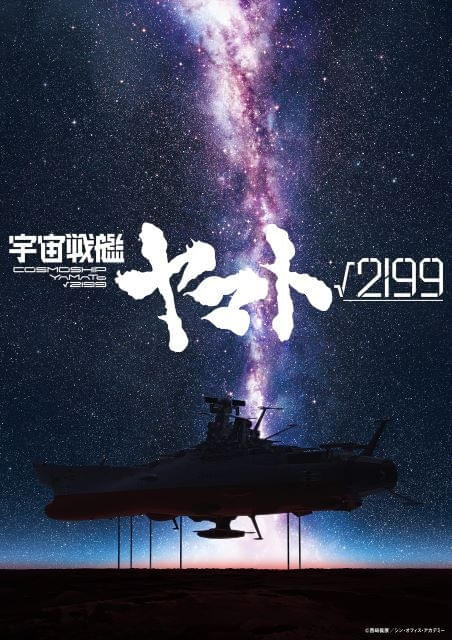
The Announcement No One Saw Coming
On February 6, 1974, Japan’s television screens flickered with the first broadcast of Space Battleship Yamato — a mecha-less, hopeful war drama about a ship launched from a radioactive ruin to beg a distant galaxy for salvation. Fifty-two years later, Hideaki Anno returned to that same origin point. Not to remake it. To reinvent it.
The project, titled Yamato √2199 (Root 2199), is a theatrical feature that splits sharply from the ongoing 2199 series. It represents the first joint production between Studio Color, Anno’s own house, and Production I.G, the studio behind Ghost in the Shell and Patlabor. Yutaka Izubuchi — the director who shepherded the 2199 reboot through six films — serves as co-director and shares design work with Anno. The announcement dropped on the original broadcast anniversary, a deliberate echo that Japanese fans read as both tribute and declaration.
What English wire services are likely to reduce to “new Yamato movie announced” misses the structural shift beneath the headline. This is not a continuation. It is a divergence.
The √ Symbol Decoded
The square root symbol in the title is the most quietly loaded choice in the entire package. In Japanese math notation, √ doesn’t merely mean “alternate timeline” — it means extraction of a fundamental value from a larger equation. √2199 reads as: take the essential root of the 2199 series and solve for a different variable.
The ongoing 2199 films have been running since 2012, accumulating five entries across two years of release. They follow a relatively faithful reimagining of the original 1974 story, updated with modern animation density. Root 2199 abandons that architecture entirely. According to production notes released by Toho, the new film will not use the existing 2199 continuity model, which has been built around incremental canon expansion — new episodes, expanded arcs, character backstories woven into the larger timeline. Instead, Root 2199 returns to a singular event structure: one ship, one mission, one film. That compression is unusual in an era when anime franchises typically expand rather than contract.
Anno’s comments confirm the intent: “We want to keep making Yamato not just to fulfill a childhood dream, but because we carry prayers and wishes for the next generation and our peers in it.”
That second clause — directed at peers and the generation after — is Anno’s signal. His 2021 Evangelion: 3.0+1.0 Thrice Upon a Time was an epitaph for a creator talking to his contemporaries about ending a four-decade mythos. Root 2199 is his statement about what comes after epiphanies. Evangelion’s ending asked whether characters could survive the collapse of their world. Yamato’s premise has always asked whether they can rebuild it. The philosophical throughline is unmistakable to anyone who has tracked Anno’s career from NERV to Iscandar.
Why Studio Color and Production I.G Matter
Studio Color was founded by Anno specifically to produce his post-Evangelion work. Its first major output was the 2026 Shin Kamen Rider film; its catalog remains narrow by industry standards. Production I.G is a veteran studio with deep roots in cyberpunk aesthetics, mechanical design, and internationally exported franchises. Their collaboration is not a merger of equals — it is an apprenticeship structure inverted. Anno brings the vision; I.G brings the pipeline muscle.
This partnership carries second-order implications for the broader industry. I.G’s involvement means the film will meet international distribution standards that Studio Color has not yet proven it can sustain independently. The studio’s previous credits are primarily domestic releases with limited overseas theatrical footprint. A Root 2199 co-production with I.G opens the door to simultaneous or near-simultaneous global release windows — something that would be unprecedented for an anime project anchored in a legacy IP rather than an original property. The business model shifts from licensing plays to co-financing.
Izubuchi’s presence bridges both camps. He directed the 2199 reboot, worked on Patlabor the Movie with I.G, and has spent thirty years designing mecha that treat technology as narrative rather than spectacle. His dual role as co-director and designer means the ship itself — Yamato — becomes the primary storyteller, the way it always was in Furuya Yoshinobu’s original concept art. Where modern anime tends to animate around characters, Izubuchi’s design philosophy treats the vessel as an environment that shapes behavior. That sensibility is exactly what distinguishes Yamato from Gundam or Macross: the ship is not a mobile base. It is the protagonist.
The Fandom Dimension
Japanese anime fandom operates on a different calendar than Western press cycles. The February 6 announcement landed inside a 50th-anniversary framework that Anno has been curating since 2024. The anniversary logo — co-designed by Anno and Izubuchi — signals institutional continuity. Fans who followed the 2199 arc from its 2012 premiere are being handed a pivot point, not a finale. That generates more speculation, more friction, more engagement than any straight sequel would.
The fanbase reaction is already bifurcating along predictable lines. The 2199 purists — a vocal cohort that treats the six-film arc as canonical reimagining — are processing whether Root 2199 constitutes betrayal or liberation. Social media analysis from Japanese forums shows the majority sentiment landing somewhere between anxiety and cautious optimism, with a minority hardlining against any departure from the established continuity. Western coverage typically flattens this into “is it a reboot or a sequel?” The real question is whether Root 2199 can satisfy fans invested in the 2199 continuity while convincing casual viewers to invest in something new.
Anno’s track record with Evangelion’s replay and reconfiguration suggests he’s betting on the latter. He has proven repeatedly that audiences will follow him across tonal shifts and structural reinventions — NGE in 1995, Restart in 2007, 3.0 in 2012, the finale in 2021 — each time recalibrating expectations while retaining a core emotional syntax. The 2199 faithful get a spiritual successor that shares DNA but walks a different course. Newcomers get an origin story that assumes zero prior knowledge. Neither audience is being asked to carry the weight of forty years of accumulated canon.
The Theatrical Gambit
No release date has been announced. No plot details have leaked. The teaser visual — Yamato lifting off from a ruined landscape toward open sky — is the only concrete artifact available. What we do know: this is a theatrical feature, not a streaming project; it carries Anno’s full creative authority as planner and executive producer; and it arrives under the weight of a half-century franchise that has outlasted every creator who ever touched it.
The theatrical commitment itself is significant. Streaming has reshaped anime economics since the mid-2020s, with most legacy franchises now optimized for episode drop cadences rather than cinematic events. Root 2199’s decision to position as a single theatrical release — rather than a limited series or streaming special — signals that Anno and I.G are treating Yamato as an event product. That carries financial risk but also cultural upside: a successful theatrical run generates word-of-mouth momentum that streaming algorithms cannot replicate, particularly for properties targeting multi-generational audiences rather than demographic-specific fanbases.
What Happens Next
The broader implication extends beyond Yamato itself. If Root 2199 succeeds, it proves that a director known primarily for apocalyptic introspection can reanimate a beloved franchise without hollowing it out. It would validate a model of legacy IP management that prioritizes creative reinvention over continuity preservation — a approach that could reshape how major Japanese studios handle their back catalogs. Gainax’s recent struggles with franchise fragmentation make this comparison unavoidable: the question of whether a shared creative vision can hold a decades-old IP together has never been more relevant.
If it fails, it confirms the risk inherent in pairing auteur ambition with legacy IP. Anime audiences have grown impatient with reinventions that feel like exercises rather than stories. The bar for Root 2199 is higher than most announcements because the franchise’s history includes both cultural phenomena and commercial misfires. Every subsequent announcement about the project will be measured against the promise of divergence — and divergence without a clear sense of direction becomes just another continuation in disguise.
Either outcome recalibrates how Western distributors approach Japanese theatrical anime — a sector that has grown significantly outside the anime fanbase since the mid-2020s. A successful Root 2199 would accelerate co-production partnerships between Japanese auteur studios and international infrastructure providers. A failure would reinforce the instinct to keep legacy properties in safe, incremental modes. The stakes are not just artistic. They are structural.
For now, the ship has launched. Whether it reaches Iscandar or orbits somewhere new remains the question Root 2199 exists to answer. What is certain is that Hideaki Anno — after closing one mythos and reopening another — has once again forced the industry to pay attention. The question is no longer whether Yamato still matters. It is whether anyone else can match the specificity of its return.