Hormuz Attacks Signal Shipping Risk Premium Has No Floor
A renewed vessel attack in the Strait of Hormuz and flattening traffic numbers show that Iran's de facto blockade is calcifying — not easing. A temporary corridor deal with Oman won't move the needle until Washington and Tehran stop talking past each other.
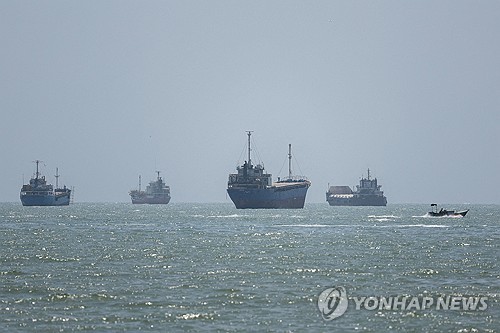
The Blockade That Won’t Let Go
Another ship was struck in the Strait of Hormuz this week. The UKMTO confirmed a medium-sized fuel tanker caught fire from an unknown projectile near the Omani coastal town of Khasab. No one was hurt. No flag or direction was disclosed. What the agency did not say — and what mattered more — was that this was yet another data point in a pattern that is hardening rather than loosening.
Traffic through the strait remains well below normal. According to Kepler data cited by Reuters, only ten bulk carriers passed through on the 26th, up marginally from eight the day before but still under the ten-day moving average of fifteen. The vessel mix tells the same story: two medium fuel tankers and one LPG carrier entered from Oman; one fuel tanker, one asphalt carrier, and one bulker left the Gulf. Cargo is moving, but at a fraction of the rhythm the strait normally carries.
And it is not just Hormuz. Traffic through the Bab el-Mandeb — the second chokepoint already disrupted by Houthi attacks — fell to nineteen vessels from twenty-four the day before, two consecutive days of decline. When two of the world’s most critical maritime bottlenecks slow at once, the risk premium stops being speculative and starts showing up in freight quotes, insurance spreads, and shelf prices.
A Corridor on Paper, Not on Water
There was a note of optimism Thursday when Iran and Oman announced they had reached a basic framework for a temporary navigation route and mine clearance. The timing was notable: amid repeated attacks, both sides signaled they wanted to avoid a full escalation. But the agreement has not been formalized, and the gap between Oman’s coastal waters and the heart of the strait remains wide.
The real constraint is not mines or routes — it is the US-Iran relationship, which remains frozen. Until Washington and Tehran find a working contact channel, any corridor that Iran and Oman sketch on paper will stay theoretical. Tanker owners do not navigate frameworks. They navigate risk assessments, and right now those assessments say the strait is still a high-threat zone.
What this means in practice is that the temporary corridor announcement is being treated by the market as a signal of intent, not a signal of capacity. Shipowners may reroute lightly around Omani waters if clearance is verified, but full-spectrum traffic will not return until there is a security guarantee that extends beyond bilateral talk between Tehran and Muscat.
Who Is Losing, and Who Is Adjusting
The immediate losers are shippers and refiners who depend on Gulf crude and LPG flowing through Hormuz. Short-haul cargoes to India, South Korea, and Japan are the first to feel the squeeze — not necessarily from outright shortages yet, but from the delay penalty and the rerouting cost. A vessel that would normally transit Hormuz in a few hours now faces insurance add-ons, potential diversion through the Cape of Good Hope, or waiting in anchorage queues outside the strait.
Tanker rates are the canary. Even before this week’s latest attack, VLCC and Suezmax spreads had been elevated compared with the previous year. Another incident pushes the forward curve higher and widens the discount on Iranian-sanctioned or Iran-linked cargoes. buyers who can access Atlantic or Brent-denominated crude will pay a smaller risk premium than those tied to Middle Eastern feeds.
For Iran, the calculus is different. Blocking or threatening Hormuz gives Tehran leverage without firing a shot. It keeps pressure on Gulf neighbors, tests US credibility in protecting shipping, and sends a message to European buyers wary of energy price spikes. But it also hurts Iran’s own exports over time — once trade shifts toward Atlantic basins or alternative pipelines, reversing that habit is expensive for everyone involved, including Tehran.
The Numbers Behind the Narrative
Here is what the data shows so far:
- Hormuz daily bulk carrier transits: 8 to 10, against a 10-day average of 15.
- Bab el-Mandeb daily bulk carrier transits: 19, down from 24, two consecutive days of decline.
- The latest UKMTO report cites one vessel struck by an unknown projectile, no casualties, ongoing investigation.
- Iran and Oman have agreed on a preliminary framework for a temporary passage route and mine clearance, but no formal agreement yet.
These are not crisis-level collapse numbers — not yet. But they are directional. Traffic has not recovered to average, and each new incident resets expectations rather than building them.
What Happens Next
Three scenarios are on the table, and none of them arrive quickly.
First, a limited de-escalation: Oman brokers a narrow corridor for non-Iranian tankers while Iran maintains selective harassment. This would lift some risk premium but leave the strait in a gray zone — enough traffic to keep markets functionally open, not enough to restore normal rates. This is the most likely near-term outcome.
Second, escalation: more vessels are targeted, insurance zones expand, and a major incident forces a temporary closure. In that case, global oil prices would spike and the rerouting cost would cascade through every index-linked commodity contract.
Third, a diplomatic reset: Washington and Tehran resume negotiations and a formal security arrangement for Hormuz is established. This is possible but currently the least probable path. It would require credible guarantees from both sides and a public face-saving mechanism for Iran that does not look like surrender.
The market is already pricing in Scenario One. The question is whether it discounts Scenario Two.
Why This Matters Outside the Region
English-language readers often treat Hormuz as a regional problem with global side effects. The opposite is true now: Hormuz is becoming a global pricing node. Every additional day of constrained traffic raises the floor under freight costs, insurance spreads, and refined product margins — especially in Asian markets that import the majority of their crude through this strait.
The temporary corridor conversation is useful politically. It is not yet useful logistically. Until the US-Iran gap narrows or a multilateral security arrangement replaces bilateral handwaving, tanker owners will keep adding risk buffers to every Hormuz-bound voyage. And those buffers are what determine whether next month’s fuel bill feels like a blip or a break.