Hormuz Burning: Why the IRGC's Latest Attack Will Hit Asia Hardest
Iran's Revolutionary Guard struck a Togolese-flagged tanker in the Strait of Hormuz, claiming the vessel was sailing under US direction. For Tokyo and Seoul, the implications run far deeper than any Western report suggests.
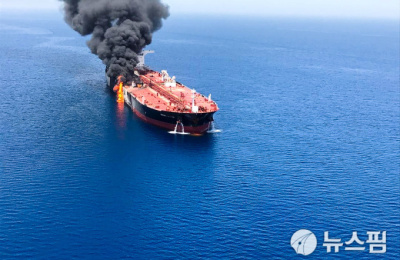
The fire over Hormuz is only the beginning.
Iran’s Islamic Revolutionary Guard Corps announced on September 18 that its navy had struck a Togolese-flagged tanker attempting to pass through the Strait of Hormuz the previous night. The vessel caught fire and stopped moving. Iranian state broadcaster IRIB carried the IRGC’s statement: the ship had fallen for “American incitement and deception,” and Iran would not tolerate passage by any “invader” through the waterway it claims to control.
Western newsrooms will run with the escalation narrative — a tanker burned, rhetoric sharpened, oil prices twitching. What they will underweight is something far more consequential for the people who actually pay the bill: the Strait of Hormuz is not a global chokepoint in the abstract. It is a daily lifeline for East Asian economies that have no realistic alternative route for the volume of crude and LNG they must move through it.
Asia drinks more from Hormuz than anyone realizes.
Roughly one-fifth of global petroleum consumption flows through the strait every day. But that share is not evenly distributed. Japan and South Korea together import approximately 6.5 million barrels of crude per day from the Middle East, almost all of it transiting Hormuz. China’s share is larger in absolute terms, but Beijing has been slowly diversifying through pipelines from Russia and Myanmar. Tokyo and Seoul have far fewer options.
South Korea processes about 2.4 million barrels per day of Middle Eastern crude at its refineries in Ulsan and Yanbu. Japan’s refined product exports — a significant source of trade surplus — depend on the same shipments arriving on time. When Hormuz coughs, Seoul and Tokyo feel it first at the pump and in wholesale diesel markets. The United States, which now produces more oil than it imports, feels it as a pricing inconvenience.
The IRGC’s claim that it exercises “complete control” over the strait is not new rhetoric. Iranian forces have harassed commercial vessels before. What makes this incident different is the specificity of the warning: an actual attack, not a boarding or a seizure, and a public declaration that any ship deemed an aggressor will be destroyed. That language raises the probability calculus for shipping insurers, charterers, and the hedge funds positioning ahead of winter demand.
The insurance premium tells the real story.
War-risk insurance for the Hormuz corridor is already priced well above pre-2022 levels. A single confirmed strike on a tanker increases that premium further and, more importantly, introduces a discontinuity. Shipping lines do not gradually adjust schedules around Hormuz; they divert around the tip of Oman through the Gulf of Aden and the Suez Canal, adding roughly 1,000 nautical miles and several days to transit times from the Persian Gulf to East Asian ports.
For spot cargoes of LNG and refined products already en route, the math is brutal. A diverted tanker burning additional fuel and absorbing higher insurance costs passes those charges to buyers. In Korea, where refined product margins are thin and refinery utilization depends on steady Middle Eastern feedstock, even a week of disruption can compress margins and force curtailments. In Japan, where refinery throughput adjustments ripple through the distribution chain, the effect shows up in wholesale diesel and jet fuel prices within days.
Korea’s political moment makes the energy risk sharper.
The attack landed at an awkward moment for President Lee Jae-myung’s administration. Lee is preparing for a press conference on September 18, his first since taking office, and the Hormuz incident is already surfacing as a question he cannot sidestep. South Korea is reviewing a US request to deploy naval forces to the strait — a decision with no comfortable answer. Deploying ships signals alliance solidarity and risks drawing Korean vessels into the same waters the IRGC just weaponized. Refusing signals independence and risks angering Washington at a time when Seoul is also negotiating investment commitments that the US administration treats as non-negotiable.
Lee’s approval rating has fallen for nine consecutive weeks to 33.8 percent, according to Realmeter data released on September 14. The survey cited the Hormuz deployment debate, real estate policy failures, and an exodus of progressive and young voters as drags on his standing. A second polling snapshot from Gallup Korea, published on September 17, placed Lee second among trusted politicians for the first time since 2021, with 35.9 percent saying they trust him and 50.4 percent saying they do not — a reversal from the previous year’s figures of 51.2 percent trust and 34.1 percent distrust.
The administration entered this week with a crowded agenda: a special investigation into alleged politically motivated prosecutions, constitutional debates around presidential term limits, and six rounds of real estate policy measures that have so far failed to reverse what the Korea Land & Housing Corporation records show as 83 consecutive weekly increases in Seoul apartment prices. Hormuz adds a foreign-policy and economic-security dimension to a domestic crisis that was already spinning.
Japan will react faster, but not necessarily better.
Japan’s government typically responds to Hormuz disruptions with a mixture of diplomatic demarches, strategic reserve releases, and quiet coordination with shipping companies to prioritize LNG tankers over crude carriers. The difference with South Korea is scale: Japan’s refining capacity is smaller relative to its consumption, but its petroleum emergency reserves are among the deepest in the OECD. Tokyo can absorb a shorter shock. Seoul cannot.
Both countries face a structural vulnerability that no press conference or diplomatic note resolves: the Persian Gulf accounts for roughly 85 percent of South Korea’s crude import origin and about 75 percent of Japan’s. Neither has built a pipeline from the Pacific side. Neither has replaced Middle Eastern LNG with sufficient alternate supply to insulate its markets. The question for Tokyo and Seoul is not whether Hormuz disruption will happen again — it is whether the next incident will cross from harassment to sustained closure, and whether their economies can survive a three-month blockade without rationing.
What happens next.
The immediate market read will be oil price volatility. Brent likely tests higher ranges as traders price in the probability of repeat incidents. Refined product cracks in East Asia — particularly jet fuel and diesel spreads against Middle Eastern feedstock — will widen faster than crude itself, because the bottleneck is not the oil but the shipping capacity and insurance availability to move it.
For Seoul, the nearer-term risk is political. The press conference on September 18 will force Lee to address both the Hormuz deployment question and the real estate impasse simultaneously. If he offers vague reassurances on both, the polling damage accelerates. If he takes a clear position on Hormuz — either committing to the US request or rejecting it — he gains a foreign-policy stance but loses room to manoeuvre on the domestic front.
For the global energy system, the takeaway is sobering. The IRGC has restated its willingness to use force against commercial shipping in Hormuz and has picked a target — a Togolese-flagged vessel — that sends a message to every flag state with a convenient registry and a commercial interest in the route. The incident is unlikely to close the strait permanently. But it establishes a lower threshold for future attacks, and every attack raises the insurance floor, raises shipping costs, and tightens the margin for East Asian economies that cannot easily walk away from the Persian Gulf.
The fire over Hormuz is a signal. The ash will land in Yokohama and Ulsan first.