Hormuz Is the Real Story as Oil Charges Past $94
Brent is flirting with $95 as US-Iran clashes push through the Strait of Hormuz. East Asian buyers are already bracing for a closure that Western desks are only beginning to process.
The number that should keep you awake
Brent crude November futures settled at $94.18 a barrel on the day in question — down just half a percent after a volatile session that opened higher and then gave almost everything back. WTI October followed the same script: $89.59, down 0.69%, after an early pop that vanished by midday.
The headline reads like normal market chatter. The context does not.
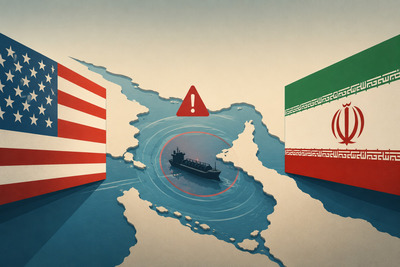
What is happening right now is a United States military operation that has effectively seized control of the Strait of Hormuz — the single most consequential chokepoint in global energy infrastructure — and Iran is fighting back by striking Kuwait, Jordan, and Bahrain with drones and missiles. Three tankers have already been hit by unidentified projectiles transiting the strait. One of those hits was reported by the UK Maritime Trade Operations agency on the 31st. No one has claimed responsibility.
That sequence matters more than the price tag.
East Asia is already pricing in closure. The West is not.
Korean financial media picked up on the Hormuz dimension within hours. That is not incidental. South Korea imports roughly 70 percent of its crude through the Strait of Hormuz. Japan’s figure is similar. China moves about 80 percent of its seaborne oil imports through that same narrow waterway. These are not diversified supply portfolios — they are single-point-of-failure dependencies disguised as energy security.
When a Korean trader watches Brent jitter between $93 and $96, they are not thinking about OPEC spare capacity or American shale output. They are thinking about whether a tanker carrying 2 million barrels of Arab Light is sitting idle outside Bandar Abbas or arriving at Ulsan three weeks late.
Western desks are only now catching up to that reality. The New York Times and Financial Times have been covering the military exchanges. Very few outlets have mapped out what a prolonged Hormuz disruption actually means for refinery runs in Busan, Yokohama, and Ningbo.
Who wins. Who loses. Who blinks first.
The Trump administration has made its posture clear. In a Truth Social post, he stated plainly that there is no rush to bring Iran back to negotiations. “We currently have a position that we like much more,” he wrote. “We have almost total control of the Hormuz Strait, and their economy is completely collapsing.”
Total control is a claim. The evidence so far is mixed. Three tankers hit by unexplained fire does not look like total control. It looks like a chokepoint that both sides can still disrupt.
If the United States maintains its current posture — controlling the strait while refusing to negotiate — Iran’s options narrow to asymmetric retaliation: more tanker attacks, drone strikes on Gulf state infrastructure, perhaps attempts to mine the waterway. Each escalation raises the insurance premium on every vessel transiting the strait. Every increased premium gets passed into the Brent price.
The winner in this scenario is anyone who entered the conflict with surplus crude already stored. The United States, with its Strategic Petroleum Reserve and massive shale output, can absorb short-term disruptions better than any other major economy. Russia benefits from elevated prices even without Hormuz involvement.
The losers are obvious and asymmetrical. Japan, South Korea, and India face the steepest bill. Their refineries cannot reroute easily. Alternative supply from the Baltic or the Persian Gulf’s eastern coast requires pipelines that do not yet exist at meaningful scale. China has been building strategic reserves for two decades precisely for this moment.
The volatility is the product, not the price
Edward Rosenberg at Strategyn Share put it plainly: prolonged conflict means sustained high prices with growing daily volatility. That is a precise description of what traders are seeing. The market is not settling at $95 and holding. It is bouncing between $93 and $97 on headlines that come and go within hours.
That pattern tells you something important. The fundamental supply shock has not yet fully materialized. A full Hormuz closure would remove roughly 20 million barrels per day from global supply — about 20 percent of worldwide seaborne trade. We are not there yet. What we have is the fear of getting there, and fear trades harder than facts in commodity markets.
Every day the conflict drags on without a resolution, the risk premium embedded in Brent grows. The question is whether that premium becomes permanent or collapses overnight if Tehran signals willingness to talk. Rosenberg noted that Iran’s own signals on whether it wants the war to end are contradictory — a recipe for exactly the kind of day-by-day price whiplash visible in today’s session.
What happens next
Three scenarios are worth tracking:
Prolonged stalemate. The most likely path. US forces maintain a heavy presence in the strait. Iran continues low-intensity harassment of commercial traffic. Gulf state allies absorb periodic drone and missile strikes. Brent oscillates between $90 and $105 for months. Refineries in East Asia begin rationing throughput. This is the scenario the Korean market is already hedging for.
Escalation to closure. Iran successfully mines or otherwise blocks the strait. Oil spikes above $110 within days. Global recession risk jumps sharply. This is the tail scenario that everyone prices in and nobody believes will happen until it is happening.
Negotiated de-escalation. Iran, facing economic collapse and military pressure, signals openness to talks. The US pivots from coercion to diplomacy. Brent drops below $80 quickly. Those who bought calls on volatility lose everything. Those who secured alternative supply contracts win silently.
The Korean press is ahead of the curve on this one. They understand that Hormuz is not a sidebar to the US-Iran conflict — it is the conflict. Western coverage is still framing this as a regional military dispute with energy consequences. The energy consequence is the dispute.
Brent at $94 is not the story. The fact that $94 feels normal right now is the story.