HBM4E Showdown: Samsung vs SK Hynix Fight for AI Memory Supremacy
Samsung and SK Hynix are locked in a high-stakes HBM4E rivalry at Seoul's SEDEX 2026, with Samsung's lead in samples versus SK Hynix's bet on a flash memory pivot that could reshape the entire AI chip supply chain.
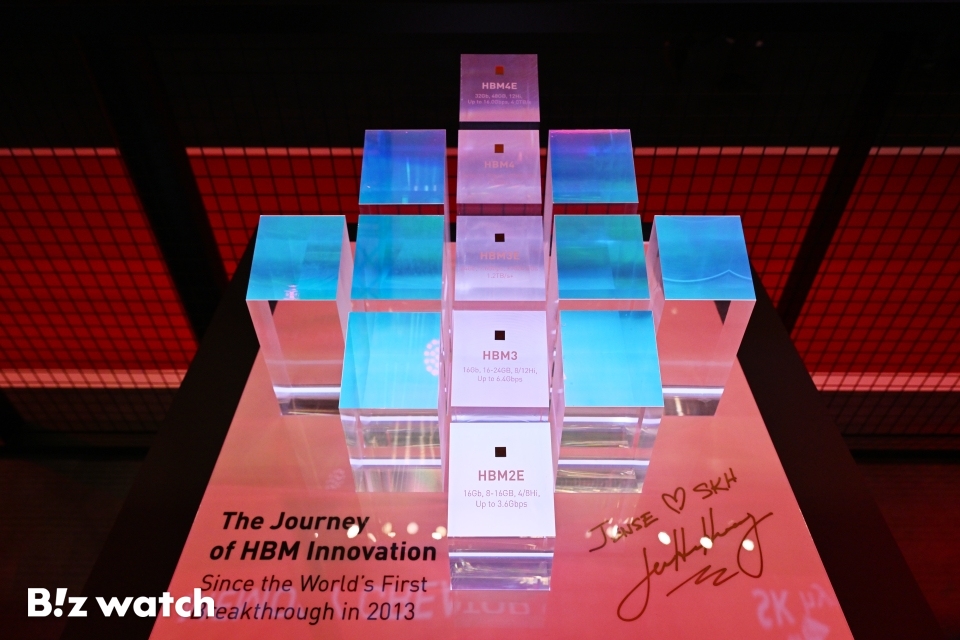
The memory war behind every AI chip just got a lot sharper.
Samsung and SK Hynix walked into Seoul’s COEX center last week for SEDEX 2026 and laid out the two competing visions for what happens after HBM3E. One path runs through sheer capacity and pace. The other runs through a completely new architecture. Neither can afford to lose.
Samsung took the stage with its HBM4E as the centerpiece, displaying a 48-gigabyte, 12-layer stack built on its 1c process node for the DRAM and a 4-nanometer logic die. The company claims it shipped the first samples of that specific configuration back in May. That lead matters — NVIDIA’s next-generation GPU architectures and Google’s custom silicon depend on shipping volume, not prototypes, and whoever holds the delivery pipeline gains leverage over the entire AI infrastructure build-out.
SK Hynix arrived with a different message. Yes, it has its own 12-layer 48GB HBM4E, which it showed off at Computex Taiwan back in June. But the real signal from SK Hynix was the HBF — High Bandwidth Flash — a memory technology that stacks NAND vertically instead of relying on the established DRAM-based HBM model. The announcement was not subtle. The company literally titled its booth theme “RUN,” and its president of development, Ahn Hyun, gave the keynote speech on why memory innovation must now go beyond bandwidth and into the realm of power efficiency and architectural novelty.
Who wins when the memory bottleneck shifts.
The conventional reading of this rivalry is simple: Samsung and SK Hynix are fighting for the same customers — NVIDIA, AMD, Intel, Google, and the growing cohort of Chinese AI chip designers who have been locked out of the most advanced American silicon. The data supports that framing. Together the two Korean firms have held roughly three-quarters of the global HBM market since HBM3E shipped in volume, and the HBM4E generation is projected to be significantly larger by revenue despite a smaller unit count, thanks to the added complexity of the 12-layer stacks and the 4nm logic integration.
But the more interesting tension is not between Samsung and SK Hynix. It is between the HBM paradigm and the HBF paradigm. If SK Hynix’s HBF proves viable at scale — and there are no public confirmations that it has — it could undercut the very architecture Samsung is betting its near-term revenue on. HBM relies on expensive through-silicon vias, premium DRAM process nodes, and co-packaging that is difficult and yield-sensitive. HBF, which stacks NAND directly, trades raw bandwidth for lower cost and better energy efficiency per transaction. For data-center workloads that are power-constrained as much as they are bandwidth-constrained, that trade-off may be exactly what the market needs next.
NVIDIA knows this. Its next-generation Blackwell-class and subsequent Rubin platforms are expected to push beyond the thermal and power envelopes that HBM3E can comfortably serve. If HBF can deliver a meaningful fraction of HBM4E’s bandwidth at a fraction of the cost, NVIDIA may find itself qualifying both paths rather than anchoring its supply chain to a single architecture. That would fracture SK Hynix’s and Samsung’s shared advantage over customers who currently have nowhere else to go.
The China angle nobody is talking about enough.
China’s semiconductor push has been the most obvious side effect of every HBM cycle. Washington’s export controls have systematically blocked Chinese access to the most advanced AI accelerators, which means Beijing has doubled down on homegrown alternatives — Huawei’s Ascend line, Cambricon, Biren, and others. Those chips are memory-starved. They need HBM or something close to it, and they cannot legally buy it from Samsung or SK Hynix under current U.S. restrictions.
That constraint is forcing Chinese designers toward lower-tier memory solutions or toward partnerships with Chinese foundries and memory makers who are still years behind. Samsung’s early sample shipments of HBM4E may seem like good news for the company, but they also highlight how far China has fallen behind in the memory tier that matters most for frontier AI training. If SK Hynix’s HBF proves cheaper and easier to produce, it could accelerate a second-order effect: Chinese chipmakers may find it easier to build around a less constrained memory architecture than one locked behind the most sophisticated packaging requirements.
What happens next.
SEDEX 2026 is being rebranded as K-CHIPS EXPO starting next year, a move that signals the Korean Semiconductor Industry Association wants to punch above its weight on the global stage. That ambition is well-placed. The three-day event drew 300 companies across 888 booths — the largest edition in the show’s history — and covered everything from memory and packaging to materials and equipment. It is becoming the de facto annual gathering point for the AI silicon supply chain outside of Taipei and San Francisco.
The real timeline to watch is not the exhibition schedule. It is the qualification cycles. Samsung says it shipped HBM4E samples in May. That is early, but sample shipment is not the same as volume production qualification, which for a customer like NVIDIA typically takes six to nine months of validation. SK Hynix’s June Computex reveal puts it slightly behind on timing but ahead on narrative, because the HBF story is a longer game.
If Samsung hits volume first, it locks in the dominant customers for a generation. If SK Hynix’s HBF gains traction even partially, it introduces a structural uncertainty that could fragment the memory supplier landscape just as demand is about to surge. Either outcome rewards the customers — Google, NVIDIA, Microsoft — who now have at least two credible alternative paths rather than a single bottleneck.
The semiconductor war in Korea is no longer just about who can build the smallest transistor. It is about who defines what the next AI chip actually looks like.