How a Hidden Bone Receptor Could Rewrite Osteoporosis Treatment
Leipzig University researchers have identified GPR133 as a key receptor for bone strength, and a compound called AP503 reversed bone loss in mice. The discovery could shift osteoporosis therapy from slowing deterioration to actively rebuilding bone — and potentially strengthen muscle at the same time.
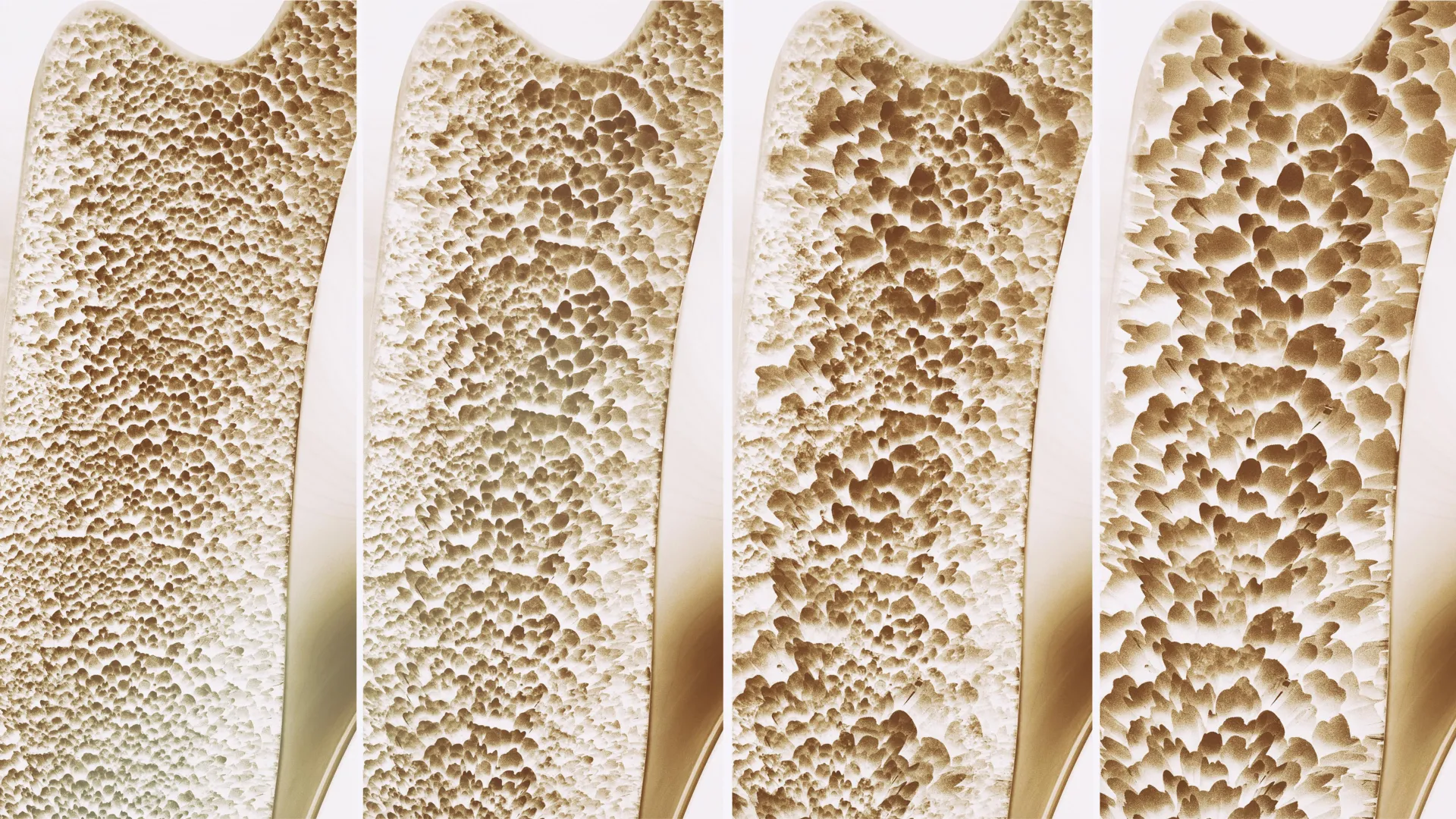
The Missing Piece in Bone Building
Osteoporosis has long been a disease of managed decline. Today’s most common treatments — bisphosphonates, denosumab, even the newer anabolic agent teriparatide — are designed either to slow bone breakdown or to spur bone formation through indirect hormonal pathways. They work, but imperfectly. Bisphosphonates carry risks of jaw bone death and atypical fractures with long-term use. Teriparatide requires daily injections and is limited to two years of use. Patients with late-stage osteoporosis still fall through the cracks.
A team at Leipzig University is betting that the answer lies in a receptor scientists barely understood until recently. GPR133, a member of the adhesion G protein-coupled receptor (GPCR) family, appears to sit at a critical junction in bone biology — responding to mechanical signals from the body’s physical environment and translating them into instructions for bone-building cells. When that signal is disrupted, bones weaken early. When it is amplified, bones grow stronger, even in mice already diagnosed with osteoporosis-like bone loss.
What GPR133 Actually Does
The receptor belongs to a poorly characterized subfamily of GPCRs known as adhesion GPCRs. These receptors sit on cell surfaces and act as molecular antennae, sensing not just chemical signals but physical interactions between neighboring cells. In bone tissue, that sensing function matters enormously. Bones are living structures that remodel continuously in response to load and stress — the reason weight-bearing exercise strengthens bone and bed rest weakens it. GPR133 appears to be part of that sensing machinery.
Professor Ines Liebscher, who leads the study at Leipzig’s Rudolf Schönheimer Institute of Biochemistry, found that mice carrying genetic disruptions to GPR133 developed significant bone density loss at an early age. The phenotype closely mirrored human osteoporosis. More importantly, when the researchers administered a compound called AP503 — discovered through a computer-assisted screen as a GPR133 stimulator — bone strength increased significantly in both healthy mice and those with induced osteoporosis.
The mechanism is clean. GPR133 activation shifts the balance between osteoblasts — the cells that build bone — and osteoclasts — the cells that break it down. It tips the scales toward builders and away from breakers. That dual action is what makes this pathway potentially more powerful than existing therapies, which typically target only one side of that equation.
The Muscle Connection
What makes this discovery particularly interesting is that AP503 does not act exclusively on bone. In an earlier study from the same research group, the team found that activating GPR133 with AP503 also strengthened skeletal muscle. That finding has now been replicated alongside the bone results, and the parallel is hard to ignore.
Aging brings a double burden. Older adults frequently experience both declining bone density and declining muscle mass — the combination known as osteosarcopenia — and both conditions feed each other. Weaker muscles increase fall risk; weaker bones increase fracture risk from those falls. A treatment that addresses both simultaneously could be transformative for an aging population, not just medically but in terms of quality of life and healthcare costs.
Dr. Juliane Lehmann, the study’s lead author, framed it directly: “The newly demonstrated parallel strengthening of bone once again highlights the great potential this receptor holds for medical applications in an aging population.”
Why This Receptor Was Overlooked
GPCRs are the most drug-targeted proteins in modern medicine. Roughly a third of all approved drugs act on them. But the adhesion GPCR subfamily has been a stubborn exception — large, structurally complex, and poorly understood compared to the well-mapped amine and peptide receptors that dominate pharmaceutical pipelines. Only in the past decade have techniques improved enough to resolve their three-dimensional structures and map their signaling pathways.
Leipzig University has made adhesion GPCRs a sustained research priority. Its Collaborative Research Center 1423, Structural Dynamics of GPCR Activation and Signaling, has operated for over a decade specifically to decode how these receptors change shape, become activated, and transmit signals inside cells. The GPR133 findings are a product of that long investment — and a reminder that the hardest targets in drug discovery are often the ones nobody had the tools to study until recently.
What Comes Next
The path from mouse study to approved drug is long, and this research is still early. AP503 has not been tested in humans. The compound’s safety profile, dosing, bioavailability, and potential off-target effects remain unknown. The Leipzig team has indicated it is pursuing several follow-up projects to understand GPR133 more fully and is exploring whether AP503 could have applications beyond bone and muscle disease.
But the trajectory is meaningful. Osteoporosis affects roughly six million people in Germany alone, most of them women, and the global prevalence is far higher. Postmenopausal osteoporosis — driven by declining estrogen, which normally helps regulate bone remodeling — represents one of the largest unmet therapeutic needs in geriatric medicine. If GPR133 agonists can safely replicate the bone-strengthening effects seen in mice, they would offer a mechanistically distinct alternative to every drug currently on the market.
The more immediate implication may be simpler: this discovery validates an entire class of receptors as viable drug targets for bone disease. The adhesion GPCRs are a family of roughly thirty members in humans. If GPR133 works, the question becomes which of its relatives might also matter — and whether any of them offer even cleaner or more potent pathways.
For now, the key takeaway is that bone-building biology may not require another hormone analog or another enzyme inhibitor. It may simply require learning how to turn on a switch that was always there, waiting for the right key.