How One Switch Prevented a Nuclear Detonation Over North Carolina
Declassified 1961 Sandia reports show a hydrogen bomb dropped over North Carolina powered itself up and ran its full arming sequence — stopped only by a single safety switch. The documents, withheld for sixty years, rewrite the story of Cold War nuclear near-misses.
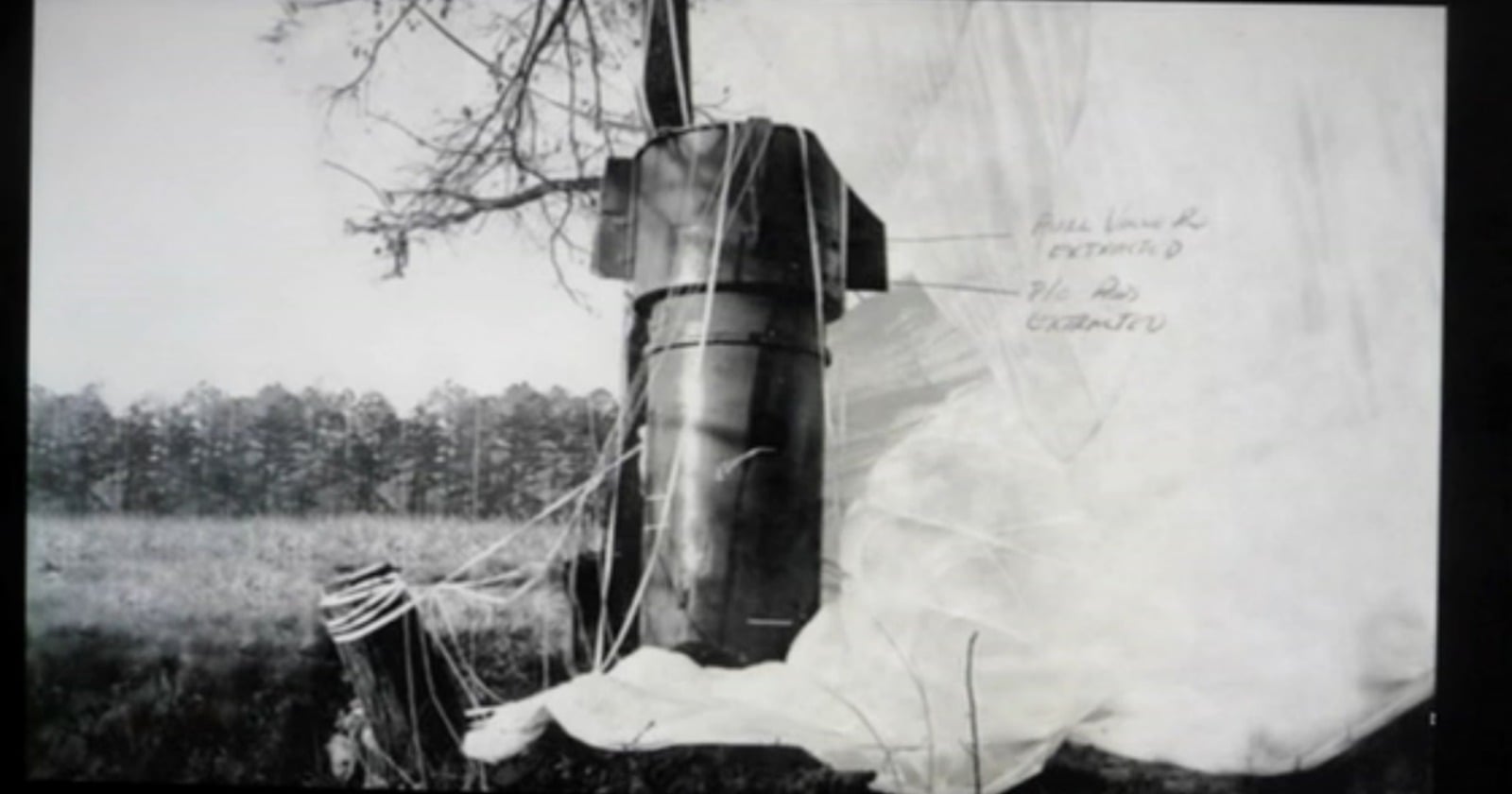
One switch stood between North Carolina and a nuclear detonation
On the night of January 24, 1961, a B-52G bomber on Strategic Air Command airborne alert began breaking apart over eastern North Carolina. It was refueling mid-air when the tanker crew spotted a fuel leak in the bomber’s right wing and pulled away. The B-52, carrying two Mk 39 Mod 2 thermonuclear weapons, lost a wing at roughly 9,000 feet and went down near Seymour Johnson Air Force Base at about 12:30 a.m.
Five of the eight crew members bailed out and survived. Three did not. The wreckage scattered along a mile and a half of flight path. The tail section landed a mile from the crew compartment, which was found inverted, burned, and demolished.
The public story at the time was simple: the plane crashed, the bombs were safe, no radiological hazard existed. The Air Force issued a statement that evening. The local newspapers ran the story, ran a human-interest follow-up the next day, and then moved on. No one was arrested. No one was publicly blamed. And the technical detail of exactly how close those two four-megaton weapons came to detonating would not see daylight for sixty years.
What the Sandia reports actually say
Two Sandia Corporation reports, written in February 1961 by H. D. Bickelman and by J. M. de Montmollin and W. R. Hoagland, reconstruct the crash with a level of specificity that the 1961 public briefings deliberately avoided. One report had been partially declassified; the other sat sealed until a Freedom of Information Act request by Government Attic forced its release in 2021. The National Security Archive published both in 2022.
Read together, the documents describe a sequence of events far more alarming than the sanitized official narrative suggested — and also far more reassuring about the safety systems themselves. The critical finding lives in the component list for the first bomb, the one that landed in sandy clay near the crash site with its parachute intact.
The safing pins had been pulled from the arming rods. The low-voltage thermal battery had fired. The internal timer had completed its full cycle. The trajectory-arming barometric switch showed all its contacts closed. The high-voltage thermal battery — the component that charges the firing capacitor — had also fired. The crush switch in the bomb’s nose was deformed, and the engineers concluded it could have supplied a fire signal at impact.
Two switches had not moved. The MC-772 arm-safe switch remained in the safe position, which is what kept current from ever reaching the high-voltage safing switch behind it. That switch stayed safe. The firing capacitor was never charged. The reservoir valve had not fired. The tritium stayed where it was.
In other words, the bomb had gone through every step of its arming sequence. It had powered up, timed itself, and was milliseconds from detonation — stopped only by a single switch left in the safe position by the crew before takeoff.
The second bomb tells an even stranger story
The forward-bay bomb fell without its parachute. SAC later told investigators that the deployment mechanism, the explosive devices, and the timers had all operated normally. The canopy simply never opened. The weapon fell free, struck past the aircraft’s own impact point, and carved a crater five feet deep and nine feet across.
Initial investigators feared a one-point detonation of the high explosive had blown the crater. It had not. The primary was recovered from twenty feet underground at the end of the month.
Here the reports produce their most alarming-looking evidence. When the arm-safe switch was pulled from the wreckage, its indicator drum read ARM.
It had not armed. Inside the housing, the plastic wafers carrying the fixed contacts had broken off their posts and shifted approximately a quarter of an inch. There was no continuity through the switch in either position. The engineers concluded that impact shock rotated the drum — the reading of ARM was impact damage, not an arming command. The switch had been in safe until the moment of impact.
The weapon’s timer had run about twelve seconds before impact damage stopped it, well short of the forty-two seconds at which its contacts would have closed. Its high-voltage battery was never activated at all.
The line everyone remembers, and what it actually means
The famous sentence about Goldsboro — that one switch being left in the safe position was the only thing standing between the United States and a nuclear detonation — comes from neither of these 1961 reports. It appears in a 1969 Sandia review by Parker F. Jones, who supervised the laboratory’s nuclear weapons safety department, and reached public attention through Eric Schlosser’s research, published by The Guardian in 2013.
The two 1961 documents describe the same mechanism in flatter, more technical language. Bickelman’s abstract states flatly that there were no detonations and that the safety features behaved in a normal manner. De Montmollin and Hoagland conclude that the arm-safe switch prevented a nuclear detonation as it was designed to do. These engineers were describing a system working, not a coin landing the right way up.
The distinction matters. The common retelling frames Goldsboro as a luck-based near-miss — a coin flip that came out safe. The contemporaneous reports frame it as a safety system doing exactly what it was engineered to do: interrupt the arming chain at the final, most critical point. The difference between those two readings shapes how we understand the entire Cold War nuclear enterprise.
A modification that came too late for this crash
The de Montmollin report ends with a specific recommendation, not a rhetorical flourish. It calls for ALT 197 — a modification approved in January 1960 — to be incorporated as rapidly as possible into every bomb of the Mk 15/39 family used on airborne alert. The change replaces the MC-772 arm-safe switch with a different design and repositions its contacts so that a weapon released in the safe condition cannot start its own power supply. With that modification in place, the report concludes, the system was considered adequately safe for alert flying without safing pins installed in the pullout rods.
The fact that ALT 197 had been approved but not yet fielded when the crash occurred speaks to the gap between engineering solutions and operational reality during the Cold War. The fix existed on paper. It did not exist on the bombs flying on alert that night.
What stayed hidden for sixty years
Bickelman’s report notes that the Air Force handled the initial release competently by the standards of 1961: the weapons were not hidden, the public was told they were safe, and the story faded quickly. But what stayed out of public view was the component-level account of the arming sequence — the precise order in which parts fired, the fact that one bomb’s timer ran nearly to completion, the deformation of the crush switch, the broken plastic wafers inside the second bomb’s arm-safe housing.
The public learned about the crash on January 24, 1961. The public learned how the sequence actually ran on February 24, 2022, when the National Security Archive published the two Sandia reports.
Sixty years is a long time to wait for the technical truth about a moment when two four-megaton weapons fell from a burning bomber over North Carolina. The good news, documented in engineering language that took decades to reach the public, is that the safety systems worked. The more complicated truth is that they worked by design, not by miracle — and that the design depended on a switch being left in the safe position by a crew that followed protocol under catastrophic conditions.