Huang's Call With Trump Reveals the Coming US-Asia AI Fault Line
Jensen Huang's public phone call with Trump from the All-In Summit is more than a tech-bro spectacle — it's a signal of where AI governance is heading, and why Asia won't follow Washington's script.
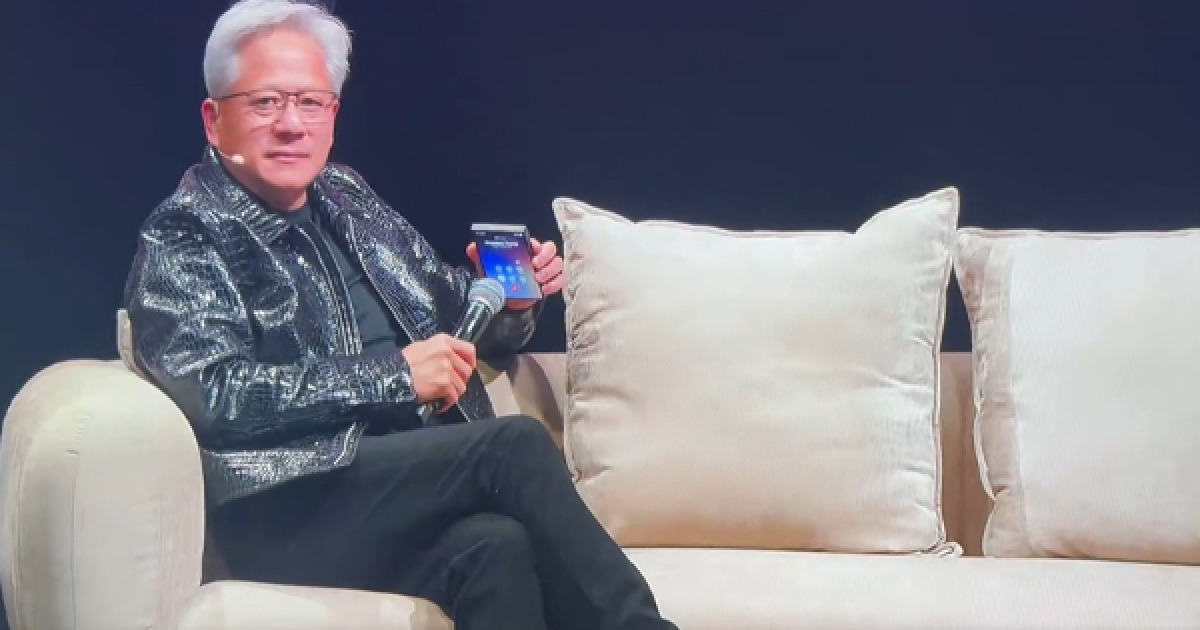
The Call That Wasn’t Private
Jensen Huang answered a call from Donald Trump on speakerphone at the All-In Summit in Los Angeles and let the audience hear every word. That detail matters. This was not a behind-closed-doors policy exchange. It was a staged moment — a CEO and a president performing alignment for an industry watching closely.
What they said together draws a line under the most active debate in Silicon Valley right now: whether the most advanced AI models should be deliberately slowed down to install safety guardrails first.
Huang said no. Trump agreed. And in that agreement, you can see the opening wedge between how the US and how much of Asia are about to approach AI governance.
The Slowdown Argument — and Why Huang Wrote It Off
The case for slowing down comes primarily from Anthropic CEO Dario Amodei, who argued publicly that model capabilities are advancing faster than the ability to test and contain them. Sam Altman at OpenAI and Elon Musk at xAI signaled sympathy. The message spread through Silicon Valley like a cold front: build more carefully, or build less.
Huang’s counter-argument was structured and specific. He rejected the framing that safety and technological leadership are a zero-sum choice — the idea that you must pick one. He also pushed back on the apocalyptic numbers being thrown around, saying there is not enough scientific grounding for claims that frontier AI will inevitably spiral beyond control. He pointed to past predictions — AI replacing radiologists, AI wiping out entry-level jobs — that simply did not materialize on schedule.
On recursive self-improvement, the scenario where AI systems iteratively enhance their own design, Huang said this is already happening in major labs as a natural engineering step. Models are evaluated, tested for regression, held to verification standards before release. The idea that the process would suddenly lose all brakes, he suggested, confuses pace with loss of control.
His prescription was not to slow down but to tighten the oversight layers inside companies — better instrumentation, faster root-cause analysis, stronger monitoring. If something goes wrong internally, treat it seriously, but do not generalize a single incident into an argument for stopping the industry.
Trump’s Version, Simplified
Trump’s contribution was less technical but politically sharp. He dismissed extreme AI risk narratives as hype, insisted the industry must not be halted, and framed AI dominance as an existential competitive project — the same argument he has made about chips, tariffs, and manufacturing. He called AI more impactful than the internet. He tied data center investment directly to regional job creation.
That framing is not incidental. It positions AI as infrastructure, not just software — a category shift that justifies massive public and private capital deployment and limits the space for precautionary regulation.
The China Variable — The Argument Asia Will Hear Loudest
Perhaps the most consequential part of Huang’s remarks was not about safety at all. It was about China.
Huang described China as treating AI as a productivity and industrial upgrade tool, leveraging a deep bench of engineers and an existing manufacturing base to close the gap fast. His point was clear: if the US pauses, China does not.
That is the exact logic that will resonate across Seoul, Tokyo, Taipei, and Singapore. Across the Asia-Pacific, governments are watching Washington debate whether to hit the brakes and wondering why they should follow. The region’s AI strategies — South Korea’s aggressive compute expansion, Japan’s push for sovereign modeling, Taiwan’s chip ecosystem defense — are built on the assumption that speed is strategic advantage. Huang’s argument validates that instinct.
Open Models as Geopolitics
Huang also made a case for open models alongside closed frontier systems. That is not just a technical preference. It is a positioning statement. An open ecosystem means more countries and companies can build their own stacks rather than renting capability from a handful of US labs. For Asian governments anxious about technological dependency, that is a compelling narrative.
It also benefits NVIDIA. Open models increase the variety of deployers, the diversity of workloads, and ultimately the size of the market for its hardware. Whether Huang sees it that way or not, the policy implication is real.
The Samsung Detail You Should Not Skip
The phone Huang held during the call was a Samsung Galaxy Z Fold8. Samsung CEO Lee Jae-yong previously gifted Huang a Fold7. That is not a random product placement.
Samsung is NVIDIA’s closest competitor in memory and a growing player in AI infrastructure. The visual of a Chinese-American CEO taking a call from a US president on a Korean phone is a small but pointed image of the supply chain this industry actually runs on. The US leads in models. Taiwan leads in fabrication. Korea leads in memory. Japan contributes robotics and precision components. China competes on scale and velocity. The Fold8 in the frame is a reminder that none of this is contained within one country’s borders — and that the countries outside the US have every reason to chart their own course.
What Comes Next
The immediate effect of this exchange is cultural more than regulatory. Huang and Trump have legitimized the accelerationist position inside the most powerful political and technical ecosystem on earth. The slowdown argument loses moral authority when its leading critics are portrayed as alarmist and its most prominent defenders sit on the outside of influence.
But the deeper effect is geographic. Asia-Pacific governments do not need to be persuaded that AI is economically vital. They already believe it. What Huang’s remarks do is remove the primary objection they might have raised — that the US wants to slow the field for safety reasons that do not apply to them. That objection is now officially gone.
Expect faster compute commitments from Seoul and Tokyo. Expect more national AI fund deployments in Taiwan and Singapore. Expect the US to face a partner system that agrees with its competitive stance toward China but disagrees with its caution — and that disagreement will shape every trade and technology negotiation that follows.