Hungary Gripen Crash Tests Europe's Fighter Industrial Base
A Hungarian Gripen crash near Szolnok has revived doubts about Saab's production depth and the European defense industrial base. The pilot survived, but the incident comes at a moment when NATO is counting on homegrown fighters to scale fast.
A Pilot Landed a Crashing Jet on a Base. The Real Crash Is Deeper.
The Hungarian pilot who lost control of his Gripen near Szolnok on Monday did not bail out over a town. He steered the failing aircraft onto military land at the nearby air base, accepting personal risk so no one on the ground would pay the price. That instinct — honed through years of training at Hungary’s only Western-style fighter wing at Kecskemét — bought him a chance to survive. Ejection seats worked. Ambulances were waiting. The defense minister was already en route. It was, by any measure, a successful emergency response.
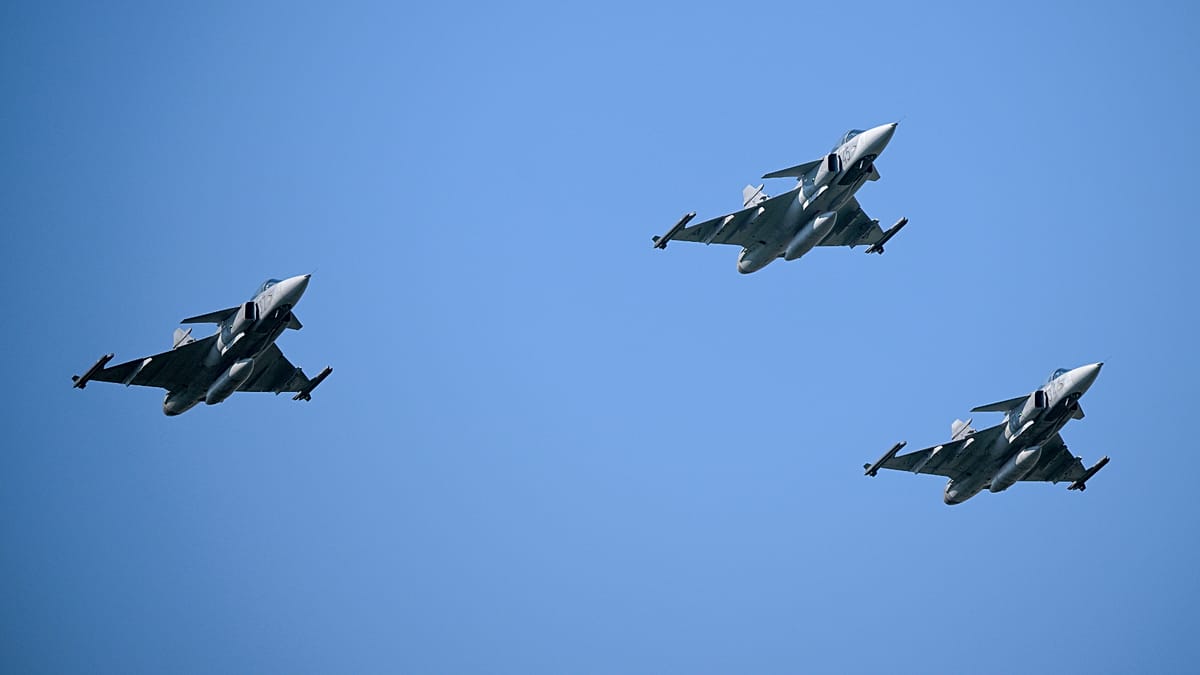
But the crash itself is a signal worth reading carefully. Hungary operates 14 JAS 39 Gripens, a fleet that has proven itself on NATO’s northern flank by rotating through Baltic Air Policing missions in the second half of last year. The aircraft is not a museum piece or a paper commitment. It is flying sorties under Article 5, sharing skies with F-16s and Typhoons from other allies, and carrying Hungarian paint while doing so.
So when one drops out of the sky for reasons still unknown, the question is not whether the Gripen is a reliable platform — Saab has spent two decades answering that. The sharper question is whether Europe’s homegrown fighter industrial base can absorb a sudden shock without slowing down the very missions allies depend on it for.
Who Is Watching This Crash
Saab is not a company that sells fighter jets the way Boeing or Lockheed Martin sell volumes. It sells a system — a smaller, lighter, digitally integrated fighter designed around the idea that a mid-tier power can punch above its weight. Sweden built it. Hungary, the Czech Republic, Thailand, and Brazil bought it. Each customer expects the same baseline of operational availability: aircraft ready to fly, spares in stock, software patches deployed on schedule.
Hungary’s Gripen story is still being written. The first three aircraft arrived in 2019, and full operational capability was declared in 2021. The fleet grew to 14, and the pilots rotated through Estonia, Latvia, and Lithuania under NATO command. The machine works. The logistics are new, and that is where fragility lives.
Saab has been transparent about production bottlenecks. The company has repeatedly warned that its supply chain for avionics, composite materials, and certain engine components is stretched thin. Sweden’s own defense ministry has flagged the same issue. When demand outpaces capacity — and in 2024 and 2025, demand surged as Poland, the Czech Republic, and others pushed for deliveries — lead times lengthened. That is not a crisis yet. It is a trend line with a dangerous slope.
What the Crash Reveals About the Industrial Base
A single accident does not make a pattern. But it lands at an inconvenient moment. NATO is asking member states to raise defense spending to 2 percent of GDP, to field air policing rotations without gaps, and to accelerate modernization programs that were conceived before the war in Ukraine made every deadline feel arbitrary. Europe’s defense industry, which spent three decades running at lean margins, is being asked to sprint.
The Gripen is supposed to be the answer to that sprint for countries that cannot afford — or do not want — the political strings attached to American fighters. It is smaller. It is cheaper to operate. It flies from roads. It fits the European profile of a defensive, dispersed-force strategy.
Yet cheaper does not mean immune to industrial reality. The Hungarian crash is a reminder that a fighter jet is only as resilient as the factories, supply chains, and trained workforce that build and sustain it. If Saab cannot deliver spares fast enough, if the Swedish state cannot invest in production tooling, if the pilot pipeline runs dry, then the Gripen becomes a fleet that looks impressive on paper but falters in practice.
That is not a hypothetical fear. Poland has complained about Gripen delivery delays. The Czech Air Force has struggled with maintenance scheduling. Hungary itself announced in recent years that it was exploring options to increase its fleet beyond 14 aircraft, a sign that the current number barely covers operational needs plus a reserve buffer.
Who Wins and Who Loses
The pilot wins. He survived. He likely will recover. The Hungarian armed forces win a reputation for disciplined emergency response. Saab wins the argument that its design kept the aircraft recoverable — the jettisonable canopy, the ejection seat, the robust airframe. None of that is trivial.
The losers are more diffuse. The European defense industrial base loses credibility when a single accident fuels questions about readiness and supply chains. NATO loses tempo when a frontline ally pulls aircraft out of the pool for investigation and grounding reviews. The Gripen program loses a subtle but real advantage: the perception that it is the dependable, no-drama alternative to American and European heavy fighters.
Allies watching from outside Hungary will file this incident into a broader mental ledger. Every crash, every delay, every public explanation about maintenance backlogs nudges procurement decisions. Countries shopping for fighters in 2026 and beyond are comparing more than price per flight hour. They are comparing supply chain resilience, export control predictability, and the willingness of home governments to fund the factories that keep planes in the air.
What Happens Next
An investigation is under way. Hungary’s defense minister is at the scene. The cause could be mechanical, could be software, could be human error, or — in modern fighters where software dominates every control surface — a combination. Whatever the finding, the immediate effect will be a temporary grounding or reduced sortie rate for part of the 14-jet fleet. That shrinks Hungary’s contribution to Baltic Air Policing rotations, which run on fixed schedules and cannot absorb delays gracefully.
Saab will issue a statement. The company will emphasize that the Gripen has a strong safety record across multiple operators and decades of service. That is true. The Swedish and Hungarian defense establishments will coordinate on any necessary modifications or software updates. Other Gripens in service will likely undergo enhanced inspections.
The longer-term story is less concrete. Hungary will decide whether to hold the line at 14 aircraft or push for more, as Prime Minister Péter Magyar’s administration has signaled interest in doing. The procurement will test the very supply chains this crash exposed. NATO will ask Hungary to maintain its Baltic rotation schedule despite the disruption. Sweden will face quiet pressure to deliver faster and deeper.
Why This Matters Beyond Hungary
The Gripen is not the largest fighter in Europe. It is not the most numerous. But it occupies a strategic niche: a Western-compatible, export-controlled, logistically compact fighter that allows medium-sized NATO members to contribute meaningfully without becoming dependent on a single superpower’s industrial base. That niche matters more now than it did five years ago.
Ukraine has taught Europe that air defense cannot be an afterthought. The war has also taught Europe that industrial mobilization is not automatic. Factories do not expand because allies need them to expand. Workforce pipelines do not fill themselves. Supply chains do not deepen through wishful thinking.
Hungary’s Gripen crash is one data point in a much larger story about whether Europe can build, sustain, and replace the hardware its alliances now require. The pilot who chose the air base over the town did his part. The rest of the system — the engineers, the suppliers, the policymakers, the NATO planners — has work to do next.