Hyperscaler Power Deals Are Rewiring the US Grid — and the Climate
A new Nature study quantifies the staggering electricity appetite of US hyperscale data centres and reveals how hyperscaler power contracts are reshaping regional grids and pulling clean-energy targets into question.
The hidden bill behind the AI boom
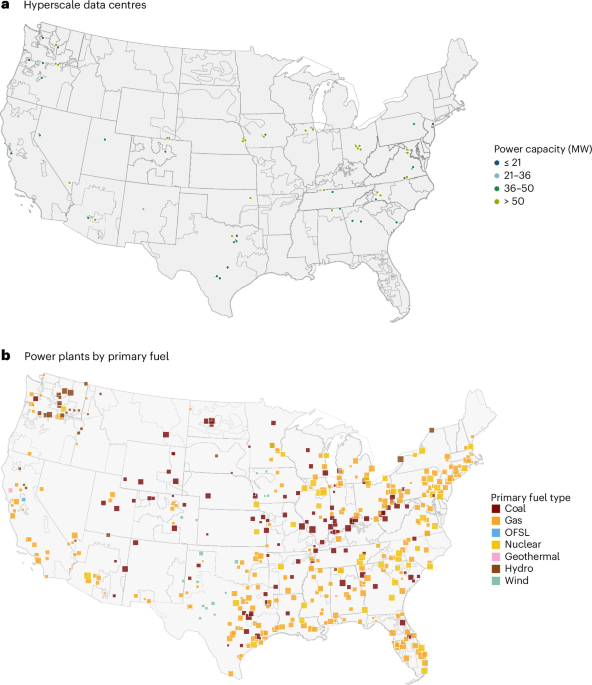
A team led by researchers at Harvard T.H. Chan School of Public Health has produced the most granular picture yet of how much electricity US hyperscale data centres draw — and the carbon price attached to that demand.
Published in Nature Sustainability, the study estimates facility-level electricity use and attributable CO₂ emissions across the continental United States, breaking results down by state and by balancing authority. It adds up to a blunt challenge for policymakers who assumed that corporate clean-power purchasing would absorb the AI-driven demand surge without fracturing regional grids.
The answer from the data is no. Not everywhere, and not soon enough.
What the study actually shows
The authors built a statistical capacity model trained on commercial facility records and calibrated it against EPA eGRID2023 emissions factors. They then projected electricity demand using a central-scenario assumption of 58 percent utilisation (μ = 0.58), which is the same baseline that produces the headline totals published alongside the paper.
The result is a county-to-state map of where the biggest loads sit, how much carbon each kilowatt-hour hides inside its local fuel mix, and which balancing authorities are already running hot.
The numbers themselves are not subtle. Hyper-scale facilities are concentrating in states whose grid profiles range from heavily coal-dependent to already strained renewable portfolios. When those facilities sign long-term power purchase agreements, they pull from whatever supply is available locally unless new transmission lines carry distant wind or solar generation over large distances. That transport gap is exactly where the carbon accounting gets murky.
Who wins, who loses
The winners are obvious: hyperscalers secure predictable capacity, often at prices below spot-market volatility, and lock in supply while competition for grid connection surges.
The losers are less visible but more consequential. Households and small businesses in the same service territory as a new hyperscale campus can face longer queue times for interconnection, higher local peak prices, and — depending on the utility regulator — cross-subsidies that let industrial buyers capture cheap power while residential customers fund infrastructure upgrades.
In balancing authorities with tight renewable penetration but limited firm capacity, hyperscaler demand can force utilities to extend the life of gas peaker plants rather than retire them. The climate math flips: the very assets needed to firm intermittent renewables become stranded liabilities if hyperscalers keep demand rising faster than storage deployment.
Why the clean-energy narrative cracks under scrutiny
Corporate clean-power buying grew 12 percent to a new record in 2023, according to BloombergNEF. That statistic sounds impressive until you overlay it on the state-level emission intensities shown in this study.
A hyperscaler signing a wind PPA in the Midwest may report zero Scope 2 emissions on paper. But if that extra wind capacity simply displaces existing retail load rather than adding new renewable generation, the marginal impact on the balancing authority’s carbon intensity is negligible. Meanwhile, a nearby fossil-fuel plant continues running to serve other customers. The net result is a double-counting problem: two sets of emissions reductions claim the same megawatt-hours.
This is the attributional–consequential gap that carbon-accounting specialists such as Brander (2022) have warned about for years. The Nature study does not resolve it, but it makes the consequences visible. State-by-state and balancing-authority-by-balance-authority, the gap between reported “clean” procurement and actual grid decarbonisation is wide enough to swallow several years off net-zero trajectories.
Where the pressure points are forming
Certain regions stand out immediately. Balancing authorities with high existing data-center density and stiff coal exposure in their fuel mix will see the largest absolute emission increases per additional megawatt committed. In contrast, authorities with surplus renewable capacity and adequate transmission headroom could absorb demand with comparatively low incremental carbon cost.
The study’s public aggregate exports let anyone verify which area falls into which bucket. They also reveal an uncomfortable truth: the buckets are not equally distributed across the country. Some states already host clusters of hyperscale campuses; others are barely on the radar. Regulatory divergence between those states will determine whether the next wave of build-out accelerates carbon goals or stalls them entirely.
What changes next
Three developments look likely in the near term.
First, regulators will face louder demands for mandatory facility-level reporting. The US already requires crypto-mining operations to disclose energy use. Data centres sit in a grey zone that the Biden administration has been considering tightening. A transparent, auditable reporting regime would make the kind of granularity this study achieves routine rather than extraordinary.
Second, utilities in stressed balancing authorities will begin pricing grid-access differently. Expect capacity charges, demand-based tariffs, and interconnection queues that reflect true system costs instead of legacy flat rates.
Third, industry players will experiment with operational shifts that reduce real-time demand peaks. Research underway at institutions including UC Berkeley and independent labs explores techniques such as timeshifting LLM training to hours when grid carbon intensity drops and adjusting workload placement dynamically to follow cheap renewable output. None of these methods scales easily, and none eliminates the base-load problem. But they signal that the industry recognises a credibility risk if AI infrastructure cannot demonstrate measurable progress on emissions intensity alongside raw capability gains.
The bottom line
The Nature study is valuable not because it invents a crisis — the power demands of generative-AI infrastructure were never a secret — but because it quantifies one of the critical variables: how that demand translates into real, location-specific carbon emissions on today’s grid.
If the goal is genuine decarbonisation rather than portfolio accounting, the implication is direct. Clean-energy targets depend on new renewable additions matching new demand incrementally, not on retrospective claims that older clean purchases somehow cover fresh load. Until policy frameworks enforce that linkage, the AI-powered electricity surge will continue to stress regional grids and delay climate commitments in the states that need the most help meeting them.