Hyundai Bets on EREVs to Outmaneuver China's EV Grip
Hyundai's 2030 plan leans hard into hybrid and range-extended electric vehicles rather than pure EVs, a calculated pivot that sidesteps China's charging infrastructure advantage while opening a new competitive front.
The real story isn’t the 555-million-unit target. It’s what Hyundai is choosing not to chase.
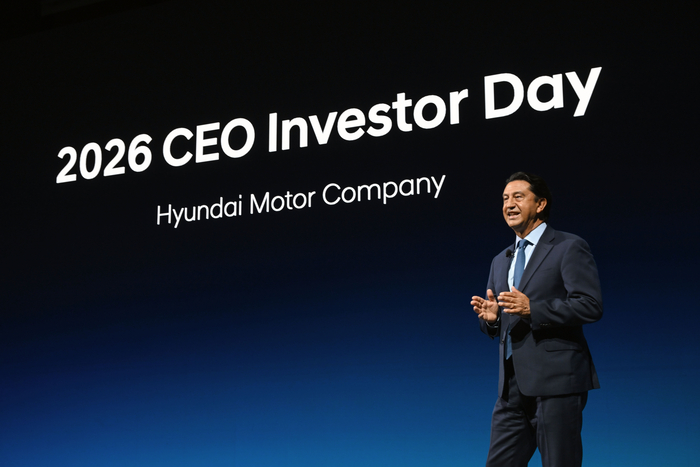
At its 2026 CEO Investor Day in Seoul, Hyundai Motor reaffirmed its 2030 global sales goal of 5.55 million vehicles and announced plans to launch over 100 new models. The headline numbers — a production capacity boost to 1.27 million units, an operating profit margin target raised to 9% or higher, and the immediate retirement of 80 billion won worth of treasury shares — are aggressive for any automaker. But they’re almost secondary to the quiet strategic pivot happening beneath them: Hyundai is betting against the pure EV hype cycle, especially in its most profitable market.
CEO Jose Munoz framed it as offering more powertrain choices, more new models, and a faster push into new segments and regions. Read between the lines and what you see is a company recalibrating for a world where China’s EV dominance has shifted the rules, and where consumer demand for battery-electric vehicles has stalled far short of 2022-era projections.
North America is where the pivot is most visible.
Hyundai plans to introduce ten hybrid-electric (HEV) models in North America by 2030 and is launching the Santa Fe EREV — an extended-range electric vehicle — in the region. The goal is to push HEVs to 50% of North American sales. That’s a dramatic shift from the pure-EV focus that defined Hyundai’s marketing through much of the late 2010s and early 2020s.
An EREV is not a traditional hybrid. It runs primarily on electricity from a battery, but carries a small gasoline generator that recharges the battery once it runs low — eliminating range anxiety without requiring plug-in access. For American buyers, many of whom live in suburbs without home charging and who still resist the idea of long road trips on a single battery charge, this is an awkwardly perfect product fit. It delivers near-EV driving most of the time, with a gasoline fallback for the rest.
This matters because the North American market is Hyundai’s profit engine. Chinese EV makers like BYD have crushed it on price in Europe and Asia, but they still face steep tariffs, regulatory barriers, and — critically — no meaningful dealer or charging infrastructure in the United States. Hyundai’s EREV play sidesteps that competitive pressure entirely. It’s selling a vehicle that looks like an EV to the consumer, performs like one in daily driving, but doesn’t require the charging ecosystem that China has spent a fortune building to dominate.
Europe gets the opposite play.
While North America moves toward hybrids and EREVs, Hyundai is doubling down on pure EVs in Europe. The Ioniq 3 launches next month, and the company targets 420,000 EV sales in the region by 2030. Genesis, Hyundai’s luxury brand, is pushing the GV90 flagship EV and a GV80 HEV alongside an EREV capable of over 1,000 kilometers of range.
This dual strategy isn’t contradictory — it’s adaptive. Europe has dense urban centers, strong emissions regulations, and a growing charging network that makes pure EVs more viable. North America, with its sprawling geography and slower infrastructure buildout, rewards the EREV approach. China, meanwhile, is winning on pure EV cost and scale in both markets, which is precisely why Hyundai is avoiding head-to-head competition on that front in its most important regions.
The profit margin bump is the signal.
Hyundai raised its operating profit margin target from 8–9% to 9% or higher, with a 3 percentage-point reduction in cost ratio as the mechanism. That sounds incremental until you consider the scale: at 5.55 million vehicles, a 1 percentage-point margin improvement represents roughly $2.5 billion in additional operating profit annually. The company is also committing to a total shareholder payout ratio of at least 35%, a minimum dividend of 10,000 won per share, and the immediate cancellation of all held treasury shares.
In other words, Hyundai is telling investors it has found a path to grow volume without sacrificing profitability — precisely the combination that has eluded so many peers as the EV transition dragged on. The EREV and HEV vehicles carry lower battery costs than pure EVs, which means better margins even at competitive prices. That’s the structural advantage Hyundai is exploiting.
What this means for Chinese EV makers.
BYD, NIO, XPeng, and the rest have built their strategies on the assumption that the world would follow China’s EV trajectory — rapid pure-electric adoption, battery cost declines, and charging network expansion. Hyundai’s 2030 plan implicitly rejects that assumption for at least two of its three largest markets. In North America, the EREV bet gives Hyundai a product category that Chinese pure-EV makers can’t easily replicate without abandoning their cost advantage. In Europe, Hyundai is meeting China on terrain where it has some competitiveness but isn’t depending on being the cheapest option.
The longer-term risk for Hyundai is that if China’s charging infrastructure and EV costs continue to improve, the EREV window could narrow. But that’s a problem for later. For now, Hyundai has identified a gap in the market and is filling it with a lineup that spans pure EV, hybrid, and extended-range electric — while Chinese rivals are largely concentrated on pure EV.
The AI and robotics angle is real but distant.
Hyundai also announced a collaboration with Nvidia to apply level 2+ autonomous driving to its software-defined vehicle (SDV) production models by 2028, and plans to begin shipping Waymo-supplied robotaxis from its Georgia plant in the fourth quarter. A 100-megawatt AI data center is slated for Saemangeum by 2029, and Atlas industrial humanoid robots will enter field deployment that same year.
These are significant commitments, but they’re years away from revenue impact. The investor day’s financial framework — the margin target, the shareholder returns, the 5.55 million unit goal — is the near-term story. The AI and robotics narrative is the long-term optionality, and Hyundai’s management was careful to frame it that way: a “physical AI” company in the making, not a technology company today.
The bottom line.
Hyundai’s 2030 strategy is a bet that the EV transition will be messier and more varied than analysts predicted a few years ago. By offering EREVs in North America, pure EVs in Europe, and hybrids across the board, Hyundai is positioning itself to capture demand from buyers who want electric driving without the infrastructure that doesn’t yet exist where they live. That’s not a retreat from electrification — it’s a more realistic roadmap to it. And in a market where Chinese manufacturers are still figuring out how to sell profitably at scale outside of China, that realism could be the competitive edge Hyundai needs.